
What Is a White Label DEX?
It is an audited AMM — factory, pair, router and quoter contracts plus a non-custodial front end — configured to your branding, launch pairs and fee tiers, then deployed to your chosen chain under keys you control.
The ownership question is sharper here than with a custodial platform. Contracts are immutable, so whoever holds the admin keys at deployment holds them permanently. That should be your multisig, not a vendor account.
What You Receive
| Component | What It Covers |
|---|---|
| AMM contracts | Factory, pair, router and quoter, deployed under your keys |
| Branded interface | Non-custodial swap and pool front end in your visual identity |
| Pool configuration | Launch pairs, fee tiers and initial liquidity parameters |
| Farming module | Optional emission schedule and liquidity mining setup |
| Audit report | The existing audit plus review of any configuration changes |
| Subgraph | Your own indexing for pools, volume and positions |
| Admin keys | Transferred to your multisig with timelocks at deployment |
| Source code | Contracts, front end, subgraph and scripts on delivery |
See a working DEX with your branding and launch pairs before you deploy anything.
Get a Free Live DemoWhoever Holds the Keys at Deployment Holds Them Forever
Contracts cannot be edited. Fee switches, pool creation permissions, emergency pause and treasury addresses are set at deployment and controlled by whichever key was named then.
If a vendor deploys with their own key and promises to transfer it later, you have a dependency with no technical enforcement. The transfer should happen at deployment, to a multisig you control, with timelocks visible on chain.
Deployed under your keys from the first transaction, not transferred afterwards on trust.
Admin controls to your multisig with timelocks anyone can verify on chain.
Audit scope stated clearly what was reviewed, and what your configuration changed.
Liquidity still your problem white label deploys fast; depth does not appear by itself.
Fee switch destination set routed to your treasury, verifiable in the contract.
Immutability accepted because a shortcut here cannot be undone later.
We deploy under your keys from the first transaction. A vendor holding admin control over your immutable contracts is a risk no contract clause can fully undo.
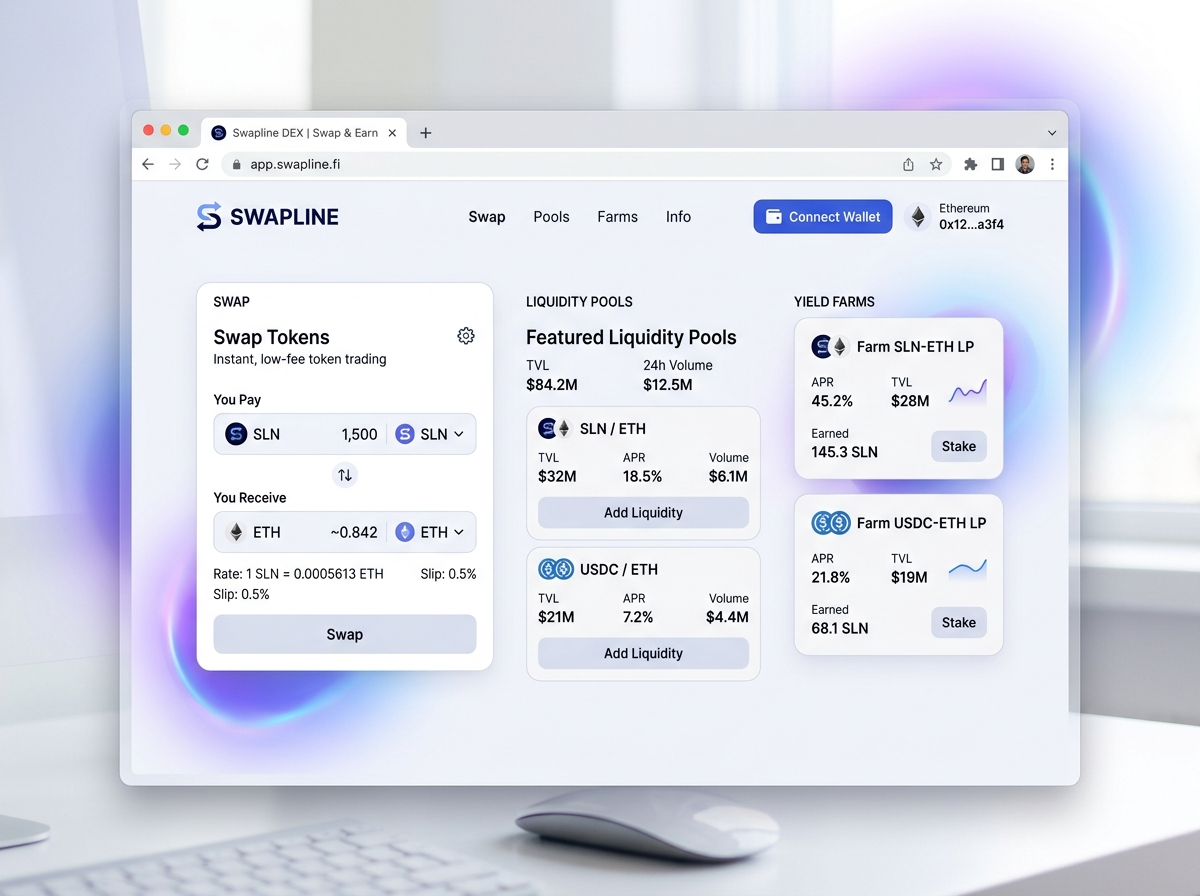
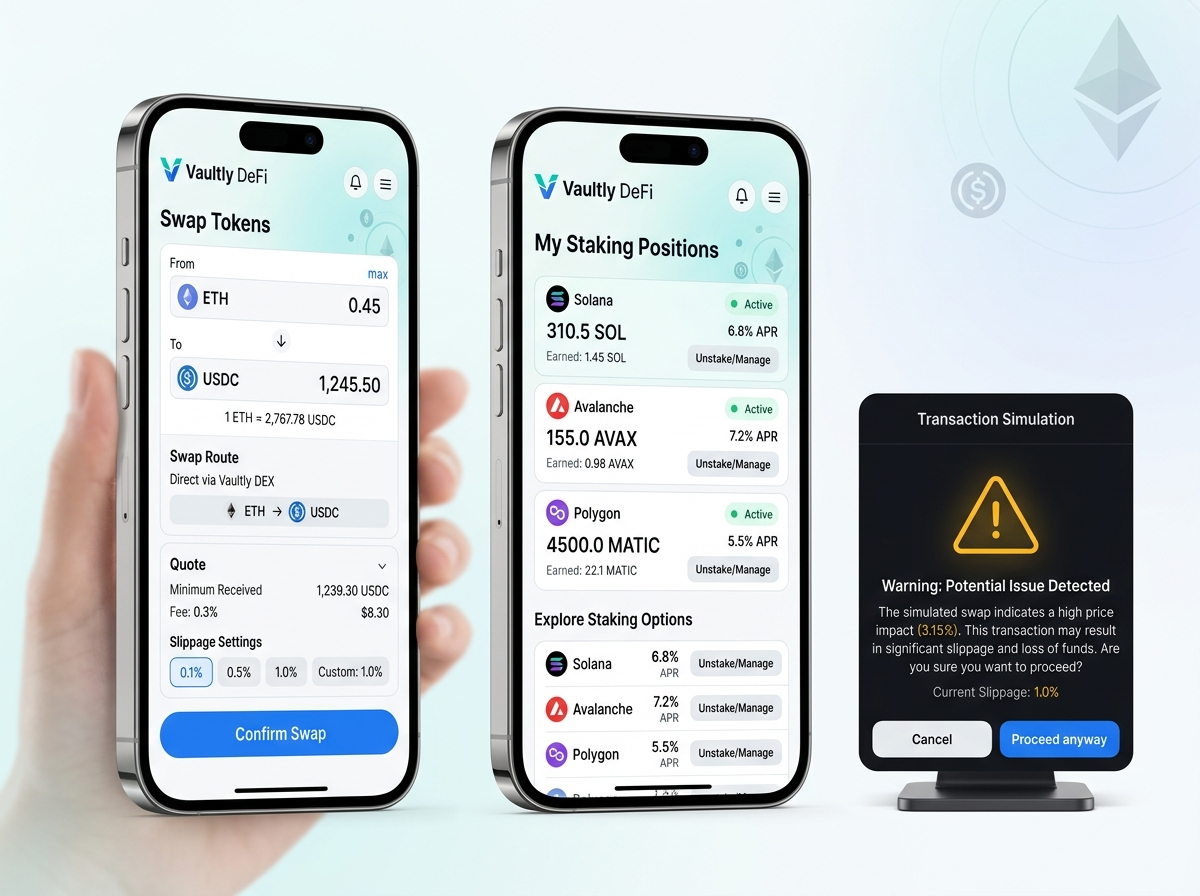
Surfaces This Scope Covers
Reference concepts for an on-chain build — swap, liquidity and position surfaces. Not screenshots of a delivered client protocol; audited deployments are shown on a call.
What Comes Configured
Swapping and Liquidity
- Constant-product pools with configurable fee tiers
- Exact-input and exact-output swaps with multi-hop routing
- Slippage tolerance and deadline controls
- Liquidity add, remove and migrate flows
- Impermanent loss display before commitment
- Pool analytics with TVL and fee earnings
Incentives
- Optional liquidity mining with emission schedules
- Per-pool weight configuration
- Staking with reward accounting
- Lockup tiers with boosted rates
- Auto-compounding vault options
- Emission reporting against real TVL
Branding and Interface
- Full visual branding across the swap interface
- Custom domain and token list configuration
- Wallet connect across major providers
- Pool and position management surfaces
- Analytics pages with your own subgraph
- Mobile-responsive throughout
Safety and Control
- Audited contracts with the report provided
- Admin keys to your multisig at deployment
- Timelocked parameter changes
- Fee switch routed to your treasury
- Emergency pause with liquidity-first recovery
- Monitoring on pool depth and volume
Mapped to a release plan
We will send a configuration plan, liquidity guidance and deployment timeline.
Request a Feature PlanHow a White Label DEX Is Deployed
The modules above map onto these layers. Each one ships with its own tests, documentation and runbook, so nothing arrives as a black box you inherit without an explanation.
Requests flow down, settlement and events flow back up. Every boundary carries logging, so a failure is traceable to a layer instead of guessed at.
Chains and Assets Supported
Each deployment is a separate audit surface, not a redeploy. Gas economics, MEV exposure and bridge assumptions differ per chain, and a contract that is safe on one can be attackable on another.
How Deployment Works
Contracts and interface follow separate tracks with separate release gates, because one is permanent and the other is not.
Configuration scoping
Branding, launch pairs, fee tiers and whether you need farming.
Output → configuration specification and deployment plan
Key and control setup
Your multisig configured, timelocks set, fee destination named.
Output → control matrix with addresses confirmed
Branding and staging
Interface branded, contracts deployed to testnet for review.
Output → staging DEX under your domain on testnet
Audit review and liquidity planning
Audit scope confirmed and initial liquidity depth planned.
Output → audit report and liquidity plan
Mainnet deployment and handover
Deployment under your keys, liquidity seeded, source transferred.
Output → live DEX with contracts under your control
Chains we deploy to
Development Timeline
| Scope | Timeline | Includes |
|---|---|---|
| Standard white label DEX | 4 to 6 weeks | Branding, standard pools, one chain, audit provided |
| DEX with farming | 7 to 10 weeks | Adds emission schedule and staking module |
| DEX with governance | 4 to 6 months | Adds vote-escrow, gauges and treasury control |
| Multi-chain deployment | 5 to 9 months | Several chains, each with its own liquidity to bootstrap |
What extends the timeline: liquidity arrangements, which are the real constraint since deployment itself is fast; review of any configuration change that affects audited contract behaviour; each additional chain, because deployments and indexing do not port; and multisig setup, which should never be rushed.
Revenue Models
| Model | How It Works |
|---|---|
| Swap fee share | A protocol cut of the pool fee, routed to your treasury |
| Farming platform fees | A cut of harvested rewards where you run emissions |
| Protocol-owned liquidity | Fees earned on positions your treasury holds |
| Launch and listing fees | Charges for pool creation and token list placement |
| Vault performance fees | A cut of auto-compounded rewards |
| Token value capture | Fees routed to stakers or burns if you issue a token |
| Sublicensing | Where you deploy the DEX for other projects |
Every fee is public and comparable on-chain, so pricing has a hard competitive ceiling. We build fee parameters as governable values rather than constants so they can be tuned without redeployment.
Related services
Who This Is For
Providing a native venue for their own asset quickly.
Seeding a first DEX so their ecosystem has price discovery.
Running a venue on their own terms without a full build.
Adding non-custodial swaps alongside a custodial product.
Serving a market with low-fee non-custodial trading.
Deploying venues for portfolio projects repeatedly.
Why Choose Coinsclone
Deployed under your keys
From the first transaction, not transferred later on a promise.
Admin control to your multisig
With timelocks anyone can verify on chain.
Audit scope stated plainly
What was reviewed, and what your configuration changed.
Liquidity addressed honestly
Fast deployment does not create depth, and we say so before quoting.
Fee destination verifiable
Routed to your treasury in the contract, not in a document.
Source code transferred
Contracts, front end, subgraph and scripts on delivery.
What Our Clients Say
Operators who launched with us, in their own words. Hover to pause.















A members-only NFT marketplace for Digital Freemasonry
 Digital Free MasonryNFT marketplace · delivered and live
Next phase in progress: the ODFT Token and the MasonicVerse platform.
Working with Coinsclone has been one of the best professional experiences I have had in the blockchain industry.
From the very beginning of our NFT Marketplace project until its successful completion, the entire team demonstrated exceptional technical expertise, professionalism, patience, and commitment. Every stage of development was handled with great attention to detail, and every challenge we encountered was approached with a solution-oriented mindset.
Read the full client note
Our project was far from a standard NFT Marketplace. It included custom blockchain architecture, Polygon integration, ERC-721 and ERC-1155 standards, royalty implementation, token-gated access through Masonic Passport, multiple payment methods, marketplace customization, advanced testing, and many unique business requirements. Throughout the entire process, the team consistently delivered high-quality work while maintaining clear communication, transparency, and a strong commitment to excellence.
I would especially like to express my sincere appreciation to Mr. Jeeva, Mr. Bala, Mr. Saravanan, Mr. Veeramani, Mr. Akshay, and the entire development team for their outstanding support, professionalism, responsiveness, and dedication throughout the project. Their technical expertise, patience, and willingness to understand even the most complex business requirements gave us complete confidence during every phase of development.
What impressed me the most was not only their excellent blockchain development skills, but also their ability to understand our vision and transform it into a secure, scalable, and highly professional NFT Marketplace.
For me, Coinsclone is not simply a software development company — they are a trusted long-term technology partner. After successfully completing our NFT Marketplace, we are now preparing to continue our collaboration on the next major phase of the Digital Freemasonry ecosystem, including the development of the ODFT Token and the future MasonicVerse platform.
I highly recommend Coinsclone to anyone looking for a reliable, experienced, and highly professional blockchain development company. They have earned my complete trust and respect, and I sincerely look forward to working with them again on future projects.
Start Your DEX Deployment
Tell us your target chains and the pairs you need to win and we will respond with a routing architecture and delivery timeline.
- Working DEX demo with your branding and pairs
- Key control and liquidity plan confirmed before deployment
- NDA signed before technical discussion
Request received
A solution architect will reply within one business day with a scoped proposal and demo link.
White Label Decentralized Exchange: Frequently Asked Questions
What is a white label DEX?
An audited AMM with a non-custodial front end, configured to your branding, pairs and fee tiers, then deployed to your chosen chain under keys you control.
Who controls the contracts after deployment?
You do. Contracts are deployed under your multisig from the first transaction, with timelocks visible on chain, rather than transferred later on a promise.
Why does key control matter so much here?
Because contracts are immutable. Fee switches, pool permissions and pause controls are set at deployment and belong permanently to whichever key was named then.
Is the software already audited?
Yes, and we provide the report. Where your configuration changes audited behaviour, that change is reviewed rather than assumed to be covered.
Does white label solve liquidity?
No, and this is the honest limitation. Deployment is fast; pool depth is not. Without liquidity a DEX quotes poorly and earns nothing, so we plan it before launch.
What can be configured?
Branding, launch pairs, fee tiers, token lists, farming schedules and module selection. Changing pool maths or router behaviour is custom development.
Can we add farming later?
Yes, if it was scoped as a module. Adding an emission programme after launch is straightforward; retrofitting one into unaudited configuration is not.
Which chains can we deploy to?
Any EVM chain, and Solana as a separate implementation. Each chain is its own deployment with its own liquidity to bootstrap rather than a copy.
Do we get our own indexing?
Yes. Your own subgraph, so search, analytics and position history do not depend on a third-party API that could rate-limit or change.
How does a DEX make money?
Protocol fee share on swaps routed to your treasury, farming platform fees, protocol-owned liquidity, listing fees and token value capture if you issue one.
How long does deployment take?
A standard white label DEX takes 4 to 6 weeks. Adding farming takes 7 to 10 weeks. Governance takes 4 to 6 months, and multi-chain 5 to 9 months.
Will we own the contracts and code?
Yes. Contracts deployed under your keys, plus front end, subgraph and scripts transferred on delivery.
Estimate Your Build
Pick a scope and the extras you need. On a protocol build the audit and economic-modelling lines are the ones that move the timeline, and neither compresses safely.
{{ estSummary }}
Ranges assume decisions arrive on time. Licensing, banking and third-party audits run on their own schedules and we plan around them rather than inside them.
Get This Scoped ProperlyReady to Deploy Your DEX?
Share your launch pairs and target chain and receive a configuration plan, liquidity guidance and deployment timeline.