
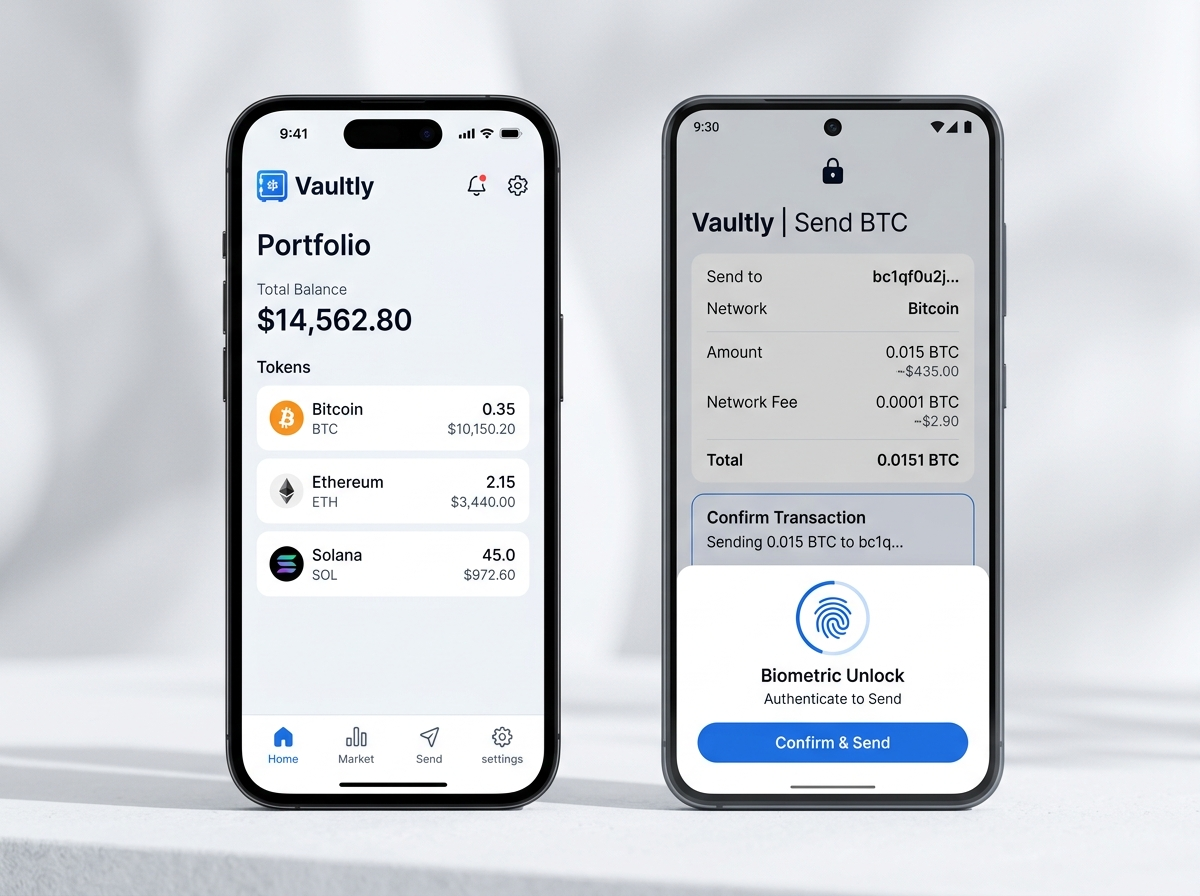
What Is Cryptocurrency App Development?
It is building native mobile apps for crypto products: wallets, exchange clients, payment apps, portfolio trackers and dApp browsers. The app talks to chains or a backend, handles keys or sessions, and presents balances and transactions on a device that is lost, stolen and offline more often than a desktop.
Mobile is where most crypto usage now happens and it is a genuinely different engineering problem. The OS suspends your app, the network switches mid-request, the keychain has its own rules, and both app stores apply extra scrutiny to anything touching crypto.
What You Receive
| Component | What It Covers |
|---|---|
| Native apps | iOS and Android builds with a shared design system |
| Key security | Secure enclave and keystore storage with biometric gating |
| Network layer | Retry, reconciliation and honest state on poor connections |
| Store compliance | Metadata, disclosures and review response handling |
| Push infrastructure | Reliable notification delivery with grouping |
| Testing | Poor-network, backgrounding and device-matrix validation |
| CI pipeline | Build, signing and staged rollout configuration |
| Source code | App source, pipelines and signing setup on delivery |
See working iOS and Android builds with your branding on internal distribution before launch.
Get a Free Live DemoThe Device Is Hostile and the Network Is Worse
A crypto app runs on a phone that gets stolen, backed up to a cloud you do not control, and rooted by its owner. It runs on networks that drop mid-transaction and switch from wifi to cellular between two requests.
Both conditions have to be designed for rather than tested around. Keys belong in hardware-backed storage, never in app storage or a cloud backup. And an app resuming from suspension must reconcile its state rather than displaying what it remembered before the socket died.
Keys in the secure enclave never in app storage, never in a cloud backup.
Biometric gating on signing with a fallback that does not weaken the guarantee.
State reconciled on resume rather than resumed from stale memory.
Poor networks tested on throttled and lossy connections, not office wifi.
Root and jailbreak policy detected with a defined response, not ignored.
Screen protection on seed phrases and sensitive balances.
We test on bad networks and hostile devices because that is where your users actually are. An app that only works on office wifi with a clean device is not finished.
Surfaces This Scope Covers
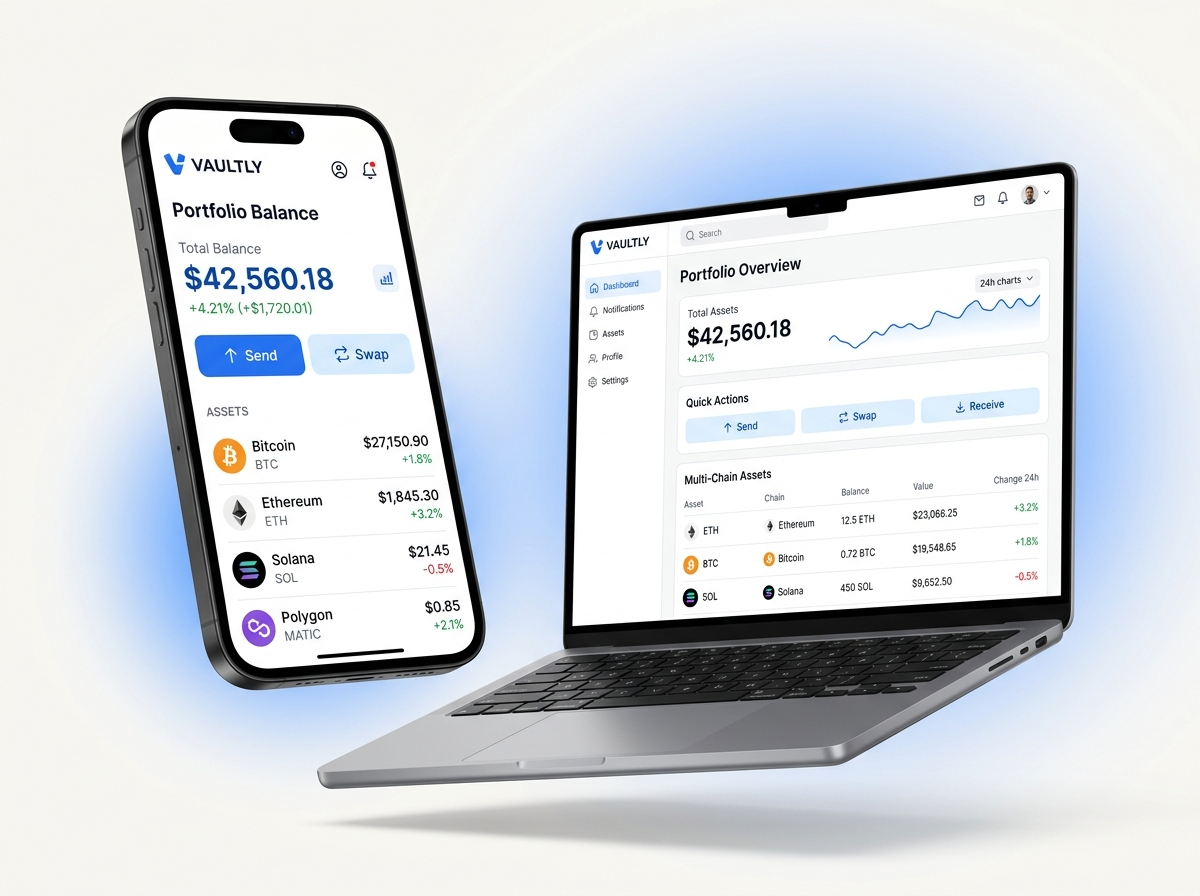
Reference concepts for an on-chain build — swap, liquidity and position surfaces. Not screenshots of a delivered client protocol; audited deployments are shown on a call.
Core Features
Security
- Secure enclave and Android keystore key storage
- Biometric authentication with secure fallback
- Device binding and session management
- Certificate pinning on all API traffic
- Jailbreak and root detection with policy response
- Screenshot and screen recording protection
- Encrypted local storage with no plaintext secrets
Crypto Functionality
- Multi-chain balance and transaction display
- Transaction construction with fee estimation
- Human-readable signing prompts with risk warnings
- Address book with validation and QR scanning
- Portfolio view with allocation and performance
- dApp browser or WalletConnect integration
- Staking, swap and earn module options
Reliability
- State reconciliation on foreground and reconnect
- Optimistic updates with rollback on failure
- Offline mode with explicit stale-data indication
- Request retry with idempotency
- Pending transaction tracking across restarts
- Crash and performance monitoring
Delivery
- App Store and Play Store submission support
- Compliance disclosures and review responses
- Push notifications with reliable delivery
- Deep linking and referral attribution
- Localisation and currency formatting
- CI with signing, staged rollout and rollback
Mapped to a release plan
We will send a mobile architecture, security model and store submission plan with a delivery timeline.
Request a Feature PlanHow a Cryptocurrency App Is Put Together
The modules above map onto these layers. Each one ships with its own tests, documentation and runbook, so nothing arrives as a black box you inherit without an explanation.
Requests flow down, settlement and events flow back up. Every boundary carries logging, so a failure is traceable to a layer instead of guessed at.
Chains and Assets We Support
Each deployment is a separate audit surface, not a redeploy. Gas economics, MEV exposure and bridge assumptions differ per chain, and a contract that is safe on one can be attackable on another.
How We Build Your App
Contracts and interface follow separate tracks with separate release gates, because one is permanent and the other is not.
Product and store scoping
Features, jurisdictions, store policy constraints and disclosures.
Output → app specification with store readiness checklist
Security architecture
Key storage, biometric policy, device binding and threat model.
Output → security design with threat model
Native development
Apps built with the network and state layer designed for failure.
Output → internal builds on TestFlight and Play testing
Security and network testing
Penetration testing plus throttled and lossy network validation.
Output → test reports with remediation completed
Submission and launch
Store submission, review responses, staged rollout and monitoring.
Output → published apps with release runbooks
Chains we deploy to
Development Timeline
| Scope | Timeline | Includes |
|---|---|---|
| Standard crypto app | 6 to 9 weeks | One platform, core features, security, submission |
| Two-platform app | 10 to 14 weeks | iOS and Android, full features, push, store review |
| App with trading or staking | 4 to 6 months | Exchange or protocol integration, advanced flows |
| Full mobile programme | 6 to 10 months | Two platforms, localisation, ongoing release cadence |
What extends the timeline: app store review, which is outside your control and stricter for crypto; security review and penetration testing before submission; poor-network and device-matrix testing, which frequently surfaces real defects; and any exchange or protocol integration the app depends on.
Revenue Models
| Model | How It Works |
|---|---|
| Transaction and swap fees | Margin on in-app conversions and transfers |
| Trading fees | Volume from mobile users where the app trades |
| Staking commission | A share of yield on in-app staking products |
| Premium subscriptions | Advanced features, higher limits and priority support |
| Referral programmes | Growth driven by in-app sharing and attribution |
| Card and payment margin | Revenue on integrated fiat on-ramps |
| White label licensing | Licensing the app to other operators |
Every fee is public and comparable on-chain, so pricing has a hard competitive ceiling. We build fee parameters as governable values rather than constants so they can be tuned without redeployment.
Related services
Who This Is For
Adding native apps to a web trading platform.
Shipping a mobile-first non-custodial product.
Putting crypto payment into a consumer app.
Adding a crypto module to an existing regulated app.
Giving a DeFi product a usable mobile surface.
Serving markets where mobile is the only channel.
Why Choose Coinsclone
Keys in hardware-backed storage
Secure enclave and keystore, never app storage or cloud backup.
State reconciled, not remembered
Because an app resuming with stale balances misleads users into bad decisions.
Tested on hostile conditions
Throttled networks, rooted devices and backgrounding, not just happy paths.
Store review planned upfront
Crypto apps face extra scrutiny, so requirements are designed for rather than discovered.
Native on both platforms
Platform behaviours around keychain, backgrounding and notifications handled properly.
Full source code ownership
App source, CI pipelines and signing configuration transfer on delivery.
What Our Clients Say
Operators who launched with us, in their own words. Hover to pause.















A members-only NFT marketplace for Digital Freemasonry
 Digital Free MasonryNFT marketplace · delivered and live
Next phase in progress: the ODFT Token and the MasonicVerse platform.
Working with Coinsclone has been one of the best professional experiences I have had in the blockchain industry.
From the very beginning of our NFT Marketplace project until its successful completion, the entire team demonstrated exceptional technical expertise, professionalism, patience, and commitment. Every stage of development was handled with great attention to detail, and every challenge we encountered was approached with a solution-oriented mindset.
Read the full client note
Our project was far from a standard NFT Marketplace. It included custom blockchain architecture, Polygon integration, ERC-721 and ERC-1155 standards, royalty implementation, token-gated access through Masonic Passport, multiple payment methods, marketplace customization, advanced testing, and many unique business requirements. Throughout the entire process, the team consistently delivered high-quality work while maintaining clear communication, transparency, and a strong commitment to excellence.
I would especially like to express my sincere appreciation to Mr. Jeeva, Mr. Bala, Mr. Saravanan, Mr. Veeramani, Mr. Akshay, and the entire development team for their outstanding support, professionalism, responsiveness, and dedication throughout the project. Their technical expertise, patience, and willingness to understand even the most complex business requirements gave us complete confidence during every phase of development.
What impressed me the most was not only their excellent blockchain development skills, but also their ability to understand our vision and transform it into a secure, scalable, and highly professional NFT Marketplace.
For me, Coinsclone is not simply a software development company — they are a trusted long-term technology partner. After successfully completing our NFT Marketplace, we are now preparing to continue our collaboration on the next major phase of the Digital Freemasonry ecosystem, including the development of the ODFT Token and the future MasonicVerse platform.
I highly recommend Coinsclone to anyone looking for a reliable, experienced, and highly professional blockchain development company. They have earned my complete trust and respect, and I sincerely look forward to working with them again on future projects.
Start Your App Project
Tell us your product and platform needs and we will respond with an architecture, security model and delivery timeline.
- Keys in the secure enclave, never app storage
- Tested on throttled networks and rooted devices
- NDA signed before technical discussion
Request received
A solution architect will reply within one business day with a scoped proposal and demo link.
Cryptocurrency App Development: Frequently Asked Questions
What does cryptocurrency app development cover?
Native iOS and Android apps for crypto products: wallets, exchange clients, payment apps, portfolio trackers and dApp browsers, including key security, network resilience and store submission.
Why not build a web app or a wrapper?
Because wrappers handle backgrounding, notifications, biometrics and poor networks badly, cannot use the secure enclave properly, and face more store scrutiny. For anything touching keys the difference is immediate.
Where should private keys be stored on mobile?
In the secure enclave on iOS or the hardware-backed keystore on Android, gated by biometrics, and explicitly excluded from cloud backups. App storage and shared preferences are not acceptable.
What is the most common mobile crypto defect?
Stale state after resume. The OS suspends the app or the network switches, and on return the app shows balances or prices it remembered rather than reconciling with the current chain state.
How is that prevented?
By reconciling state on foreground and reconnect, marking data explicitly stale when it cannot be verified, and tracking pending transactions across app restarts rather than in memory.
Do crypto apps get rejected by app stores?
They face additional scrutiny around financial disclosures, regional availability and anything resembling unlicensed products. We plan for the requirements before development rather than at submission.
How do you handle rooted or jailbroken devices?
With detection and a defined policy: warn, restrict sensitive functions, or block, depending on your risk posture. Ignoring it entirely is the only option we would advise against.
Are push notifications reliable enough for price alerts?
Only if engineered for. Both platforms throttle and batch, so alerts need server-side prioritisation, grouping and delivery monitoring rather than being fired and forgotten.
Can the app include swaps or staking?
Yes, through protocol or exchange integration, with clear fee display and human-readable confirmation before signing. Complex flows need more deliberate design on a small screen, not less.
How long does app development take?
A standard single-platform app takes 6 to 9 weeks. Two platforms with full features take 10 to 14 weeks. Trading or staking integration takes 4 to 6 months, and a full programme 6 to 10 months.
Do you handle store submission?
Yes: metadata, screenshots, compliance documentation, review responses and staged rollout, plus CI and signing setup so your team can ship updates independently afterwards.
Will we own the app source?
Yes. App source, build pipelines and signing configuration transfer on delivery, published under your own developer accounts.
Estimate Your Build
Pick a scope and the extras you need. On a protocol build the audit and economic-modelling lines are the ones that move the timeline, and neither compresses safely.
{{ estSummary }}
Ranges assume decisions arrive on time. Licensing, banking and third-party audits run on their own schedules and we plan around them rather than inside them.
Get This Scoped ProperlyReady to Build Your App?
Share your product and platform requirements and receive an architecture, security model, store plan and delivery timeline.