
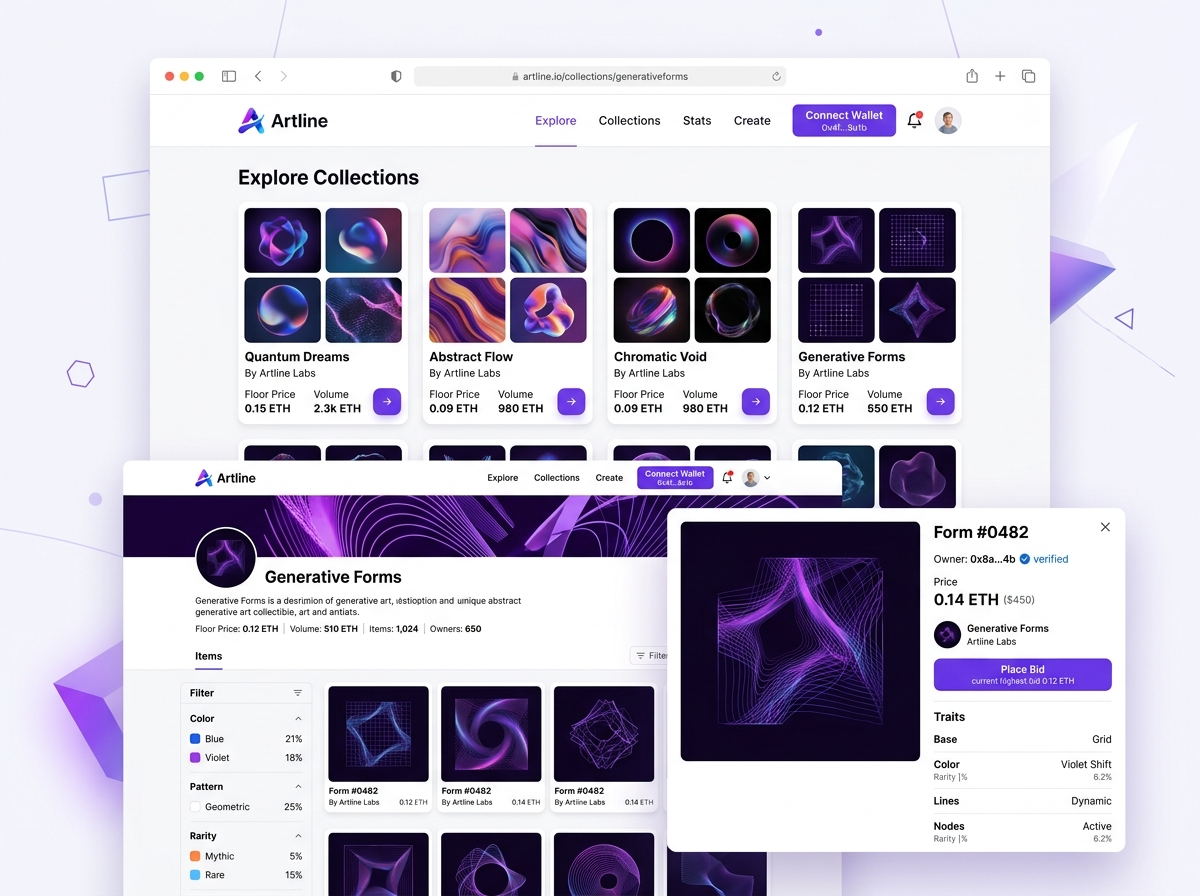
What Is a Foundation Clone Script?
A Foundation clone script is a curated art marketplace rather than an open one. Artists are invited rather than self-listing, works are usually one-of-one rather than large collections, and sales run as reserve auctions that begin when the first bid meets the reserve.
Curation is the entire product. An open marketplace competes on volume and fees; a curated one competes on who it lets in, because that is what makes a collector believe the work will hold value.
What You Receive
| Component | What It Covers |
|---|---|
| Curation system | Invite issuance, artist applications and review workflow |
| Auction contracts | Reserve auctions with extension on late bids |
| Royalty enforcement | On-chain artist royalties with venue enforcement mapping |
| Minting | Artist-controlled minting with permanent pinned metadata |
| Provenance | Full ownership and sale history for every work |
| Artist profiles | Portfolio, biography, verification and sales history |
| Collector tools | Bidding, watchlists, offers and collection display |
| Source code | Contracts, platform, pipeline and infrastructure on delivery |
See a working curated platform with your branding and curation model before committing.
Get a Free Live DemoCuration Is the Product. Everything Else Is Commodity.
Marketplace software is close to commodity — listings, auctions, wallets and royalties are all solved problems. What distinguishes a curated platform is entirely who it admits, and that is an editorial function rather than a technical one.
Which means the platform succeeds or fails on decisions software cannot make for you: which artists to invite, how many works to admit per month, and whether to say no to a well-known name whose work does not fit. Building the tooling is the easy part.
Invite supply controlled because unlimited invites make curation meaningless.
Review workflow real with named reviewers and recorded reasoning, not a rubber stamp.
Artist verification identity confirmed and plagiarism checked before first mint.
Scarcity enforced one-of-one and limited editions honoured in the contract.
Royalties enforced where possible with honest disclosure of which venues comply.
Provenance permanent metadata pinned redundantly, because a broken image ends a sale history.
We build the curation tooling well, and we will be direct that the tooling is not the hard part. A curated platform that admits everyone is an open marketplace with extra steps.
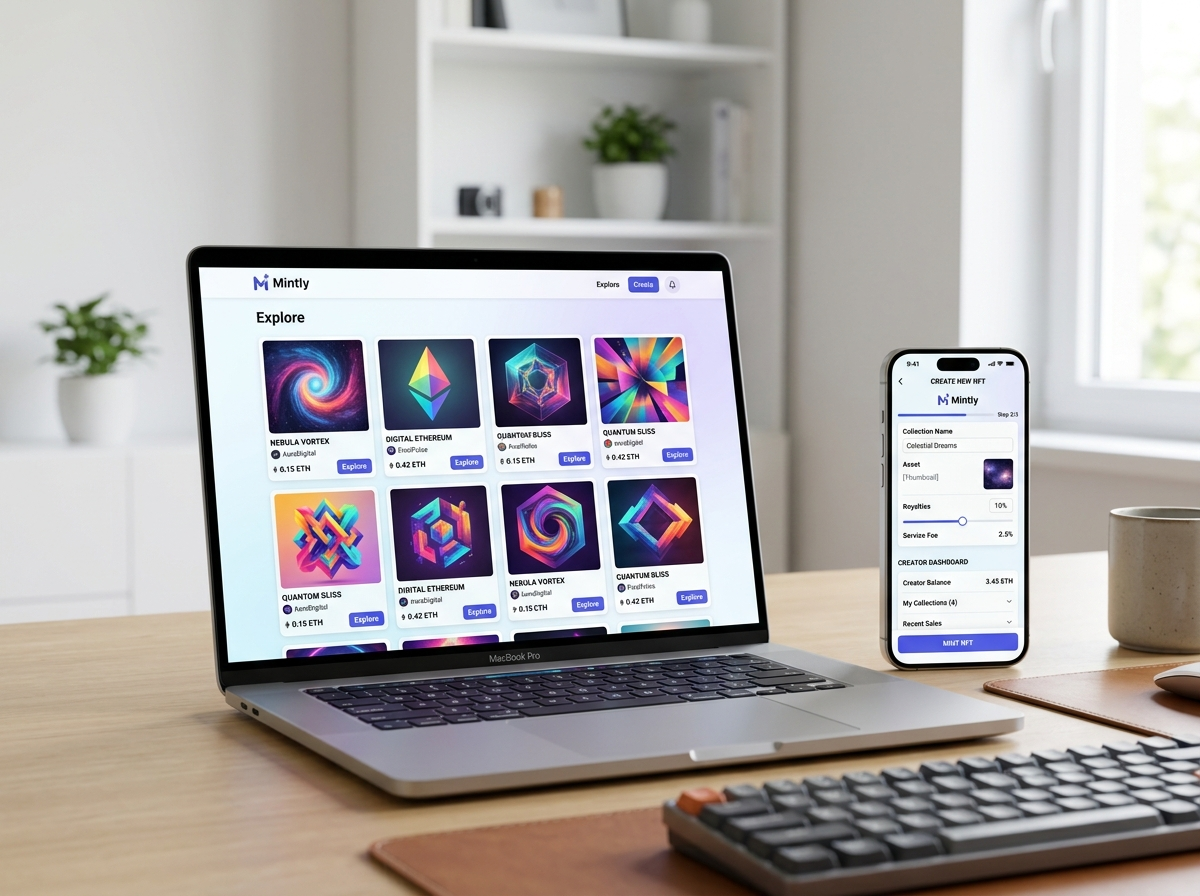
Surfaces This Scope Covers
Reference concepts for an on-chain build — swap, liquidity and position surfaces. Not screenshots of a delivered client protocol; audited deployments are shown on a call.
Core Features
Curation and Onboarding
- Invite issuance with configurable supply
- Artist application and review workflow
- Named reviewer notes and decision records
- Identity verification before first mint
- Plagiarism and duplicate work detection
- Community-nominated invite mechanisms
- Artist verification badges
Auctions and Sales
- Reserve auctions starting on first qualifying bid
- Auction extension on late bids to prevent sniping
- Fixed price listings and private sales
- Collector offers with expiry
- Edition sales with numbered releases
- Settlement with automatic royalty split
- Bid history visible on every work
Artist and Artwork
- Artist-controlled minting with immutable metadata
- One-of-one and limited edition support
- High-resolution media with permanent pinned storage
- Artwork detail with full provenance chain
- Artist profile, biography and exhibition history
- Royalty percentage set by the artist within platform bounds
Collector Experience
- Wallet connect with multiple providers
- Watchlists and outbid notifications
- Collection display and portfolio view
- Offer management across works
- Purchase with card or stablecoin where licensed
- Secondary listing from within a collection view
Mapped to a release plan
We will send a platform architecture, curation workflow and royalty plan with a delivery timeline.
Request a Feature PlanHow a Curated Art Platform Is Put Together
The modules above map onto these layers. Each one ships with its own tests, documentation and runbook, so nothing arrives as a black box you inherit without an explanation.
Requests flow down, settlement and events flow back up. Every boundary carries logging, so a failure is traceable to a layer instead of guessed at.
Chains and Standards We Work With
Each deployment is a separate audit surface, not a redeploy. Gas economics, MEV exposure and bridge assumptions differ per chain, and a contract that is safe on one can be attackable on another.
How We Build Your Platform
Contracts and interface follow separate tracks with separate release gates, because one is permanent and the other is not.
Curation and platform design
Invite model, review criteria, admission volume and what gets published.
Output → curation policy and platform specification
Contract development
Minting, reserve auction, royalty and edition contracts with full coverage.
Output → contract suite with test reports
Platform development
Gallery, artwork pages, artist and collector surfaces, admin tooling.
Output → staging platform for your review
Independent audit
Third-party review of auction, escrow and royalty paths.
Output → audit report with findings resolved
Launch and artist onboarding
Deployment, first invited artists, monitoring and support runbooks.
Output → live platform with founding artist cohort
Chains we deploy to
Development Timeline
| Scope | Timeline | Includes |
|---|---|---|
| White label art platform | 4 to 7 weeks | Rebranded platform, standard auctions, one chain |
| Standard curated platform | 9 to 13 weeks | Custom curation, reserve auctions, royalties, audit |
| Platform with editions and offers | 3 to 6 months | Edition mechanics, offer system, advanced curation |
| Multi-chain art platform | 5 to 9 months | Several chains, cross-chain provenance, full artist tooling |
What extends the timeline: independent audit of auction and escrow contracts, which hold bids and settlement; metadata pinning with redundancy, since a broken image destroys a work sale history; curation workflow design, which is policy work; and artist onboarding, which runs on relationship timelines rather than engineering ones.
Revenue Models
| Model | How It Works |
|---|---|
| Primary sale commission | A percentage of first sales by invited artists |
| Secondary commission | A cut of resales on the platform |
| Artist royalty routing | Enforcement and administration of ongoing artist royalties |
| Curation and membership fees | Charges for collector or artist membership tiers |
| Featured placement | Premium promotion for exhibitions and drops |
| Private sale brokerage | Fees on high-value works sold off the open market |
| Editions and print licensing | Revenue on secondary formats where artists permit |
Every fee is public and comparable on-chain, so pricing has a hard competitive ceiling. We build fee parameters as governable values rather than constants so they can be tuned without redeployment.
Related services
Who This Is For
Bringing an existing curatorial reputation on chain.
Running a platform on their own admission terms.
Adding a digital-native sales channel.
Issuing and selling digital works with provenance.
Curating for an audience that already trusts them.
Serving artists global platforms overlook.
Why Choose Coinsclone
Curation tooling built properly
Invite supply, review records and verification, because curation is the product.
Honest about the hard part
The tooling is straightforward; who you admit is what decides success.
Auction mechanics that work
Reserve auctions with late-bid extension so sniping does not decide outcomes.
Royalties enforced and disclosed
We map which venues honour them rather than assuming all do.
Metadata permanence
Pinned redundantly, because a broken image ends a work sale history.
Full source code ownership
Contracts, platform, pipeline and infrastructure transfer on delivery.
What Our Clients Say
Operators who launched with us, in their own words. Hover to pause.














A members-only NFT marketplace for Digital Freemasonry
 Digital Free MasonryNFT marketplace · delivered and live
Next phase in progress: the ODFT Token and the MasonicVerse platform.
Working with Coinsclone has been one of the best professional experiences I have had in the blockchain industry.
From the very beginning of our NFT Marketplace project until its successful completion, the entire team demonstrated exceptional technical expertise, professionalism, patience, and commitment. Every stage of development was handled with great attention to detail, and every challenge we encountered was approached with a solution-oriented mindset.
Read the full client note
Our project was far from a standard NFT Marketplace. It included custom blockchain architecture, Polygon integration, ERC-721 and ERC-1155 standards, royalty implementation, token-gated access through Masonic Passport, multiple payment methods, marketplace customization, advanced testing, and many unique business requirements. Throughout the entire process, the team consistently delivered high-quality work while maintaining clear communication, transparency, and a strong commitment to excellence.
I would especially like to express my sincere appreciation to Mr. Jeeva, Mr. Bala, Mr. Saravanan, Mr. Veeramani, Mr. Akshay, and the entire development team for their outstanding support, professionalism, responsiveness, and dedication throughout the project. Their technical expertise, patience, and willingness to understand even the most complex business requirements gave us complete confidence during every phase of development.
What impressed me the most was not only their excellent blockchain development skills, but also their ability to understand our vision and transform it into a secure, scalable, and highly professional NFT Marketplace.
For me, Coinsclone is not simply a software development company — they are a trusted long-term technology partner. After successfully completing our NFT Marketplace, we are now preparing to continue our collaboration on the next major phase of the Digital Freemasonry ecosystem, including the development of the ODFT Token and the future MasonicVerse platform.
I highly recommend Coinsclone to anyone looking for a reliable, experienced, and highly professional blockchain development company. They have earned my complete trust and respect, and I sincerely look forward to working with them again on future projects.
Start Your Art Platform Project
Tell us your curation model and artist pipeline and we will respond with a platform architecture and delivery timeline.
- Curation tooling built as a first-class feature
- Metadata pinned redundantly so sale history survives
- NDA signed before technical discussion
Request received
A solution architect will reply within one business day with a scoped proposal and demo link.
Foundation Clone Script: Frequently Asked Questions
What is a Foundation clone script?
A curated art marketplace where artists are invited rather than self-listing, works are usually one-of-one, and sales run as reserve auctions that begin when the first bid meets the reserve.
How is it different from an open marketplace?
An open marketplace competes on volume and fees. A curated one competes on who it admits, which is what makes collectors believe the work will hold value.
What is a reserve auction?
The work is listed with a reserve price and no clock. The auction starts when the first bid meets that reserve, then runs for a fixed window with extensions on late bids.
Why extend the auction on late bids?
To stop sniping from deciding outcomes. Without extension, a bid in the final seconds wins by timing rather than by price, which suppresses what collectors are willing to offer.
How does the invite system work?
Invites are issued with controlled supply, sometimes allocated to existing artists to nominate others. Unlimited invites make curation meaningless, so supply is a deliberate constraint.
Are artist royalties enforceable?
On-chain standards exist and we implement them, but enforcement depends on the venue honouring them. We map which marketplaces comply so artists are told the truth rather than a promise.
Who controls the minting?
The artist, from their own wallet, so the work is authentically theirs on chain. The platform controls admission and the sale mechanics, not the authorship.
How is provenance maintained?
Every mint, bid, sale and transfer is recorded on chain, with metadata pinned redundantly so the work itself keeps resolving. A broken image destroys the value of a sale history.
Can we support editions as well as one-of-ones?
Yes, with numbered limited editions alongside unique works. Scarcity is enforced in the contract rather than stated in a description.
How does a curated platform make money?
Primary sale commission, secondary commission, royalty administration, membership and curation fees, featured placement, private sale brokerage and licensing where artists permit.
How long does it take to build?
A white label platform takes 4 to 7 weeks. A standard curated platform takes 9 to 13 weeks. Editions and offers take 3 to 6 months, and multi-chain 5 to 9 months.
Will we own the platform?
Yes. Contracts, platform code, metadata pipeline and infrastructure configuration transfer on delivery, deployed under your own keys and accounts.
Estimate Your Build
Pick a scope and the extras you need. On a protocol build the audit and economic-modelling lines are the ones that move the timeline, and neither compresses safely.
{{ estSummary }}
Ranges assume decisions arrive on time. Licensing, banking and third-party audits run on their own schedules and we plan around them rather than inside them.
Get This Scoped ProperlyReady to Launch Your Art Platform?
Share your curation model and artist pipeline and receive a platform architecture, curation workflow and delivery timeline.