
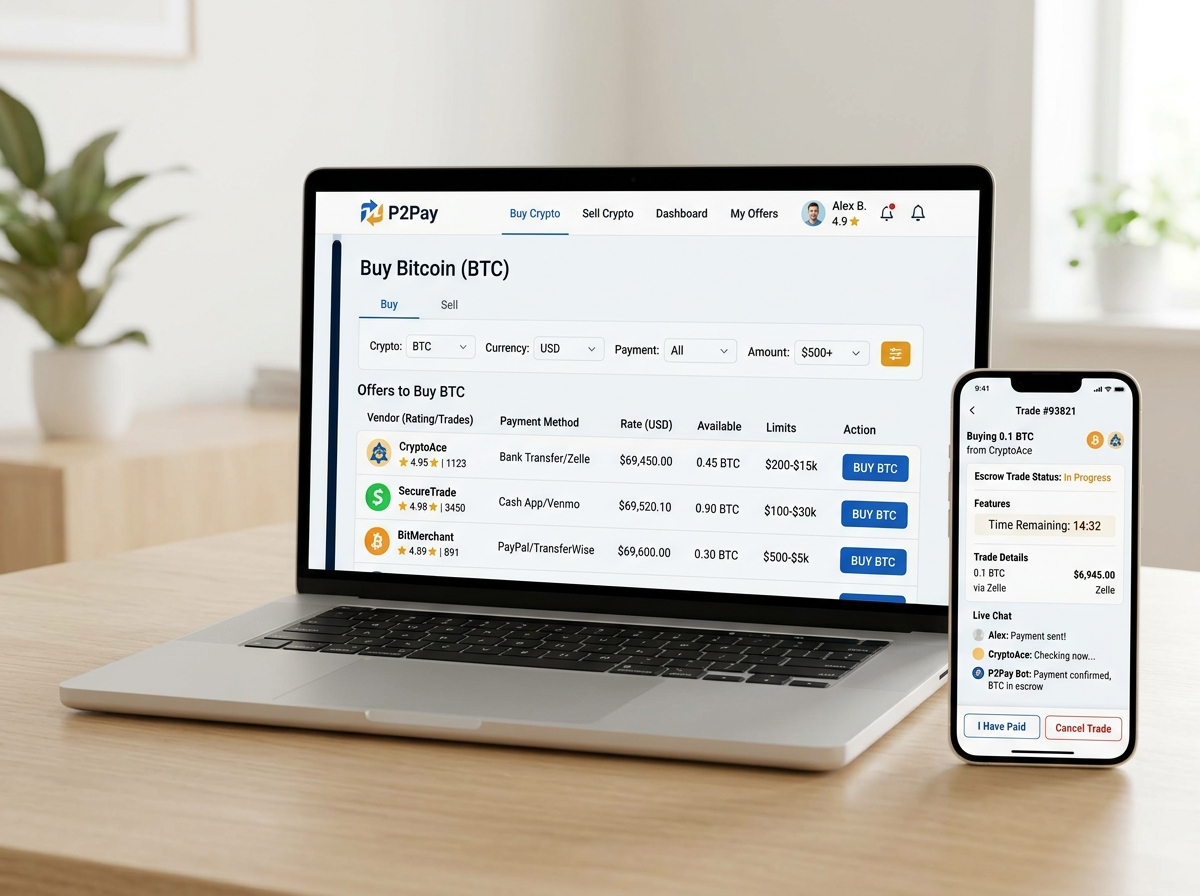
What Is P2P Crypto Exchange Development?
A P2P exchange does not hold an order book. Buyers and sellers post offers with their own price and payment method, the platform escrows the crypto while fiat moves directly between them, and releases it when both sides confirm.
That makes the platform an arbitrator rather than a counterparty. Your product is trust: escrow that holds, reputation that means something, and a dispute process that resolves fairly when one side lies.
What You Receive
| Component | What It Covers |
|---|---|
| Escrow contracts | Crypto held on trade creation, released on confirmation or ruling |
| Offer system | Buy and sell offers with price, limits and payment methods |
| Reputation engine | Completion rate, volume and trust score resistant to farming |
| Dispute arbitration | Case queue with evidence, chat history and ruling tools |
| Payment methods | Local bank transfer, wallets and cash options per market |
| Fraud controls | Device fingerprinting, velocity limits and chargeback patterns |
| Trade chat | In-trade messaging with evidence attachment and retention |
| Source code | Contracts, platform and infrastructure transfer on delivery |
See a working P2P platform with your branding, payment methods and fee structure.
Get a Free Live DemoYour Product Is Dispute Resolution
Most P2P trades complete without incident. The ones that do not are what your reputation is built on: a buyer claiming they paid when they did not, a seller releasing late, a chargeback three weeks after settlement.
Every one of those needs a process, evidence, and a person who can rule on it quickly. Platforms that treat arbitration as a support ticket queue lose their users to whoever handles it properly.
Escrow holds until ruling no admin path to release funds outside the defined process.
Evidence captured in-trade chat, receipts and timestamps retained for arbitration.
Reputation resistant to farming volume and counterparty diversity weighted, not raw trade count.
Payment method risk tiered reversible methods held longer, with limits sized to risk.
Arbitration staffed and measured response time tracked, because slow rulings lose users.
Chargeback patterns monitored since fiat reversal after crypto release is the core fraud.
We design the dispute process before the interface, because that is the product. A P2P platform is judged on the trade that went wrong, not the hundred that went right.
Surfaces This Scope Covers
Reference concepts for an on-chain build — swap, liquidity and position surfaces. Not screenshots of a delivered client protocol; audited deployments are shown on a call.
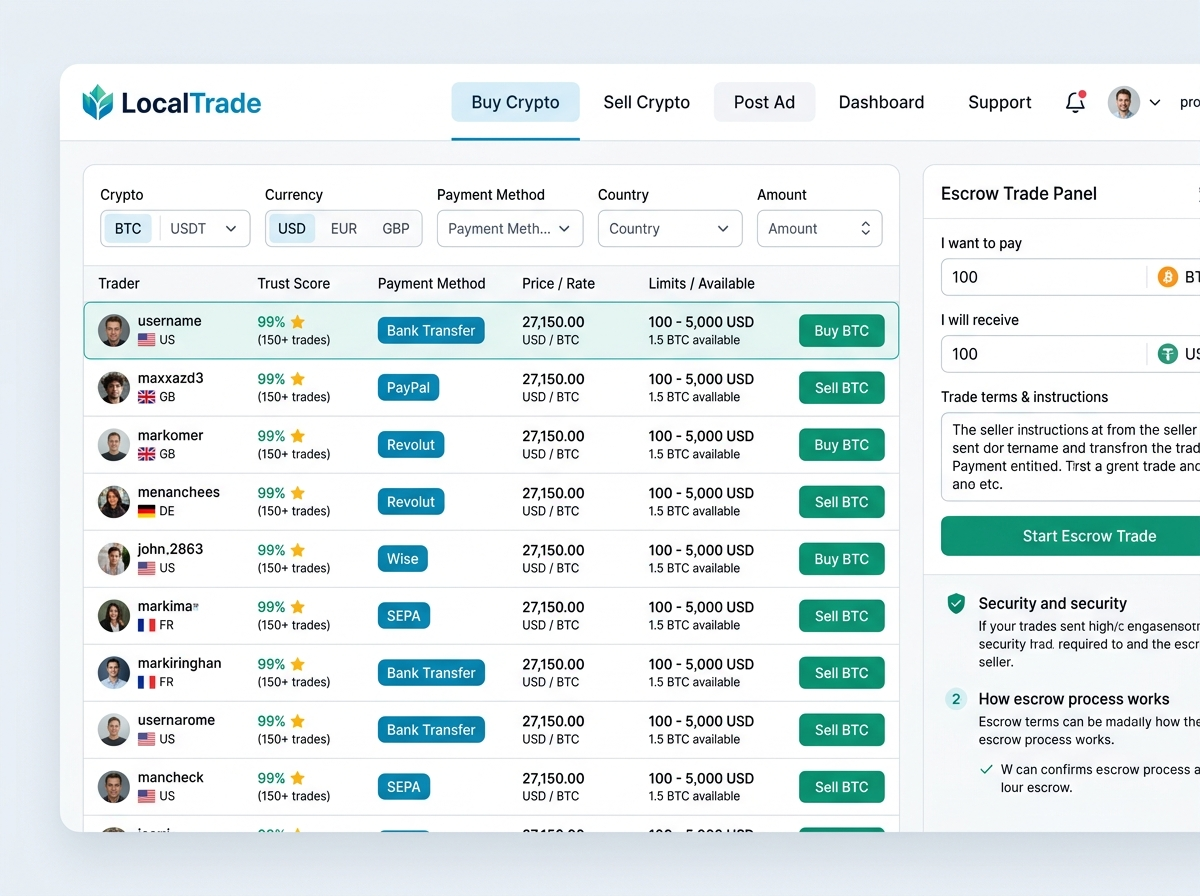
Core Features
Marketplace
- Buy and sell offers with custom pricing
- Fixed price and market-linked pricing with margin
- Per-offer limits, terms and payment windows
- Payment method filtering by country
- Offer visibility rules and pausing
- Merchant and verified trader tiers
- Bulk offer management for high-volume traders
Escrow and Trades
- Crypto escrowed on trade creation
- Time-boxed payment windows with auto-cancel
- Both-party confirmation before release
- Partial trade support where suited
- Trade chat with evidence attachment
- Automatic escrow release rules with safeguards
Trust and Disputes
- Reputation score weighted for counterparty diversity
- Completion rate, volume and response time displayed
- Dispute filing with structured evidence
- Arbitration queue with case history and rulings
- Appeal path with a second reviewer
- Ban and restriction tooling with audit trail
Compliance and Fraud
- Tiered KYC with limits by verification level
- AML monitoring and sanctions screening
- Device fingerprinting and velocity limits
- Chargeback pattern detection
- Geo-fencing and payment method restriction
- Regulator reporting exports
Mapped to a release plan
We will send a platform architecture, dispute process design and delivery timeline.
Request a Feature PlanHow a P2P Exchange Is Put Together
The modules above map onto these layers. Each one ships with its own tests, documentation and runbook, so nothing arrives as a black box you inherit without an explanation.
Requests flow down, settlement and events flow back up. Every boundary carries logging, so a failure is traceable to a layer instead of guessed at.
Chains and Assets We Support
Each deployment is a separate audit surface, not a redeploy. Gas economics, MEV exposure and bridge assumptions differ per chain, and a contract that is safe on one can be attackable on another.
How We Build Your P2P Platform
Contracts and interface follow separate tracks with separate release gates, because one is permanent and the other is not.
Market and payment scoping
Target countries, payment methods, typical trade sizes and fraud patterns.
Output → platform specification with payment matrix
Escrow and dispute design
Release rules, evidence requirements, arbitration workflow and appeals.
Output → escrow design and dispute process document
Platform development
Marketplace, escrow, reputation and arbitration tooling with tests.
Output → staging platform for your review
Security and fraud review
Penetration testing plus fraud scenario walkthroughs.
Output → test reports with remediation completed
Launch and operations
Deployment, arbitrator training, monitoring and support runbooks.
Output → live platform with trained arbitration team
Chains we deploy to
Development Timeline
| Scope | Timeline | Includes |
|---|---|---|
| White label P2P platform | 4 to 6 weeks | Rebranded platform, core payment methods, escrow |
| Standard P2P exchange | 10 to 14 weeks | Custom escrow, reputation, disputes, local payments |
| P2P with merchant tiers | 4 to 6 months | Merchant tooling, advanced fraud, multi-country |
| Multi-region platform | 6 to 10 months | Several markets, many payment rails, full compliance |
What extends the timeline: payment method integration, which is country-specific and often needs local partners; dispute process design and arbitrator training, which is operational work; fraud controls tuned against real patterns; and compliance scoping per market, since P2P attracts more regulatory attention than order book trading.
Revenue Models
| Model | How It Works |
|---|---|
| Trade fees | A percentage from maker, taker or both |
| Merchant subscriptions | Recurring fees for higher limits and better placement |
| Featured offer placement | Charges for visibility in the marketplace |
| Withdrawal fees | A margin above network transaction cost |
| Express trade spread | Margin on an instant-match flow |
| Advertising | Paid placement for verified merchants |
| Escrow float | Yield on escrowed balances where disclosed |
Every fee is public and comparable on-chain, so pricing has a hard competitive ceiling. We build fee parameters as governable values rather than constants so they can be tuned without redeployment.
Related services
Who This Is For
Serving markets where card rails and global exchanges do not reach.
Adding a peer marketplace to existing corridors.
Offering a fiat on-ramp without banking relationships.
Running a trusted marketplace for a specific group.
Productising an existing informal trading network.
Adding peer-to-peer crypto to a consumer product.
Why Choose Coinsclone
Dispute process designed first
Because that is the product, not a support function bolted on later.
Escrow with no admin bypass
Funds release through the defined process only, enforced in the contract.
Reputation resistant to farming
Weighted for counterparty diversity rather than raw trade count.
Payment risk tiered
Reversible methods held longer, with limits sized to actual chargeback risk.
Fraud controls from real patterns
Device signals, velocity limits and chargeback detection built in.
Full source code ownership
Contracts, platform and infrastructure transfer on delivery.
What Our Clients Say
Operators who launched with us, in their own words. Hover to pause.















A members-only NFT marketplace for Digital Freemasonry
 Digital Free MasonryNFT marketplace · delivered and live
Next phase in progress: the ODFT Token and the MasonicVerse platform.
Working with Coinsclone has been one of the best professional experiences I have had in the blockchain industry.
From the very beginning of our NFT Marketplace project until its successful completion, the entire team demonstrated exceptional technical expertise, professionalism, patience, and commitment. Every stage of development was handled with great attention to detail, and every challenge we encountered was approached with a solution-oriented mindset.
Read the full client note
Our project was far from a standard NFT Marketplace. It included custom blockchain architecture, Polygon integration, ERC-721 and ERC-1155 standards, royalty implementation, token-gated access through Masonic Passport, multiple payment methods, marketplace customization, advanced testing, and many unique business requirements. Throughout the entire process, the team consistently delivered high-quality work while maintaining clear communication, transparency, and a strong commitment to excellence.
I would especially like to express my sincere appreciation to Mr. Jeeva, Mr. Bala, Mr. Saravanan, Mr. Veeramani, Mr. Akshay, and the entire development team for their outstanding support, professionalism, responsiveness, and dedication throughout the project. Their technical expertise, patience, and willingness to understand even the most complex business requirements gave us complete confidence during every phase of development.
What impressed me the most was not only their excellent blockchain development skills, but also their ability to understand our vision and transform it into a secure, scalable, and highly professional NFT Marketplace.
For me, Coinsclone is not simply a software development company — they are a trusted long-term technology partner. After successfully completing our NFT Marketplace, we are now preparing to continue our collaboration on the next major phase of the Digital Freemasonry ecosystem, including the development of the ODFT Token and the future MasonicVerse platform.
I highly recommend Coinsclone to anyone looking for a reliable, experienced, and highly professional blockchain development company. They have earned my complete trust and respect, and I sincerely look forward to working with them again on future projects.
Start Your P2P Project
Tell us your target chains and the pairs you need to win and we will respond with a routing architecture and delivery timeline.
- Working P2P demo with your branding applied
- Payment methods and dispute process mapped to your market
- NDA signed before technical discussion
Request received
A solution architect will reply within one business day with a scoped proposal and demo link.
P2P Crypto Exchange Development: Frequently Asked Questions
What is a P2P crypto exchange?
A marketplace where buyers and sellers post their own offers and trade directly. The platform escrows crypto while fiat moves between the parties, releasing it on confirmation.
How is it different from a regular exchange?
There is no order book and no fiat handling by the platform. Users transact with each other, which removes banking dependency and makes the platform an arbitrator rather than a counterparty.
What is the hardest part to build?
Dispute resolution. Most trades complete cleanly; your reputation is built on how you handle the ones where one party lies about payment.
How does escrow work?
Crypto is locked when a trade starts and released only when both parties confirm or an arbitrator rules. There is no admin path to move it outside that process.
How do you stop reputation farming?
By weighting the score for counterparty diversity, trade size and response time rather than raw completion count, so two accounts trading with each other gains nothing.
What about chargebacks?
That is the core fraud in P2P: fiat reversed after crypto is released. Reversible payment methods get longer hold windows, lower limits and pattern monitoring.
Which payment methods should we support?
Whatever your market actually uses, which is usually local bank transfer and mobile money rather than cards. Method choice is market research, not a technical decision.
Does a P2P platform need KYC?
In most jurisdictions yes, and P2P attracts more regulatory attention than order book trading because fiat moves outside your visibility. Your counsel sets the requirement.
How is arbitration staffed?
With trained arbitrators working a case queue with structured evidence, tracked response times and an appeal path. Slow rulings lose users faster than almost anything else.
How does a P2P exchange make money?
Trade fees, merchant subscriptions, featured placement, withdrawal fees, express trade spread, advertising and escrow float where disclosed.
How long does it take to build?
A white label platform takes 4 to 6 weeks. A standard P2P exchange takes 10 to 14 weeks. Merchant tiers take 4 to 6 months, and a multi-region platform 6 to 10 months.
Will we own the platform?
Yes. Escrow contracts, marketplace, arbitration tooling and infrastructure configuration transfer on delivery.
Estimate Your Build
Pick a scope and the extras you need. On a protocol build the audit and economic-modelling lines are the ones that move the timeline, and neither compresses safely.
{{ estSummary }}
Ranges assume decisions arrive on time. Licensing, banking and third-party audits run on their own schedules and we plan around them rather than inside them.
Get This Scoped ProperlyReady to Launch Your P2P Exchange?
Share your target markets and payment methods and receive a scoped proposal covering escrow, disputes, compliance and timeline.