

What Is an NFT Lending Platform?
An NFT lending platform lets a holder borrow against an NFT without selling it. The token goes into escrow, the borrower receives funds, and if the loan is not repaid the lender takes the collateral. Models vary: direct peer-to-peer offers, or pools where lenders deposit and borrowers draw against a collection-wide valuation.
The difficulty is that the collateral is illiquid and thinly priced. A collection with twenty sales a week has no reliable market price, and the floor listing can be moved by one seller. Lending against that safely is a risk engineering problem, not a contract problem.
What You Receive
| Component | What It Covers |
|---|---|
| Lending contracts | Loan origination, escrow, repayment and default handling |
| Valuation system | Manipulation-resistant pricing with staleness handling |
| Liquidation engine | Auction or buyout design suited to illiquid collateral |
| Risk parameters | Per-collection loan-to-value tiers and exposure caps |
| Lender interface | Offer creation, pool deposits, position and yield views |
| Borrower interface | Collateral selection, terms, health and repayment flows |
| Monitoring | Loan health, floor price movement and bad debt alerting |
| Source code | Contracts, tests, front end and deployment scripts on delivery |
Share your target collections and we will model liquidation outcomes before you build.
Get a Free Live DemoThe Floor Price Is Not a Price
Lending protocols need a valuation. For NFTs, the number most platforms reach for is the floor listing, which is whatever the cheapest seller asked for today. It is not a clearing price, and a single actor can set it.
That creates an obvious attack: move the floor, borrow against an inflated valuation, walk away. It also creates a quieter failure — when a collection actually falls, every loan goes underwater at once and there is no bid to liquidate into, so the protocol absorbs the loss.
Valuation from sales, not listings time-weighted realised prices rather than the cheapest ask.
Manipulation cost modelled so moving the price is more expensive than the loan gained.
Loan-to-value set conservatively sized to what the collection can absorb in a decline.
Liquidation designed for illiquidity auctions with time, not instant market sells into no bid.
Exposure capped per collection so one collection collapsing does not take the pool.
Bad debt handled explicitly with a reserve and a stated policy rather than silence.
We will model what happens to your loan book if a collection falls sixty percent in a week, and tell you which collections should not be accepted as collateral at all. That conversation is cheaper before launch.
Surfaces This Scope Covers
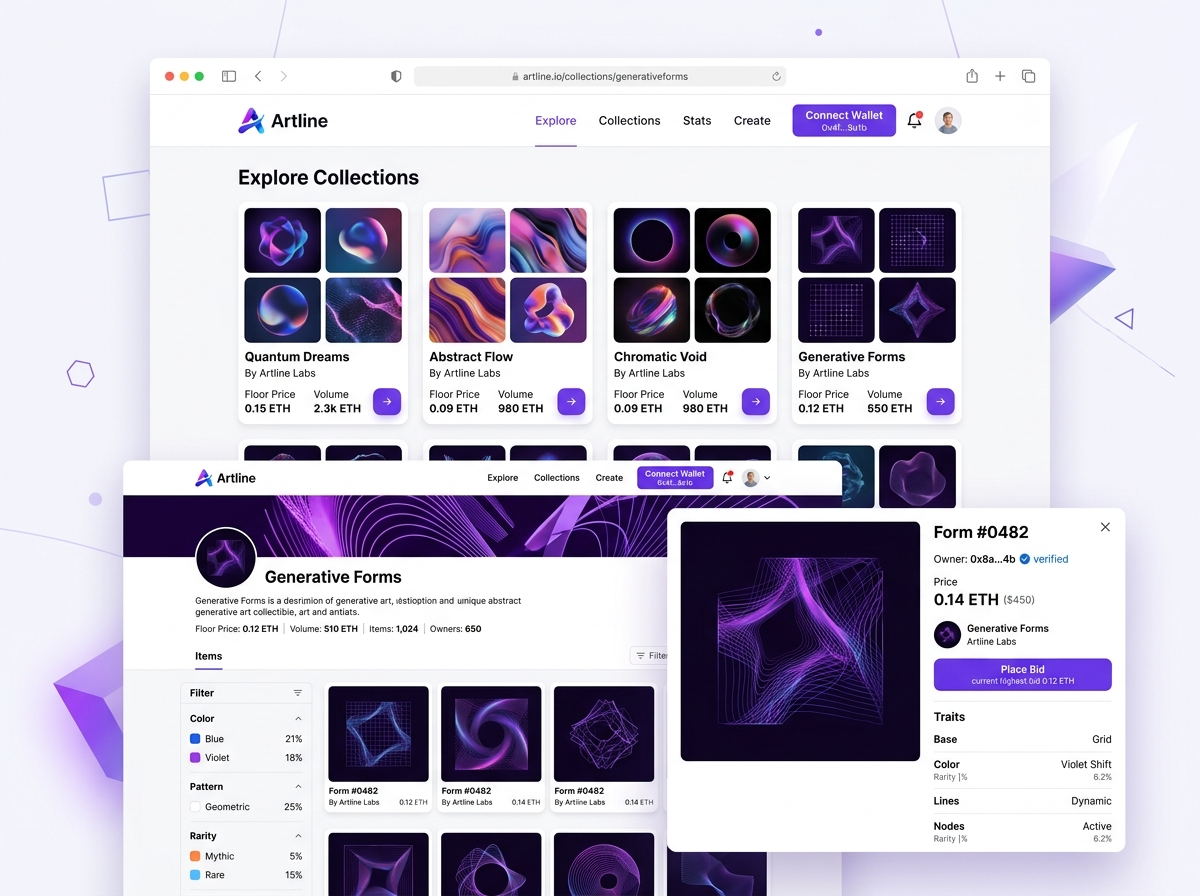
Reference concepts for an on-chain build — swap, liquidity and position surfaces. Not screenshots of a delivered client protocol; audited deployments are shown on a call.
Core Features
Lending Models
- Peer-to-peer offers with custom terms per loan
- Pooled lending against collection-wide valuation
- Collection offers open to any token in a set
- Fixed-term and open-ended loan structures
- Refinancing and loan extension flows
- Multi-asset collateral bundles
Valuation and Risk
- Time-weighted realised sale pricing
- Outlier filtering and wash trade detection
- Staleness thresholds with borrowing suspension
- Per-collection loan-to-value tiers
- Trait-aware valuation for high-variance collections
- Exposure caps per collection and per token
Liquidation
- Timed auction liquidation rather than instant sale
- Grace period with borrower cure options
- Partial repayment to restore health
- Liquidation incentive tuning
- Fallback to lender takeover of collateral
- Bad debt reserve and loss accounting
Platform and Safety
- Audited escrow with no admin withdrawal path
- Loan health dashboards for both sides
- Notification on health decline and expiry
- Emergency pause and borrow-only suspension
- Timelocked parameter governance
- Monitoring on floor movement and pool solvency
Mapped to a release plan
We will send a risk model, valuation design and audit plan with a delivery timeline.
Request a Feature PlanHow an NFT Lending Platform Is Put Together
The modules above map onto these layers. Each one ships with its own tests, documentation and runbook, so nothing arrives as a black box you inherit without an explanation.
Requests flow down, settlement and events flow back up. Every boundary carries logging, so a failure is traceable to a layer instead of guessed at.
Chains and Standards We Work With
Each deployment is a separate audit surface, not a redeploy. Gas economics, MEV exposure and bridge assumptions differ per chain, and a contract that is safe on one can be attackable on another.
How We Build Your Platform
Contracts and interface follow separate tracks with separate release gates, because one is permanent and the other is not.
Collateral and risk scoping
Which collections are acceptable, at what loan-to-value and with what caps.
Output → collateral policy with risk tiers
Valuation and liquidation design
Pricing source, manipulation cost analysis and auction mechanics.
Output → risk model with stress scenarios
Contract development
Lending, escrow, valuation and liquidation logic with invariant coverage.
Output → contract suite with test reports
Independent audit
Third-party review of escrow and liquidation paths, remediation and retest.
Output → audit report with findings resolved
Staged launch
Conservative caps, monitoring, alerting and bad debt procedures.
Output → live platform with caps and response runbooks
Chains we deploy to
Development Timeline
| Scope | Timeline | Includes |
|---|---|---|
| Peer-to-peer lending platform | 7 to 10 weeks | P2P offers, escrow, repayment, audit |
| Pooled lending platform | 12 to 16 weeks | Pool model, valuation oracle, liquidation engine |
| Platform with advanced risk | 4 to 7 months | Trait-aware valuation, refinancing, bad debt reserve |
| Multi-chain lending suite | 7 to 11 months | Several chains, cross-collection risk, full governance |
What extends the timeline: independent audit of escrow and liquidation, which hold collateral directly; valuation design and manipulation cost modelling, which is the highest-value work; liquidation mechanics, which need stress testing against thin markets; and staged launch with conservative caps rather than open borrowing.
Revenue Models
| Model | How It Works |
|---|---|
| Origination fee | A charge on each loan created |
| Interest spread | The difference between borrower rate and lender yield |
| Liquidation fee | A cut of proceeds when collateral is liquidated |
| Pool management fee | An annual rate on lender deposits |
| Refinancing fee | A charge on loan extension or rollover |
| Premium risk data | Selling valuation and risk analytics |
| White label licensing | Licensing the lending stack to other operators |
Every fee is public and comparable on-chain, so pricing has a hard competitive ceiling. We build fee parameters as governable values rather than constants so they can be tuned without redeployment.
Related services
Who This Is For
Adding borrowing so holders can access liquidity without selling.
Extending lending into non-fungible collateral.
Borrowing against holdings rather than liquidating.
Letting players borrow against in-game assets.
Adding NFT collateral to an existing credit product.
Offering native liquidity to their own holders.
Why Choose Coinsclone
Valuation from realised sales
Time-weighted actual prices rather than the cheapest listing, which one seller controls.
Manipulation cost modelled
Attack profitability calculated before parameters are set.
Liquidation built for illiquidity
Timed auctions rather than instant sells into a market with no bid.
Exposure capped per collection
So a single collapse cannot take the whole pool.
Bad debt policy stated
With a reserve and a published procedure rather than improvisation.
Full source code ownership
Contracts, tests, front end and deployment scripts transfer on delivery.
What Our Clients Say
Operators who launched with us, in their own words. Hover to pause.















A members-only NFT marketplace for Digital Freemasonry
 Digital Free MasonryNFT marketplace · delivered and live
Next phase in progress: the ODFT Token and the MasonicVerse platform.
Working with Coinsclone has been one of the best professional experiences I have had in the blockchain industry.
From the very beginning of our NFT Marketplace project until its successful completion, the entire team demonstrated exceptional technical expertise, professionalism, patience, and commitment. Every stage of development was handled with great attention to detail, and every challenge we encountered was approached with a solution-oriented mindset.
Read the full client note
Our project was far from a standard NFT Marketplace. It included custom blockchain architecture, Polygon integration, ERC-721 and ERC-1155 standards, royalty implementation, token-gated access through Masonic Passport, multiple payment methods, marketplace customization, advanced testing, and many unique business requirements. Throughout the entire process, the team consistently delivered high-quality work while maintaining clear communication, transparency, and a strong commitment to excellence.
I would especially like to express my sincere appreciation to Mr. Jeeva, Mr. Bala, Mr. Saravanan, Mr. Veeramani, Mr. Akshay, and the entire development team for their outstanding support, professionalism, responsiveness, and dedication throughout the project. Their technical expertise, patience, and willingness to understand even the most complex business requirements gave us complete confidence during every phase of development.
What impressed me the most was not only their excellent blockchain development skills, but also their ability to understand our vision and transform it into a secure, scalable, and highly professional NFT Marketplace.
For me, Coinsclone is not simply a software development company — they are a trusted long-term technology partner. After successfully completing our NFT Marketplace, we are now preparing to continue our collaboration on the next major phase of the Digital Freemasonry ecosystem, including the development of the ODFT Token and the future MasonicVerse platform.
I highly recommend Coinsclone to anyone looking for a reliable, experienced, and highly professional blockchain development company. They have earned my complete trust and respect, and I sincerely look forward to working with them again on future projects.
Start Your Lending Project
Tell us your target collections and lending model and we will respond with a risk model and delivery timeline.
- Liquidation outcomes modelled against thin markets
- Valuation manipulation cost calculated upfront
- NDA signed before technical discussion
Request received
A solution architect will reply within one business day with a scoped proposal and demo link.
NFT Lending Platform Development: Frequently Asked Questions
What is an NFT lending platform?
A platform letting holders borrow against an NFT without selling it. The token goes into escrow, the borrower receives funds, and the lender takes the collateral if the loan is not repaid.
What lending models are there?
Peer-to-peer offers with terms negotiated per loan, and pooled lending where depositors fund loans drawn against a collection-wide valuation. Pools scale better and carry more systemic risk.
Why is NFT collateral harder than token collateral?
Because it is illiquid and thinly priced. A collection with a handful of weekly sales has no reliable clearing price, and there may be no bid at all when you need to liquidate.
Why is the floor price a poor valuation source?
It is the cheapest current ask, not a transaction price, and one seller can set it. That makes it manipulable: move the floor, borrow against an inflated value, and default.
What should valuation be based on instead?
Time-weighted realised sale prices with outlier filtering and wash-trade detection, plus staleness thresholds that suspend borrowing when recent data is insufficient.
How does liquidation work for an illiquid asset?
Through timed auctions rather than instant market sales, with a grace period and partial repayment options first. Instant liquidation assumes a bid that often does not exist.
What happens if a collection crashes?
Every loan against it goes underwater at once. Conservative loan-to-value limits, per-collection exposure caps and a bad debt reserve are what keep that from becoming a pool-wide loss.
How do you decide which collections to accept?
By modelling sale volume, price stability and manipulation cost. Some collections should not be accepted as collateral at any loan-to-value, and we say so during scoping.
Is the collateral safe in escrow?
The escrow contract is audited with no admin withdrawal path, so neither the platform operator nor we can move a borrower asset. That is a design requirement, not a policy.
How does the platform make money?
Origination fees, interest spread, liquidation fees, pool management fees, refinancing charges, premium risk data and white label licensing.
How long does it take to build?
A peer-to-peer platform takes 7 to 10 weeks. A pooled platform takes 12 to 16 weeks. Advanced risk features take 4 to 7 months, and a multi-chain suite 7 to 11 months.
Will we own the contracts?
Yes. Lending, escrow, valuation and liquidation contracts, plus tests, front end and deployment scripts, transfer on delivery under your own keys and governance.
Estimate Your Build
Pick a scope and the extras you need. On a protocol build the audit and economic-modelling lines are the ones that move the timeline, and neither compresses safely.
{{ estSummary }}
Ranges assume decisions arrive on time. Licensing, banking and third-party audits run on their own schedules and we plan around them rather than inside them.
Get This Scoped ProperlyReady to Build Your Lending Platform?
Share your target collections and lending model and receive a risk model, valuation design, audit plan and delivery timeline.