
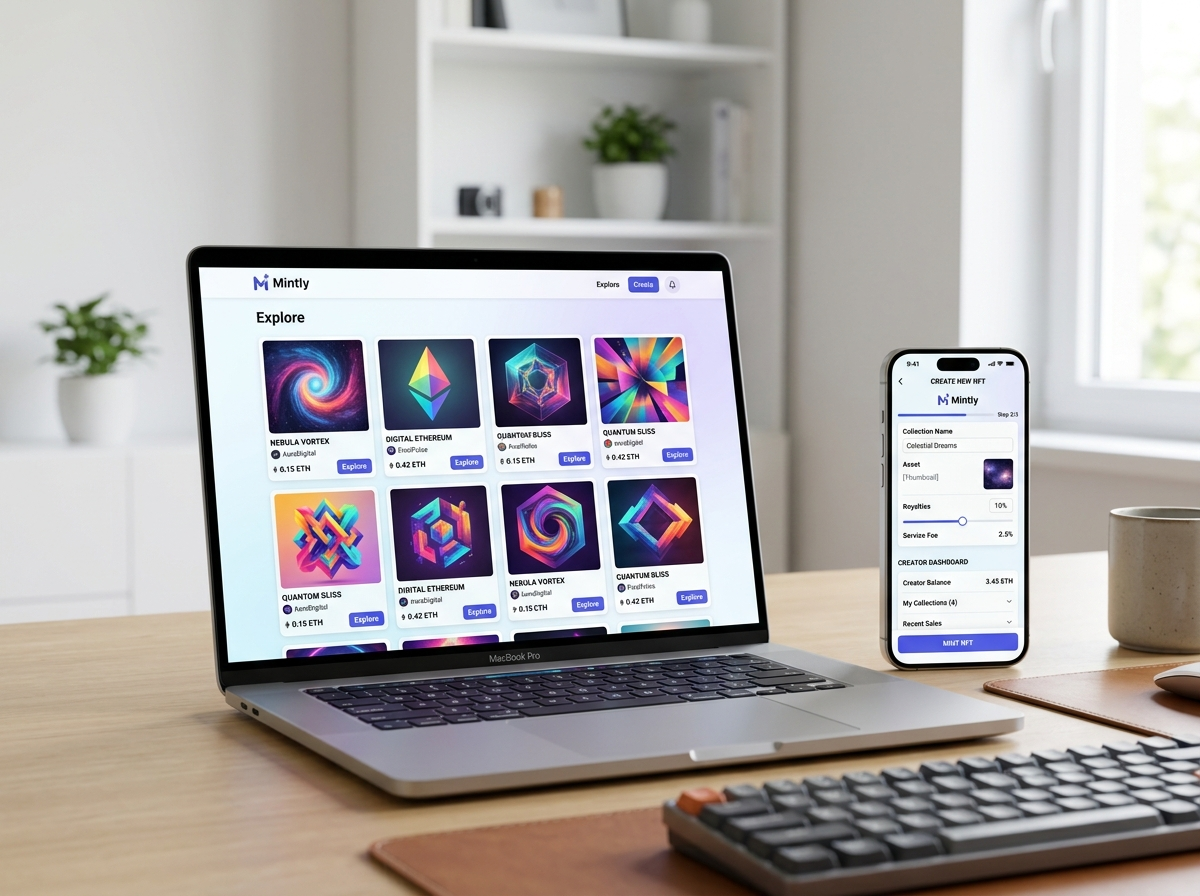
What Does an NFT Development Company Do?
NFT development covers the contracts that define ownership and the platforms built around them: marketplaces for trading, launchpads for hosting drops, minting platforms for issuance, and staking or lending systems that give held assets something to do.
The work that decides whether any of it lasts is unglamorous. Where the metadata lives, whether the URI can be repointed, whether provenance was committed before reveal, and whether royalties are enforceable on the venues your collectors actually use.
What You Receive
| Component | What It Covers |
|---|---|
| Token contracts | Audited ERC721, ERC1155 or Metaplex implementations |
| Platform build | Marketplace, launchpad, minting or staking system as scoped |
| Metadata infrastructure | Permanent pinned storage with redundancy across providers |
| Provenance system | Collection hash published before reveal |
| Royalty configuration | On-chain standards with venue enforcement mapping |
| Interfaces | Collector and creator surfaces with wallet connect |
| Indexing | Subgraph or indexer for collections, listings and activity |
| Source code | Contracts, platform, pipeline and infrastructure on delivery |
Share your concept and see working NFT infrastructure with your branding before committing.
Get a Free Live DemoAn NFT Is a Pointer. Most Projects Break the Thing It Points At.
A token records who owns an identifier. The art, the traits and the description live at a URI, and the token is only as durable as whatever that URI resolves to. Server-hosted metadata dies with the hosting bill. Unpinned IPFS content disappears when the last node drops it.
This is the most common failure in the category and the least discussed. It is entirely preventable at build time: permanent storage, redundant pinning, and an immutable URI in the contract. After deployment there is nothing anyone can do about it.
Metadata stored permanently pinned IPFS with redundancy or Arweave, never a server URL.
URI immutable in the contract so the pointer cannot be silently changed.
Provenance committed before reveal proving trait assignment was fixed in advance.
Royalties mapped to real venues because enforcement varies by marketplace.
Contracts independently audited since deployed code cannot be patched.
Indexing owned by you rather than depending on a third-party API.
We treat metadata permanence as a launch blocker. A collection whose art stops resolving in two years was mis-engineered on day one, and by then it is unfixable.
Surfaces This Scope Covers
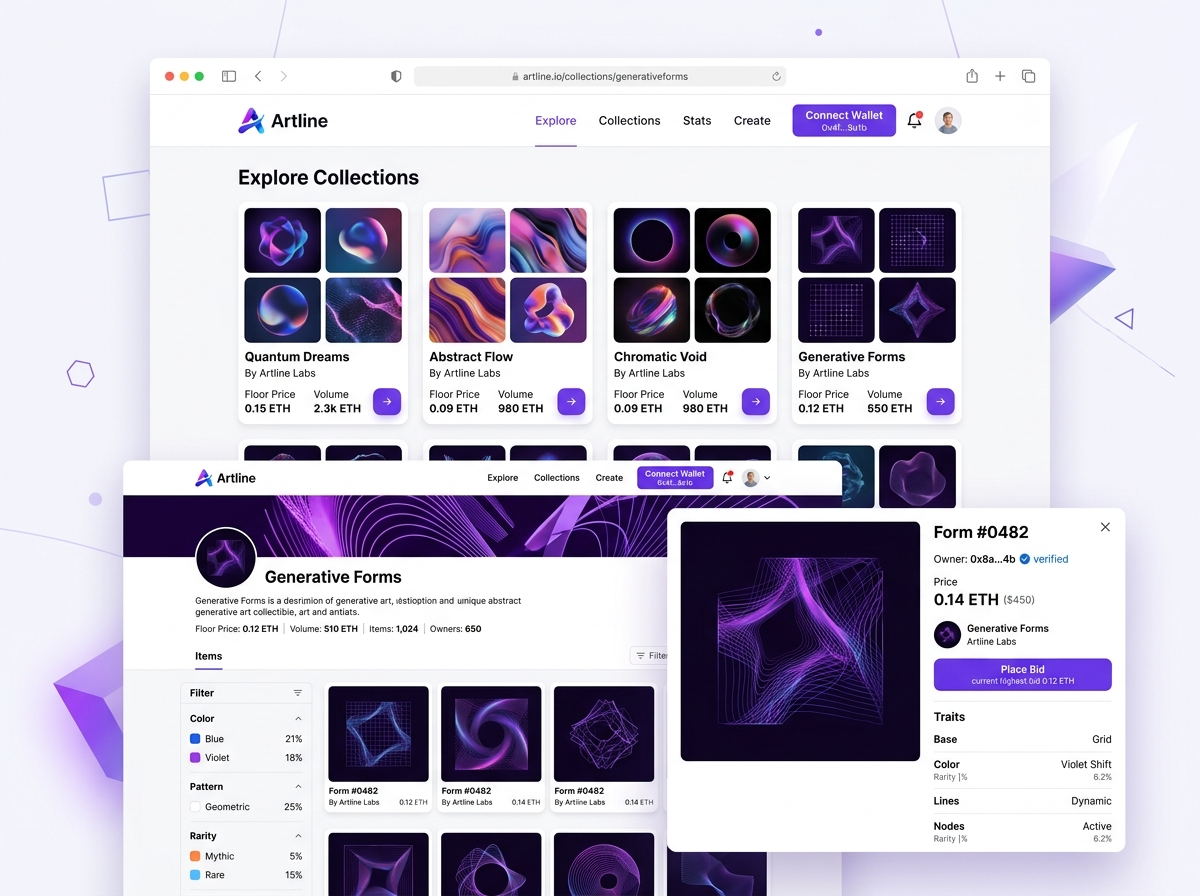
Reference concepts for an on-chain build — swap, liquidity and position surfaces. Not screenshots of a delivered client protocol; audited deployments are shown on a call.
What We Build
Marketplaces
- Multi-chain listing and discovery
- Fixed price, auction and offer flows
- On-chain royalty enforcement
- Collection pages with trait filtering
- Bulk listing and sweep purchase
- Creator verification and badges
- Activity feeds and price history
Launch and Minting
- Gas-optimised batch mint contracts
- Allowlist phases with independent pricing
- Delayed reveal with provenance commitment
- Creator vetting and onboarding workflows
- Automatic revenue splitting
- Load testing before launch
Utility Systems
- NFT staking with trait-weighted rewards
- Lending against NFT collateral
- Fractionalisation where legally scoped
- Gated access and membership mechanics
- Upgrade and combination mechanics
- Cross-game and cross-platform asset use
Contracts and Standards
- ERC721 and ERC721A implementations
- ERC1155 for semi-fungible assets
- ERC2981 royalty standard
- Soulbound and non-transferable tokens
- Metaplex and SPL on Solana
- Independent audit with remediation
Mapped to a release plan
We will send an architecture, metadata plan and audit approach with a delivery timeline.
Request a Feature PlanHow NFT Infrastructure Is Put Together
The modules above map onto these layers. Each one ships with its own tests, documentation and runbook, so nothing arrives as a black box you inherit without an explanation.
Requests flow down, settlement and events flow back up. Every boundary carries logging, so a failure is traceable to a layer instead of guessed at.
Chains and Standards We Work With
Each deployment is a separate audit surface, not a redeploy. Gas economics, MEV exposure and bridge assumptions differ per chain, and a contract that is safe on one can be attackable on another.
How We Build Your NFT Project
Contracts and interface follow separate tracks with separate release gates, because one is permanent and the other is not.
Concept and scope
Which platform, which standard, which chain and what the assets are for.
Output → specification with architecture and standard choice
Metadata and provenance setup
Permanent storage, pinning redundancy and provenance generation.
Output → pinned metadata with published provenance hash
Contract and platform build
Token contracts and platform surfaces with full test coverage.
Output → staging platform with contract test reports
Independent audit
Third-party review, remediation, retest and gas analysis.
Output → audit report with findings resolved
Launch and handover
Deployment, load testing, monitoring, runbooks and training.
Output → live platform with source code transferred
Chains we deploy to
Development Timeline
| Scope | Timeline | Includes |
|---|---|---|
| NFT collection and mint | 3 to 5 weeks | Contract, metadata, mint page, reveal |
| NFT marketplace | 9 to 13 weeks | Listings, auctions, royalties, indexing, audit |
| Launchpad or staking platform | 3 to 6 months | Creator tooling or reward mechanics, governance |
| Multi-chain NFT ecosystem | 6 to 11 months | Several chains, marketplace plus launchpad plus utility |
What extends the timeline: metadata pinning with redundancy, which is slow but non-negotiable; independent audit, since contracts are immutable once deployed; provenance generation, which must be published before any mint; and load testing, which frequently reveals RPC limits before launch rather than during it.
Revenue Models
| Model | How It Works |
|---|---|
| Marketplace commission | A percentage of every secondary sale |
| Primary mint revenue | Proceeds from initial collection sales |
| Launchpad commission | A cut of hosted drops on your platform |
| Minting and deployment fees | Charges for contract deployment and setup |
| Royalty share | A portion of creator royalties where enforced |
| Staking and utility fees | Charges on reward claims and upgrades |
| Premium creator tools | Analytics, scheduling and verification tiers |
Every fee is public and comparable on-chain, so pricing has a hard competitive ceiling. We build fee parameters as governable values rather than constants so they can be tuned without redeployment.
Related services
Who This Is For
Issuing collectibles or access tokens tied to a product.
Releasing work with verifiable provenance.
Making in-game assets ownable and tradeable.
Building or rebuilding trading infrastructure.
Seeding native NFT infrastructure.
Issuing membership and governance assets.
Why Choose Coinsclone
Metadata permanence enforced
Pinned redundant storage and an immutable URI, because this is the category most common failure.
Provenance published before reveal
Trait assignment provably fixed in advance rather than asserted afterwards.
Royalty enforcement mapped
We tell you which venues honour royalties instead of assuming all do.
Contracts independently audited
Deployed code is permanent, so review happens before mainnet.
Indexing you own
Your own subgraph rather than dependence on a third-party API.
Full source code ownership
Contracts, platform, pipeline and infrastructure transfer on delivery.
What Our Clients Say
Operators who launched with us, in their own words. Hover to pause.










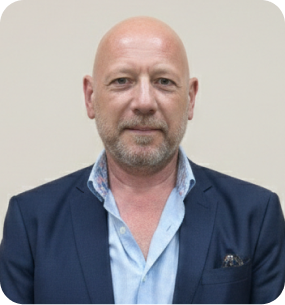


A members-only NFT marketplace for Digital Freemasonry
 Digital Free MasonryNFT marketplace · delivered and live
Next phase in progress: the ODFT Token and the MasonicVerse platform.
Working with Coinsclone has been one of the best professional experiences I have had in the blockchain industry.
From the very beginning of our NFT Marketplace project until its successful completion, the entire team demonstrated exceptional technical expertise, professionalism, patience, and commitment. Every stage of development was handled with great attention to detail, and every challenge we encountered was approached with a solution-oriented mindset.
Read the full client note
Our project was far from a standard NFT Marketplace. It included custom blockchain architecture, Polygon integration, ERC-721 and ERC-1155 standards, royalty implementation, token-gated access through Masonic Passport, multiple payment methods, marketplace customization, advanced testing, and many unique business requirements. Throughout the entire process, the team consistently delivered high-quality work while maintaining clear communication, transparency, and a strong commitment to excellence.
I would especially like to express my sincere appreciation to Mr. Jeeva, Mr. Bala, Mr. Saravanan, Mr. Veeramani, Mr. Akshay, and the entire development team for their outstanding support, professionalism, responsiveness, and dedication throughout the project. Their technical expertise, patience, and willingness to understand even the most complex business requirements gave us complete confidence during every phase of development.
What impressed me the most was not only their excellent blockchain development skills, but also their ability to understand our vision and transform it into a secure, scalable, and highly professional NFT Marketplace.
For me, Coinsclone is not simply a software development company — they are a trusted long-term technology partner. After successfully completing our NFT Marketplace, we are now preparing to continue our collaboration on the next major phase of the Digital Freemasonry ecosystem, including the development of the ODFT Token and the future MasonicVerse platform.
I highly recommend Coinsclone to anyone looking for a reliable, experienced, and highly professional blockchain development company. They have earned my complete trust and respect, and I sincerely look forward to working with them again on future projects.
Start Your NFT Project
Tell us your concept and target chain and we will respond with an architecture, metadata plan and delivery timeline.
- Metadata permanence planned before contracts
- Royalty enforcement mapped to real venues
- NDA signed before technical discussion
Request received
A solution architect will reply within one business day with a scoped proposal and demo link.
NFT Development Company: Frequently Asked Questions
What does an NFT development company do?
Builds the contracts defining ownership and the platforms around them: marketplaces, launchpads, minting platforms, staking and lending systems, plus metadata infrastructure and indexing.
What is the most common NFT project failure?
Broken metadata. The token points at a URI, and when that URI was a company server or an unpinned IPFS hash, the art stops resolving and the contract cannot be edited to fix it.
How should NFT metadata be stored?
Pinned IPFS with redundancy across providers, or Arweave for one-time permanent storage, with the base URI immutable in the contract so it can never be repointed.
Which token standard should we use?
ERC721 for unique assets, ERC721A when batch minting matters, ERC1155 for semi-fungible items, ERC5192 for non-transferable credentials, Metaplex on Solana. The asset model decides, not preference.
Are NFT royalties actually enforceable?
On-chain standards exist and we implement them, but enforcement depends on the marketplace honouring them, and practice varies. We map which venues do before royalties go into a revenue model.
What is provenance and why does it matter?
A hash of the full collection published before reveal, proving trait assignment was fixed in advance. Without it, collectors cannot rule out rares being reassigned after mint.
Do we need an audit for NFT contracts?
Yes for anything holding value or handling payment splits. Contracts are immutable once deployed, so a defect found afterwards cannot be patched, only worked around.
Can NFTs have utility beyond ownership?
Yes: staking with rewards, collateral for lending, gated access, upgrades and combination mechanics, cross-platform asset use. Utility needs designing alongside the collection, not bolted on later.
Which chain should we launch on?
It follows where your collectors hold funds and how often they will transact. Low-fee chains suit frequent interaction; Ethereum still carries the deepest secondary liquidity for high-value work.
How do NFT platforms make money?
Marketplace commission, primary mint revenue, launchpad commission, deployment fees, royalty share where enforced, staking and utility fees, and premium creator tooling.
How long does an NFT project take?
A collection and mint takes 3 to 5 weeks. A marketplace takes 9 to 13 weeks. A launchpad or staking platform takes 3 to 6 months, and a full multi-chain ecosystem 6 to 11 months.
Will we own everything on delivery?
Yes. Contracts, platform code, metadata pipeline, subgraph and infrastructure configuration transfer to you, deployed under your own keys and accounts.
Estimate Your Build
Pick a scope and the extras you need. On a protocol build the audit and economic-modelling lines are the ones that move the timeline, and neither compresses safely.
{{ estSummary }}
Ranges assume decisions arrive on time. Licensing, banking and third-party audits run on their own schedules and we plan around them rather than inside them.
Get This Scoped ProperlyReady to Build Your NFT Project?
Share your concept and target chain and receive an architecture, metadata plan, audit approach and delivery timeline.