
What Is an MVP in a Blockchain Context?
An MVP is the smallest product that answers a specific question about whether your idea works. Not a demo, and not a feature-reduced version of the full vision — a working product doing one thing, with real users, producing real data.
In crypto, the usual MVP shortcut breaks down. If the product touches custody or executes transactions, security cannot be the thing you defer, because a compromised MVP costs you the users you were trying to learn from.
What You Receive
| Component | What It Covers |
|---|---|
| Scoped hypothesis | The question the MVP exists to answer, written down |
| One core flow | Built properly end to end rather than several flows built partially |
| Real security | Genuine key handling and access control wherever funds are involved |
| Usage analytics | Instrumentation to answer the hypothesis with data |
| Extension path | Architecture that grows rather than needing replacement |
| Deployment | Live environment with monitoring appropriate to the stage |
| Findings review | What the data says and what we would build next |
| Source code | Everything transfers on delivery, including infrastructure config |
Share your hypothesis and we will scope the smallest build that genuinely tests it.
Get a Free Live DemoSecurity Is Not a Phase Two Feature When Funds Are Involved
Standard MVP advice says defer everything non-essential and iterate. That works for a scheduling app. It does not work when your MVP holds a private key or moves value, because the failure mode is not a bug report, it is a loss.
So a crypto MVP is scoped differently: narrower in features, but uncompromised on the parts that hold value. One flow with real key management beats five flows with a key in an environment variable.
Scope narrows, security does not fewer features, properly secured, rather than more features loosely built.
Testnet first where possible so the hypothesis can be tested before real funds are involved.
Real key handling from day one because retrofitting key management means rebuilding.
Contracts audited if they hold value even at MVP stage, if real funds are involved.
Extension designed in an MVP that must be thrown away is a prototype, priced as one.
Hypothesis stated upfront so success and failure are both recognisable.
We will tell you when a hypothesis can be tested without touching real funds, which is usually cheaper and always safer. And when it cannot, we will not pretend the security work is optional.
Surfaces This Scope Covers
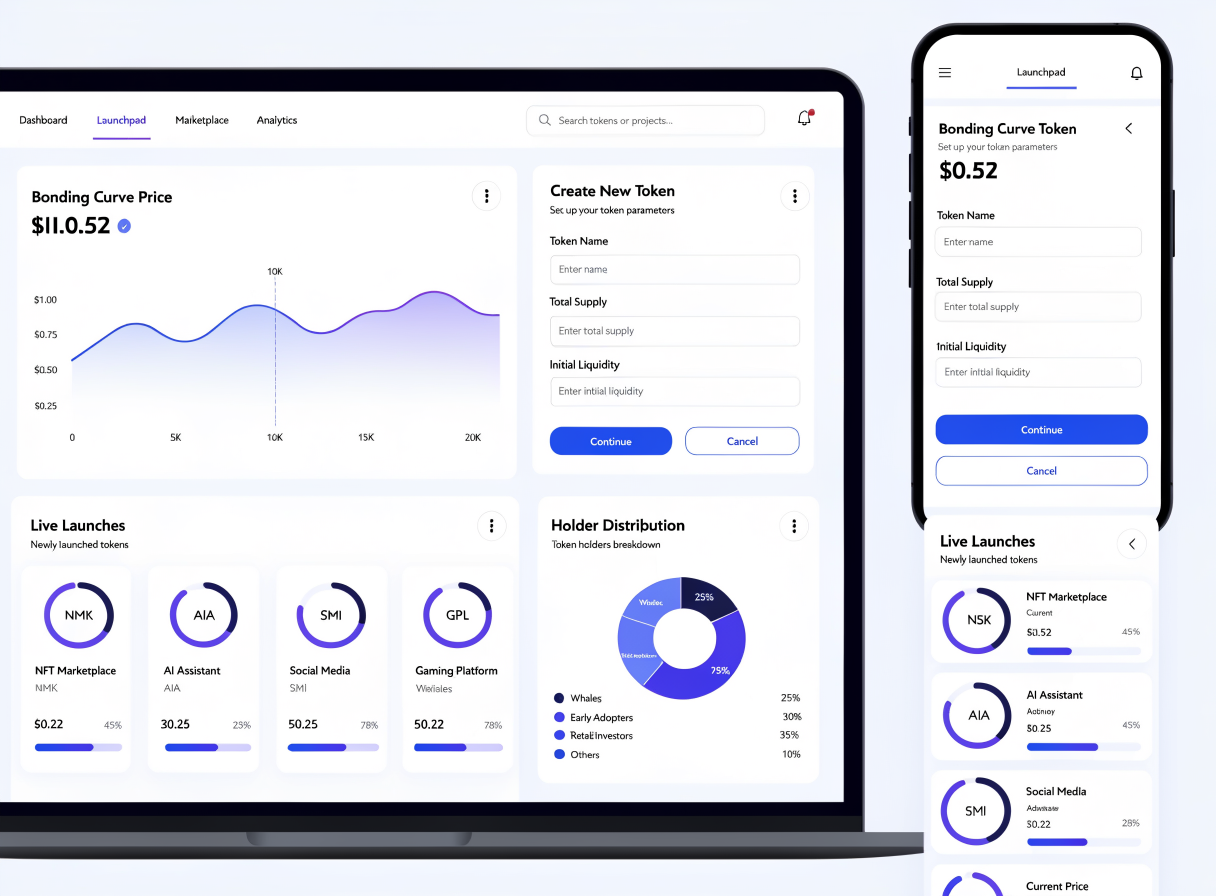
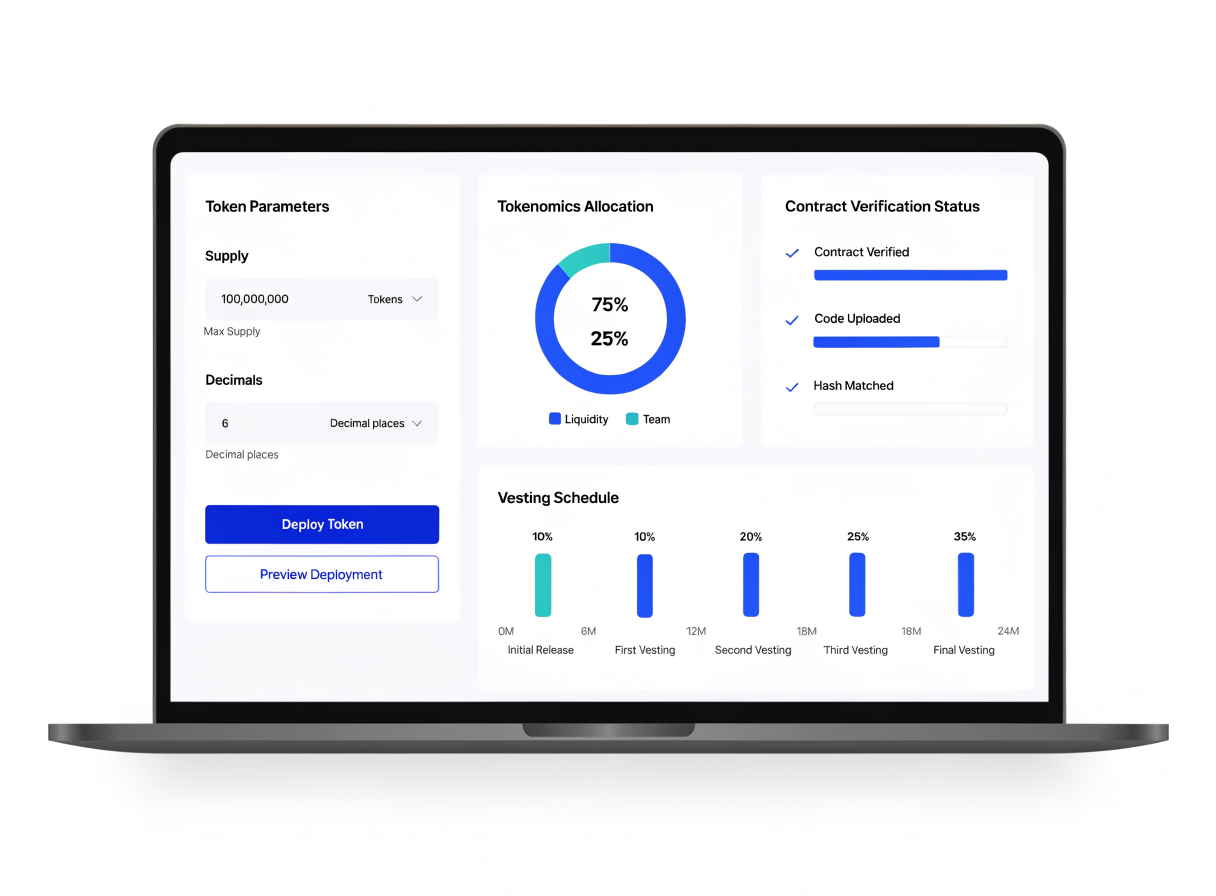
Reference concepts for an on-chain build — swap, liquidity and position surfaces. Not screenshots of a delivered client protocol; audited deployments are shown on a call.
How We Scope an MVP
Discovery
- Hypothesis definition: what question needs answering
- Success criteria agreed before building
- User and market assumption mapping
- Competitive and comparable review
- Technical feasibility assessment
- Regulatory constraint identification
Scoping
- One core flow selected and justified
- Explicit list of what is deliberately excluded
- Testnet versus mainnet decision
- Security requirements set by funds exposure
- Analytics plan tied to the hypothesis
- Extension path documented
Build
- Single flow built end to end properly
- Real key management where funds are involved
- Contract audit where value is held
- Usage instrumentation from day one
- Deployment with stage-appropriate monitoring
- Weekly demos against the hypothesis
Learning
- Usage data reviewed against success criteria
- Findings written up with a recommendation
- Options for continue, pivot or stop
- Roadmap for the validated direction
- Technical debt register with priorities
- Handover of everything built
Mapped to a release plan
We will send a scoped MVP proposal with the hypothesis, exclusions and success criteria stated.
Request a Feature PlanHow an MVP Is Structured
The modules above map onto these layers. Each one ships with its own tests, documentation and runbook, so nothing arrives as a black box you inherit without an explanation.
Requests flow down, settlement and events flow back up. Every boundary carries logging, so a failure is traceable to a layer instead of guessed at.
Chains and Standards We Deploy To
Each deployment is a separate audit surface, not a redeploy. Gas economics, MEV exposure and bridge assumptions differ per chain, and a contract that is safe on one can be attackable on another.
How We Run an MVP Engagement
Contracts and interface follow separate tracks with separate release gates, because one is permanent and the other is not.
Discovery and hypothesis
What you need to learn, what would count as success, and what would falsify it.
Output → written hypothesis with success criteria
Scoping
One flow selected, exclusions listed explicitly, security requirements set.
Output → MVP scope with a documented exclusion list
Build
The flow built end to end with real security and instrumentation.
Output → working product deployed with analytics live
Measure
Usage data gathered against the success criteria over an agreed window.
Output → findings report against the hypothesis
Decide
Continue, pivot or stop, with a roadmap for whichever you choose.
Output → recommendation and roadmap for the next phase
Chains we deploy to
Development Timeline
| Scope | Timeline | Includes |
|---|---|---|
| Proof of concept | 2 to 4 weeks | One technical question answered, testnet, no production users |
| Standard MVP | 5 to 8 weeks | One core flow, real security, analytics, live users |
| MVP with custody | 9 to 14 weeks | Real funds, audited contracts, key management, monitoring |
| Extended MVP programme | 4 to 7 months | Several validated flows built out into a product |
What extends the timeline: contract audit where the MVP holds real value, which is not skippable; the measurement window itself, which needs enough users to be meaningful; any compliance requirement that applies even at pilot scale; and security work, which scales with funds exposure rather than with feature count.
Revenue Models
| Model | How It Works |
|---|---|
| Faster time to revenue | A narrow product earning sooner than a broad one launching later |
| Reduced wasted build | Features validated before they are engineered at full quality |
| Investor evidence | A working product with usage data rather than a deck |
| Early customer contracts | Paid pilots signed against something real |
| Lower total cost | One focused build rather than a rebuild after the wrong bet |
| Clearer roadmap | Direction set by measured behaviour rather than opinion |
| Retained option value | Ability to change direction cheaply while it is still cheap |
Every fee is public and comparable on-chain, so pricing has a hard competitive ceiling. We build fee parameters as governable values rather than constants so they can be tuned without redeployment.
Related services
Who This Is For
Testing a hypothesis before committing to a full build.
Validating a blockchain use case with real evidence.
Testing whether an on-chain component adds value.
Needing a working product with usage data rather than a deck.
Testing a mechanism on testnet before mainnet economics.
Running a contained pilot before a wider rollout.
Why Choose Coinsclone
Hypothesis first
We ask what question the MVP answers, and decline to build one with no question.
Narrow scope, real quality
One flow properly built beats five loosely built, especially where funds are involved.
Security not deferred
Because a compromised MVP costs you the users you were learning from.
Testnet where possible
Cheaper and safer, and often sufficient to answer the question.
Built to extend
An MVP that must be thrown away is a prototype, and we would price it as one.
Findings written down
With a recommendation to continue, pivot or stop, including stop.
What Our Clients Say
Operators who launched with us, in their own words. Hover to pause.













A members-only NFT marketplace for Digital Freemasonry
 Digital Free MasonryNFT marketplace · delivered and live
Next phase in progress: the ODFT Token and the MasonicVerse platform.
Working with Coinsclone has been one of the best professional experiences I have had in the blockchain industry.
From the very beginning of our NFT Marketplace project until its successful completion, the entire team demonstrated exceptional technical expertise, professionalism, patience, and commitment. Every stage of development was handled with great attention to detail, and every challenge we encountered was approached with a solution-oriented mindset.
Read the full client note
Our project was far from a standard NFT Marketplace. It included custom blockchain architecture, Polygon integration, ERC-721 and ERC-1155 standards, royalty implementation, token-gated access through Masonic Passport, multiple payment methods, marketplace customization, advanced testing, and many unique business requirements. Throughout the entire process, the team consistently delivered high-quality work while maintaining clear communication, transparency, and a strong commitment to excellence.
I would especially like to express my sincere appreciation to Mr. Jeeva, Mr. Bala, Mr. Saravanan, Mr. Veeramani, Mr. Akshay, and the entire development team for their outstanding support, professionalism, responsiveness, and dedication throughout the project. Their technical expertise, patience, and willingness to understand even the most complex business requirements gave us complete confidence during every phase of development.
What impressed me the most was not only their excellent blockchain development skills, but also their ability to understand our vision and transform it into a secure, scalable, and highly professional NFT Marketplace.
For me, Coinsclone is not simply a software development company — they are a trusted long-term technology partner. After successfully completing our NFT Marketplace, we are now preparing to continue our collaboration on the next major phase of the Digital Freemasonry ecosystem, including the development of the ODFT Token and the future MasonicVerse platform.
I highly recommend Coinsclone to anyone looking for a reliable, experienced, and highly professional blockchain development company. They have earned my complete trust and respect, and I sincerely look forward to working with them again on future projects.
Start Your MVP Project
Tell us what you need to learn and we will respond with a scoped MVP proposal and success criteria.
- Hypothesis and success criteria agreed before building
- Security not deferred where funds are involved
- NDA signed before technical discussion
Request received
A solution architect will reply within one business day with a scoped proposal and demo link.
MVP Development: Frequently Asked Questions
What is an MVP?
The smallest working product that answers a specific question about whether your idea works. Not a demo, and not a feature-reduced version of the full vision.
How is a blockchain MVP different?
If it touches custody or moves value, security cannot be deferred. A compromised MVP costs you the users you were trying to learn from, so scope narrows while security stays real.
What is the difference between a proof of concept and an MVP?
A proof of concept answers a technical question, usually on testnet with no real users. An MVP puts a working flow in front of real users to test whether they want it.
How narrow should the scope be?
One core flow, built end to end. If you cannot name the single flow, the hypothesis is not clear enough yet, and that is worth resolving before any building.
Can we test on testnet instead of mainnet?
Often yes, and it is cheaper and safer. We will tell you when a hypothesis can be answered without real funds, which is more frequently than teams expect.
Do MVP contracts need an audit?
If they hold real value, yes. Contracts are immutable regardless of whether you call the deployment an MVP, and an exploit at pilot stage ends the pilot.
Will the MVP code be thrown away?
It should not be. We design an extension path so the MVP grows into the product. If throwaway code is genuinely the right choice, we say so and price it as a prototype.
How do you measure whether the MVP succeeded?
Against success criteria agreed before building, using instrumentation built in from day one. Without both, an MVP produces opinions rather than evidence.
What happens if the hypothesis is disproved?
You have learned something valuable at a fraction of the cost of a full build. We write up the findings and recommend pivot or stop, which is a legitimate outcome.
How much does an MVP cost?
It depends on the flow and on funds exposure, since security scales with the latter rather than with feature count. We quote after the discovery and scoping stage.
How long does an MVP take?
A proof of concept takes 2 to 4 weeks. A standard MVP takes 5 to 8 weeks. An MVP with real custody takes 9 to 14 weeks, and an extended programme 4 to 7 months.
Will we own the code?
Yes. Everything built transfers on delivery, including infrastructure configuration and documentation, running in your own accounts.
Estimate Your Build
Pick a scope and the extras you need. On a protocol build the audit and economic-modelling lines are the ones that move the timeline, and neither compresses safely.
{{ estSummary }}
Ranges assume decisions arrive on time. Licensing, banking and third-party audits run on their own schedules and we plan around them rather than inside them.
Get This Scoped ProperlyReady to Test Your Idea Properly?
Share what you need to learn and receive a scoped MVP proposal with hypothesis, exclusions, success criteria and timeline.