
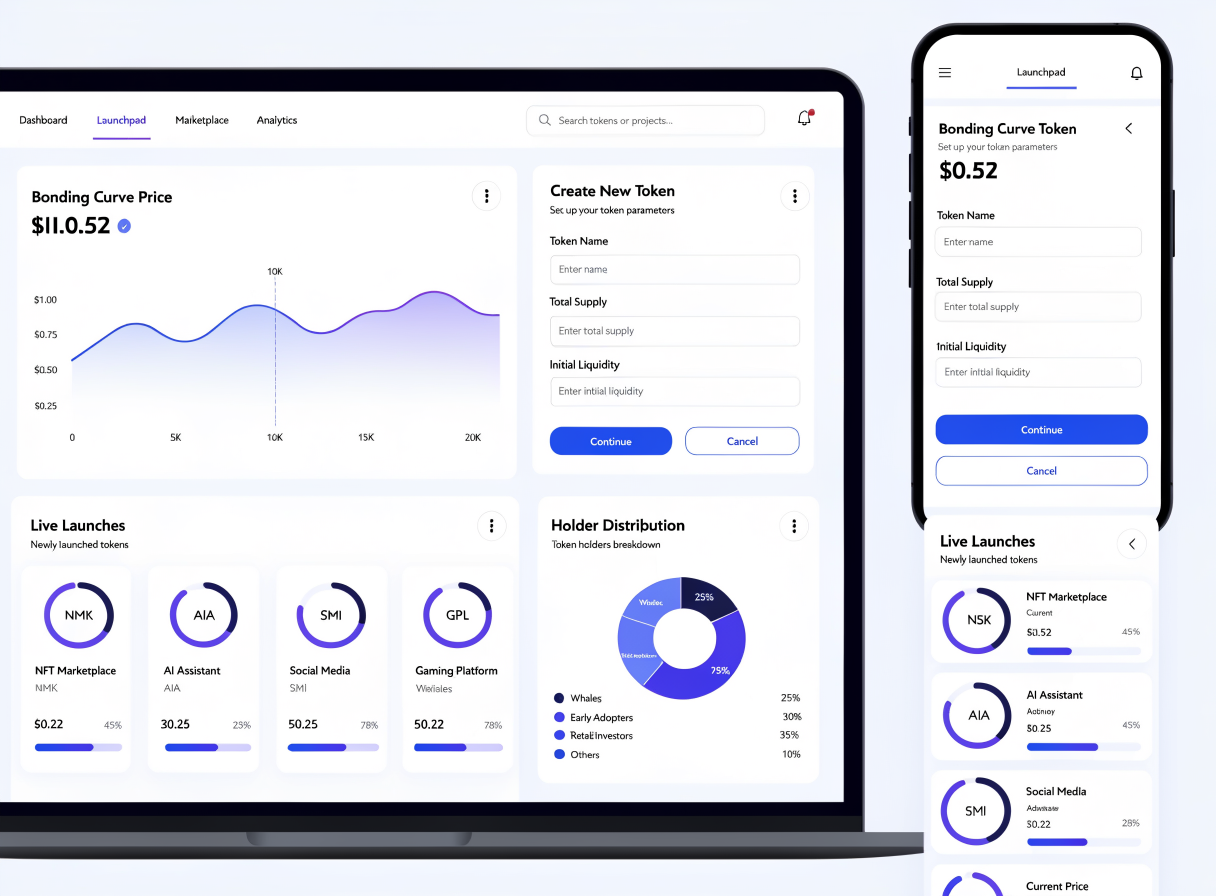
What Is IDO Development?
An IDO distributes a token through a decentralised exchange rather than a company-run sale page. Contributors interact with contracts directly, initial liquidity is seeded into a pool, and trading begins immediately afterwards — often within the same block.
That immediacy is the appeal and the problem. There is no gap between distribution and a liquid market, so anything unfair in the first minutes is permanent and visible on chain forever.
What You Receive
| Component | What It Covers |
|---|---|
| Sale contracts | Audited contribution and allocation logic with caps |
| Anti-bot mechanics | Sniping resistance for the first blocks of trading |
| Liquidity locking | Initial pool liquidity locked with a public unlock date |
| Vesting contracts | On-chain cliff and linear release for team and buyers |
| Launch sequencing | Ordered deployment so nothing is tradeable before it should be |
| Sale interface | Contribution, allocation and claim surfaces |
| Load testing | Sale flow validated at expected peak concurrency |
| Source code | Contracts, front end, scripts and documentation on delivery |
Share your launch plan and we will model the first hour of trading before you deploy.
Get a Free Live DemoThe First Block Decides How Your Launch Is Remembered
The moment liquidity is live, automated traders are watching the mempool. Without protection, bots buy the first block, front-run every early buyer, and sell into the people who arrived a minute later.
That outcome is entirely predictable and entirely preventable, but only before deployment. Anti-sniping mechanics, transaction limits in early blocks, private launch submission and locked liquidity have to exist in the contract at launch, not be added afterwards.
Anti-sniping in the contract transaction and wallet limits for the first blocks.
Private launch submission so the liquidity-add transaction is not visible in the mempool.
Liquidity locked publicly with a verifiable unlock date, because unlocked liquidity can be pulled.
Vesting on chain team allocation visibly locked rather than promised.
Trading enabled deliberately one switch, at a moment you control.
First hour modelled so you know what a bot would attempt and what it costs them.
We model the first hour of trading against realistic bot behaviour before deployment. A launch that gets sniped is remembered for that and nothing else, and it cannot be undone.
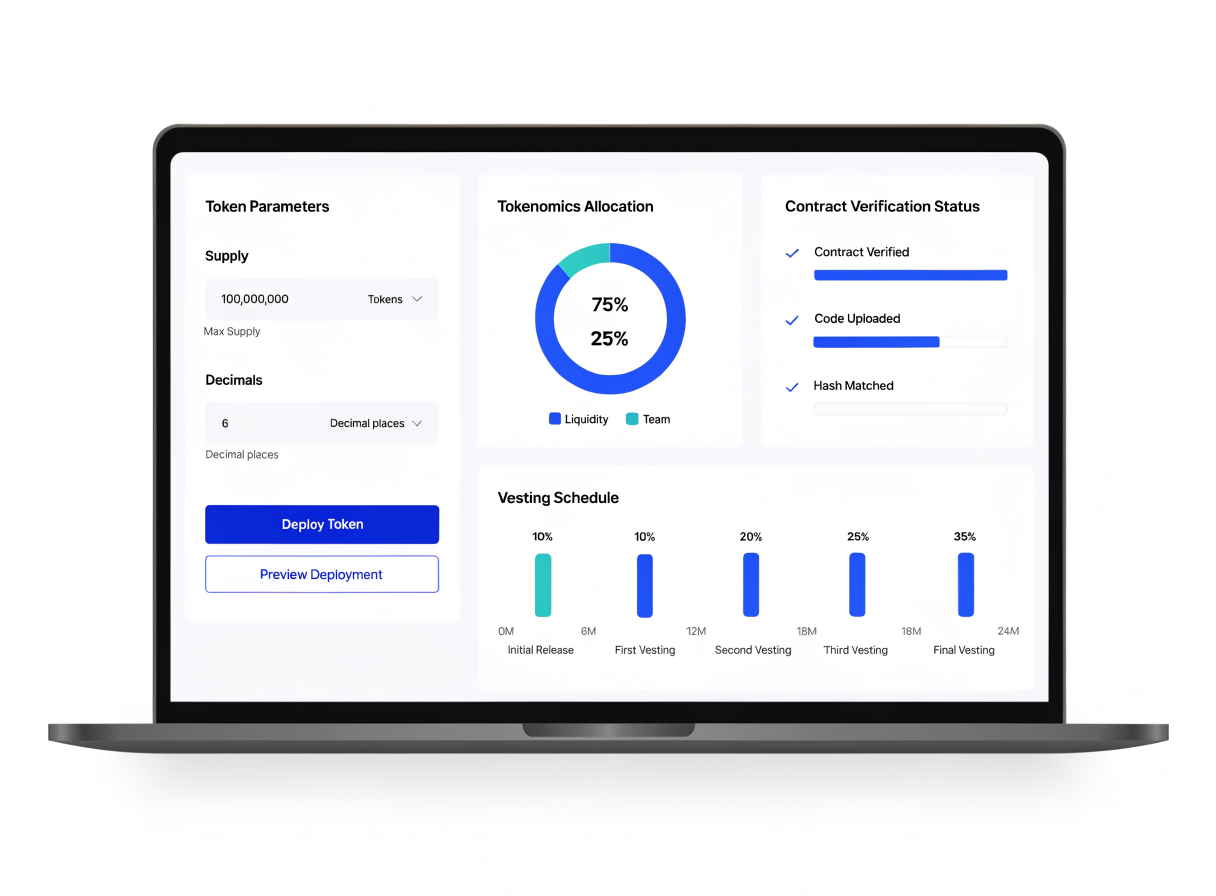
Surfaces This Scope Covers
Reference concepts for an on-chain build — swap, liquidity and position surfaces. Not screenshots of a delivered client protocol; audited deployments are shown on a call.
Core Features
Launch Mechanics
- Fair-launch contribution with per-wallet caps
- Whitelist and tier-based allocation
- Overflow handling with proportional refunds
- Multiple sale rounds with independent pricing
- Bonding curve options
- Time-boxed windows with public countdowns
- Trading enable switch under your control
Anti-Bot and Fairness
- Transaction and wallet limits in early blocks
- Private submission of the liquidity-add transaction
- Cooldown between buys during launch window
- Blacklist capability for identified sniper contracts
- Gradual limit relaxation over defined blocks
- Public disclosure of every protection in use
Liquidity and Vesting
- Initial pool seeding with configurable ratio
- Liquidity locked with public unlock date
- On-chain vesting for team, advisors and buyers
- Per-tranche claim flows
- Public verification of locked supply
- Emergency pause that never blocks earned claims
Platform and Safety
- Independent audit before deployment
- Load testing at expected peak concurrency
- Launch runbook with sequencing and rollback points
- Monitoring on pool depth, price and large transactions
- Multisig treasury with timelocked withdrawal
- Post-launch analytics on holder distribution
Mapped to a release plan
We will send a launch architecture, anti-bot plan and audit approach with a delivery timeline.
Request a Feature PlanHow IDO Infrastructure Is Put Together
The modules above map onto these layers. Each one ships with its own tests, documentation and runbook, so nothing arrives as a black box you inherit without an explanation.
Requests flow down, settlement and events flow back up. Every boundary carries logging, so a failure is traceable to a layer instead of guessed at.
Chains and Standards We Deploy To
Each deployment is a separate audit surface, not a redeploy. Gas economics, MEV exposure and bridge assumptions differ per chain, and a contract that is safe on one can be attackable on another.
How We Build Your Launch
Contracts and interface follow separate tracks with separate release gates, because one is permanent and the other is not.
Launch design and modelling
Sale structure, allocation, liquidity ratio and adversarial modelling of the first hour.
Output → launch plan with bot scenario analysis
Tokenomics and vesting
Supply, allocation and unlock schedule modelled against expected pool depth.
Output → tokenomics model with unlock analysis
Contract development
Sale, protection, liquidity lock and vesting contracts with full coverage.
Output → contract suite with test reports
Independent audit
Third-party review of contribution, protection and vesting paths.
Output → audit report with findings resolved
Launch execution
Sequenced deployment, private liquidity add, monitoring and support.
Output → completed launch with liquidity locked and monitoring live
Chains we deploy to
Development Timeline
| Scope | Timeline | Includes |
|---|---|---|
| Standard IDO | 4 to 7 weeks | Sale contract, anti-bot, liquidity lock, vesting, audit |
| IDO with tiered rounds | 8 to 12 weeks | Multiple rounds, whitelist tiers, dashboard, audit |
| IDO with governance | 3 to 5 months | Post-launch governance, treasury, staking |
| Multi-chain launch | 5 to 9 months | Several chains, cross-chain liquidity, full token programme |
What extends the timeline: independent audit, since sale and protection contracts cannot be patched after deployment; adversarial modelling of launch behaviour; load testing before the window opens; and coordination with the DEX and any launchpad partner, which runs on their schedule.
Revenue Models
| Model | How It Works |
|---|---|
| Capital raised | The primary purpose, allocated per your published plan |
| Trading fee accrual | Fees earned on protocol-owned liquidity positions |
| Treasury yield | Returns on unspent proceeds held in the treasury |
| Protocol fees post-launch | Revenue from whatever the token funds |
| Staking participation | Value from holders locking rather than selling |
| Listing access | Exchange and partnership opportunities after a clean launch |
| Governance value | Influence over treasury deployment held by holders |
Every fee is public and comparable on-chain, so pricing has a hard competitive ceiling. We build fee parameters as governable values rather than constants so they can be tuned without redeployment.
Related services
Who This Is For
Launching a token with immediate DEX liquidity.
Distributing governance supply to an active community.
Launching an in-ecosystem token fairly.
Bootstrapping treasury and distribution simultaneously.
Running native launches with credible protections.
Adding liquidity on a new chain properly.
Why Choose Coinsclone
First hour modelled adversarially
We simulate what bots attempt and what it costs them before you deploy.
Protection in the contract
Transaction limits and cooldowns at launch, since they cannot be added afterwards.
Liquidity locked publicly
With a verifiable unlock date, because unlocked liquidity can be withdrawn.
Private liquidity submission
So the add transaction is not visible in the mempool before it lands.
Vesting verifiable
Team allocation locked on chain rather than described in a document.
Full source code ownership
Contracts, front end, scripts and documentation transfer on delivery.
What Our Clients Say
Operators who launched with us, in their own words. Hover to pause.














A members-only NFT marketplace for Digital Freemasonry
 Digital Free MasonryNFT marketplace · delivered and live
Next phase in progress: the ODFT Token and the MasonicVerse platform.
Working with Coinsclone has been one of the best professional experiences I have had in the blockchain industry.
From the very beginning of our NFT Marketplace project until its successful completion, the entire team demonstrated exceptional technical expertise, professionalism, patience, and commitment. Every stage of development was handled with great attention to detail, and every challenge we encountered was approached with a solution-oriented mindset.
Read the full client note
Our project was far from a standard NFT Marketplace. It included custom blockchain architecture, Polygon integration, ERC-721 and ERC-1155 standards, royalty implementation, token-gated access through Masonic Passport, multiple payment methods, marketplace customization, advanced testing, and many unique business requirements. Throughout the entire process, the team consistently delivered high-quality work while maintaining clear communication, transparency, and a strong commitment to excellence.
I would especially like to express my sincere appreciation to Mr. Jeeva, Mr. Bala, Mr. Saravanan, Mr. Veeramani, Mr. Akshay, and the entire development team for their outstanding support, professionalism, responsiveness, and dedication throughout the project. Their technical expertise, patience, and willingness to understand even the most complex business requirements gave us complete confidence during every phase of development.
What impressed me the most was not only their excellent blockchain development skills, but also their ability to understand our vision and transform it into a secure, scalable, and highly professional NFT Marketplace.
For me, Coinsclone is not simply a software development company — they are a trusted long-term technology partner. After successfully completing our NFT Marketplace, we are now preparing to continue our collaboration on the next major phase of the Digital Freemasonry ecosystem, including the development of the ODFT Token and the future MasonicVerse platform.
I highly recommend Coinsclone to anyone looking for a reliable, experienced, and highly professional blockchain development company. They have earned my complete trust and respect, and I sincerely look forward to working with them again on future projects.
Start Your IDO Project
Tell us your launch plan and target chain and we will respond with a launch architecture and delivery timeline.
- First hour modelled against realistic bot behaviour
- Initial liquidity locked with a public unlock date
- NDA signed before technical discussion
Request received
A solution architect will reply within one business day with a scoped proposal and demo link.
IDO Development Company: Frequently Asked Questions
What is IDO development?
Building the infrastructure for a token launch on a decentralised exchange: sale contracts, anti-bot protection, initial liquidity seeding and locking, and on-chain vesting.
How does an IDO differ from an ICO?
An ICO is a company-run sale with tokens distributed before trading. An IDO distributes through a DEX with trading live immediately, which removes the gap where problems could be fixed.
What is sniping and why does it matter?
Bots monitoring the mempool buy the first block of a new pool, then sell into buyers arriving minutes later. Without protection it happens on nearly every unprotected launch, and it is permanent on chain.
How is sniping prevented?
Transaction and wallet limits during the first blocks, cooldowns between buys, private submission of the liquidity-add transaction, and a trading-enable switch you control rather than an automatic start.
Why must initial liquidity be locked?
Because unlocked liquidity can be withdrawn by whoever controls it, which is the mechanism behind most rug pulls. Locking with a public unlock date is what makes the launch credible.
Should team tokens vest on chain?
Yes. A team allocation described as locked in a document is not locked. On-chain vesting with a public schedule is verifiable by anyone considering buying.
How is the liquidity ratio decided?
From expected volume and the price impact you can tolerate. Too little liquidity means violent price movement on small trades; too much locks capital that could fund development.
Can we run multiple sale rounds?
Yes, with independent pricing, caps and whitelists per round, and clearly published terms for each so later buyers understand what earlier ones paid.
Do you audit the contracts?
Yes, independently, covering contribution, protection, liquidity lock and vesting paths. None of it can be patched after deployment, so review happens before.
What happens if the sale oversubscribes?
Overflow is refunded proportionally or capped per wallet, by a rule published before the sale rather than decided during it.
How long does an IDO build take?
A standard IDO takes 4 to 7 weeks. Tiered rounds take 8 to 12 weeks. Adding governance takes 3 to 5 months, and a multi-chain launch 5 to 9 months.
Will we own the contracts?
Yes. Sale, protection, liquidity lock and vesting contracts, front end and deployment scripts transfer on delivery, deployed under your own keys and multisig.
Estimate Your Build
Pick a scope and the extras you need. On a protocol build the audit and economic-modelling lines are the ones that move the timeline, and neither compresses safely.
{{ estSummary }}
Ranges assume decisions arrive on time. Licensing, banking and third-party audits run on their own schedules and we plan around them rather than inside them.
Get This Scoped ProperlyReady to Launch Your Token?
Share your launch plan and target chain and receive a launch architecture, anti-bot plan, tokenomics review and delivery timeline.