
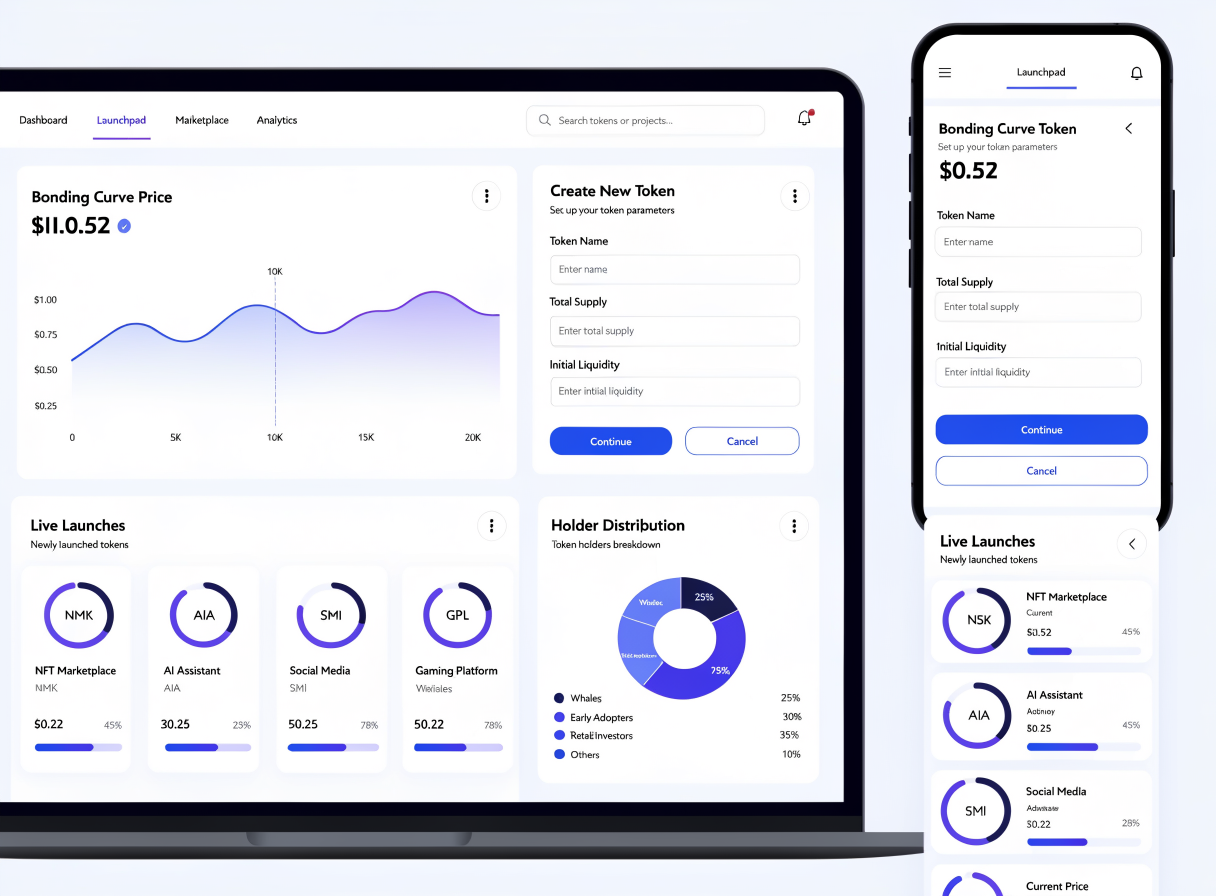
What Is ICO Development?
ICO development builds the machinery of a public token sale: the contract that accepts contributions and allocates tokens, the verification layer deciding who may participate, the pricing and cap logic, and the vesting schedule releasing tokens over time.
It is the seam where other people money meets your code, under regulatory attention, usually in a single compressed window. Contracts are immutable, the sale cannot be re-run, and a mistake in allocation or refund logic is public within minutes.
What You Receive
| Component | What It Covers |
|---|---|
| Sale contracts | Audited contribution, allocation and claim logic with caps |
| Compliance gating | KYC and jurisdiction restriction enforced before contribution |
| Pricing engine | Tiered, time-based or bonding curve pricing as scoped |
| Refund conditions | Defined circumstances where contributions return automatically |
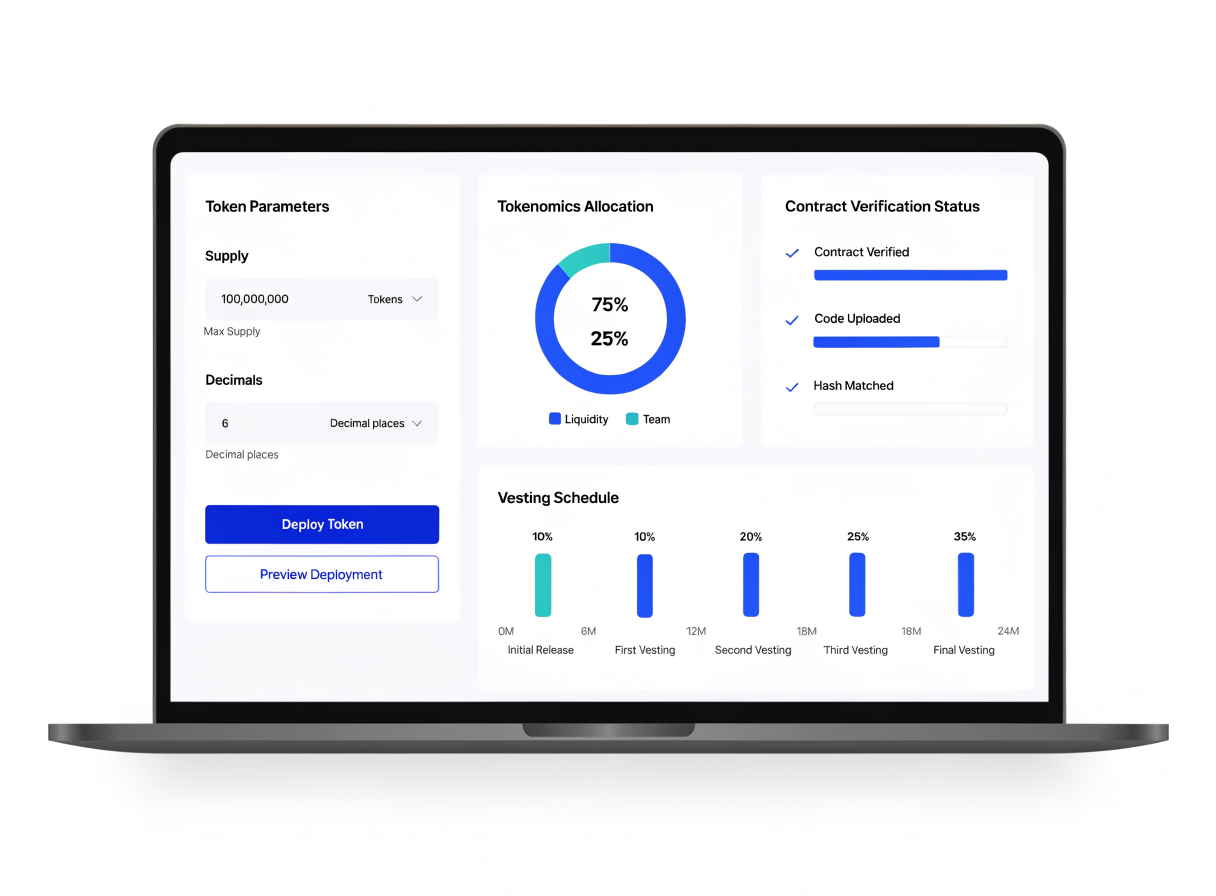
| Vesting contracts | On-chain cliff and linear release, verifiable by anyone |
| Treasury setup | Multisig control with timelocked withdrawal |
| Sale dashboard | Live progress, contribution history and claim interface |
| Source code | Contracts, front end, scripts and documentation on delivery |
Share your raise structure and we will map compliance requirements before any contract is written.
Get a Free Live DemoA Token Sale Is a Securities Question Before It Is a Code Question
How you structure a sale — what buyers are promised, how proceeds are used, whether returns are implied — determines whether it is treated as a securities offering in the jurisdictions your buyers live in. That is a legal analysis, not a technical one.
The engineering consequence is real. If your counsel concludes you must restrict certain countries, verify accreditation or impose transfer restrictions, those become contract-level requirements. Retrofitting them after the sale is not possible.
Legal structure first because it determines what the contract must enforce.
Jurisdiction gating in the contract not just a checkbox in the interface.
Accreditation checks where required enforced before contribution rather than after.
Transfer restrictions where mandated built into the token, not promised in a document.
Proceeds use documented because implied returns change the legal analysis.
Refund paths defined before the sale, when they are still enforceable.
We will not start contract work before your counsel has given a view on structure. Building a sale contract and then discovering it must restrict half its buyers is an expensive way to learn this.
Surfaces This Scope Covers
Reference concepts for an on-chain build — swap, liquidity and position surfaces. Not screenshots of a delivered client protocol; audited deployments are shown on a call.
Core Features
Sale Mechanics
- Tiered pricing with time or volume-based rounds
- Soft cap, hard cap and per-wallet limits
- Multi-currency and stablecoin contribution
- Bonding curve and dutch auction options
- Overflow handling with proportional refunds
- Whitelist and allowlist enforcement
- Time-boxed rounds with public countdowns
Compliance and Access
- KYC and identity verification before contribution
- Jurisdiction blocking enforced at contract level
- Accreditation verification where required
- Sanctions and PEP screening
- Contribution source-of-funds checks
- Audit trail of every verification decision
Vesting and Claims
- On-chain vesting with cliff and linear release
- Per-tranche claim flows for contributors
- Team and advisor vesting on the same rails
- Vesting schedule public before contribution
- Emergency pause that never blocks earned claims
- Public verification of remaining locked supply
Treasury and Governance
- Multisig treasury with timelocked withdrawal
- Proceeds allocation documented and reported
- Deployer keys transferred to your own multisig
- Governance hooks for post-sale parameter changes
- Public treasury reporting
- Independent audit before mainnet deployment
Mapped to a release plan
We will send a sale architecture, compliance mapping and audit plan with a delivery timeline.
Request a Feature PlanHow ICO Infrastructure Is Put Together
The modules above map onto these layers. Each one ships with its own tests, documentation and runbook, so nothing arrives as a black box you inherit without an explanation.
Requests flow down, settlement and events flow back up. Every boundary carries logging, so a failure is traceable to a layer instead of guessed at.
Chains and Standards We Deploy To
Each deployment is a separate audit surface, not a redeploy. Gas economics, MEV exposure and bridge assumptions differ per chain, and a contract that is safe on one can be attackable on another.
How We Build Your Sale
Contracts and interface follow separate tracks with separate release gates, because one is permanent and the other is not.
Structure and compliance scoping
Sale model, jurisdictions, verification depth and transfer restrictions, with your counsel.
Output → compliance matrix and sale specification
Token economics modelling
Supply, allocation, pricing tiers and unlock schedule against realistic liquidity.
Output → tokenomics model with unlock analysis
Contract development
Sale, vesting and treasury contracts with invariant and fuzz coverage.
Output → contract suite with test reports
Independent audit
Third-party review of contribution, allocation and vesting paths.
Output → audit report with findings resolved
Launch and post-sale
Deployment, live monitoring, claim support and treasury handover.
Output → completed sale with treasury under your multisig
Chains we deploy to
Development Timeline
| Scope | Timeline | Includes |
|---|---|---|
| Standard token sale | 5 to 8 weeks | Sale contract, KYC gating, vesting, audit |
| Sale with tiered rounds | 9 to 13 weeks | Multiple rounds, custom pricing, dashboard, audit |
| Compliance-heavy sale | 4 to 6 months | Transfer restrictions, accreditation, multi-jurisdiction |
| Full token programme | 6 to 10 months | Sale plus governance, treasury, staking and listing support |
What extends the timeline: legal structuring with your counsel, which gates everything else; independent audit of contribution and vesting contracts, which hold contributor funds; compliance provider integration for verification and screening; and load testing before the sale opens, since a sale is a single event.
Revenue Models
| Model | How It Works |
|---|---|
| Capital raised | The primary purpose, allocated per your published plan |
| Treasury yield | Returns on unspent proceeds held in the treasury |
| Protocol fees post-launch | Revenue from whatever the token funds |
| Staking participation | Value from holders locking rather than selling |
| Listing and partnership value | Access created by a successfully executed raise |
| Secondary market depth | Liquidity supporting the token after the sale |
| Governance value | Influence over treasury deployment held by token holders |
Every fee is public and comparable on-chain, so pricing has a hard competitive ceiling. We build fee parameters as governable values rather than constants so they can be tuned without redeployment.
Related services
Who This Is For
Funding development with a public token distribution.
Raising from a community rather than only from funds.
Adding a token layer to an established product.
Distributing governance supply through a public sale.
Funding a native token launch with proper controls.
Running a compliant sale with verification and restrictions.
Why Choose Coinsclone
Legal structure leads
We do not start contract work before your counsel has given a view on structure.
Compliance enforced in contracts
Jurisdiction gating and restrictions at contract level, not just interface checks.
Vesting on chain
Public and verifiable, because a promised lockup is not a lockup.
Unlock schedules modelled
Against realistic liquidity, since a cliff bigger than the market is a scheduled price event.
Treasury under your multisig
Deployer keys transferred to you with timelocked controls.
Independently audited
Contribution, allocation and vesting paths reviewed before mainnet.
What Our Clients Say
Operators who launched with us, in their own words. Hover to pause.













A members-only NFT marketplace for Digital Freemasonry
 Digital Free MasonryNFT marketplace · delivered and live
Next phase in progress: the ODFT Token and the MasonicVerse platform.
Working with Coinsclone has been one of the best professional experiences I have had in the blockchain industry.
From the very beginning of our NFT Marketplace project until its successful completion, the entire team demonstrated exceptional technical expertise, professionalism, patience, and commitment. Every stage of development was handled with great attention to detail, and every challenge we encountered was approached with a solution-oriented mindset.
Read the full client note
Our project was far from a standard NFT Marketplace. It included custom blockchain architecture, Polygon integration, ERC-721 and ERC-1155 standards, royalty implementation, token-gated access through Masonic Passport, multiple payment methods, marketplace customization, advanced testing, and many unique business requirements. Throughout the entire process, the team consistently delivered high-quality work while maintaining clear communication, transparency, and a strong commitment to excellence.
I would especially like to express my sincere appreciation to Mr. Jeeva, Mr. Bala, Mr. Saravanan, Mr. Veeramani, Mr. Akshay, and the entire development team for their outstanding support, professionalism, responsiveness, and dedication throughout the project. Their technical expertise, patience, and willingness to understand even the most complex business requirements gave us complete confidence during every phase of development.
What impressed me the most was not only their excellent blockchain development skills, but also their ability to understand our vision and transform it into a secure, scalable, and highly professional NFT Marketplace.
For me, Coinsclone is not simply a software development company — they are a trusted long-term technology partner. After successfully completing our NFT Marketplace, we are now preparing to continue our collaboration on the next major phase of the Digital Freemasonry ecosystem, including the development of the ODFT Token and the future MasonicVerse platform.
I highly recommend Coinsclone to anyone looking for a reliable, experienced, and highly professional blockchain development company. They have earned my complete trust and respect, and I sincerely look forward to working with them again on future projects.
Start Your Token Sale Project
Tell us your raise structure and target jurisdictions and we will respond with a compliance mapping and delivery timeline.
- Compliance requirements mapped before contract work
- Vesting enforced on chain, verifiable by buyers
- NDA signed before technical discussion
Request received
A solution architect will reply within one business day with a scoped proposal and demo link.
ICO Development Company: Frequently Asked Questions
What is ICO development?
Building the machinery of a public token sale: audited contribution contracts, verification gating, pricing and cap logic, refund conditions and on-chain vesting that releases tokens over time.
Is an ICO legal?
It depends entirely on structure and jurisdiction. How buyers are solicited, what they are promised and how proceeds are used all affect whether a sale is treated as a securities offering. Your counsel determines this before we build.
Why does legal structure affect the code?
Because restrictions have to be enforced somewhere. If your counsel requires jurisdiction blocking, accreditation checks or transfer restrictions, those become contract-level requirements that cannot be retrofitted after the sale.
How is KYC handled?
Verification happens before contribution is possible, gated at contract level via allowlists rather than only in the interface, with an audit trail of every verification decision retained.
Can contributions be refunded?
Where refund conditions are defined in advance, such as a soft cap being missed. Conditions written into the contract before the sale are enforceable; anything negotiated afterwards is not.
Why must vesting be on chain?
Because a promised lockup is not a lockup. On-chain vesting with cliffs and linear release is verifiable by anyone, including buyers deciding whether to participate.
How should unlock schedules be designed?
Modelled against realistic liquidity depth. A cliff that releases more supply than the market can absorb is a price event you scheduled yourself, months in advance.
Who controls the proceeds?
You do, through a multisig treasury with timelocked withdrawal. Deployer keys transfer to your own multisig, and we retain no access after handover.
Do you audit the contracts?
Yes, independently, focused on contribution, allocation, refund and vesting paths. The contracts hold contributor funds and cannot be patched after deployment.
What happens if the sale oversubscribes?
Overflow is refunded proportionally or capped per wallet, according to a rule defined and published before the sale rather than decided under pressure.
How long does an ICO build take?
A standard sale takes 5 to 8 weeks. Tiered rounds take 9 to 13 weeks. A compliance-heavy sale takes 4 to 6 months, and a full token programme 6 to 10 months.
Will we own the contracts?
Yes. Sale, vesting and treasury contracts, front end, deployment scripts and documentation transfer on delivery, deployed under your own keys and multisig.
Estimate Your Build
Pick a scope and the extras you need. On a protocol build the audit and economic-modelling lines are the ones that move the timeline, and neither compresses safely.
{{ estSummary }}
Ranges assume decisions arrive on time. Licensing, banking and third-party audits run on their own schedules and we plan around them rather than inside them.
Get This Scoped ProperlyReady to Run Your Token Sale?
Share your raise structure and target jurisdictions and receive a compliance mapping, tokenomics review, audit plan and delivery timeline.