
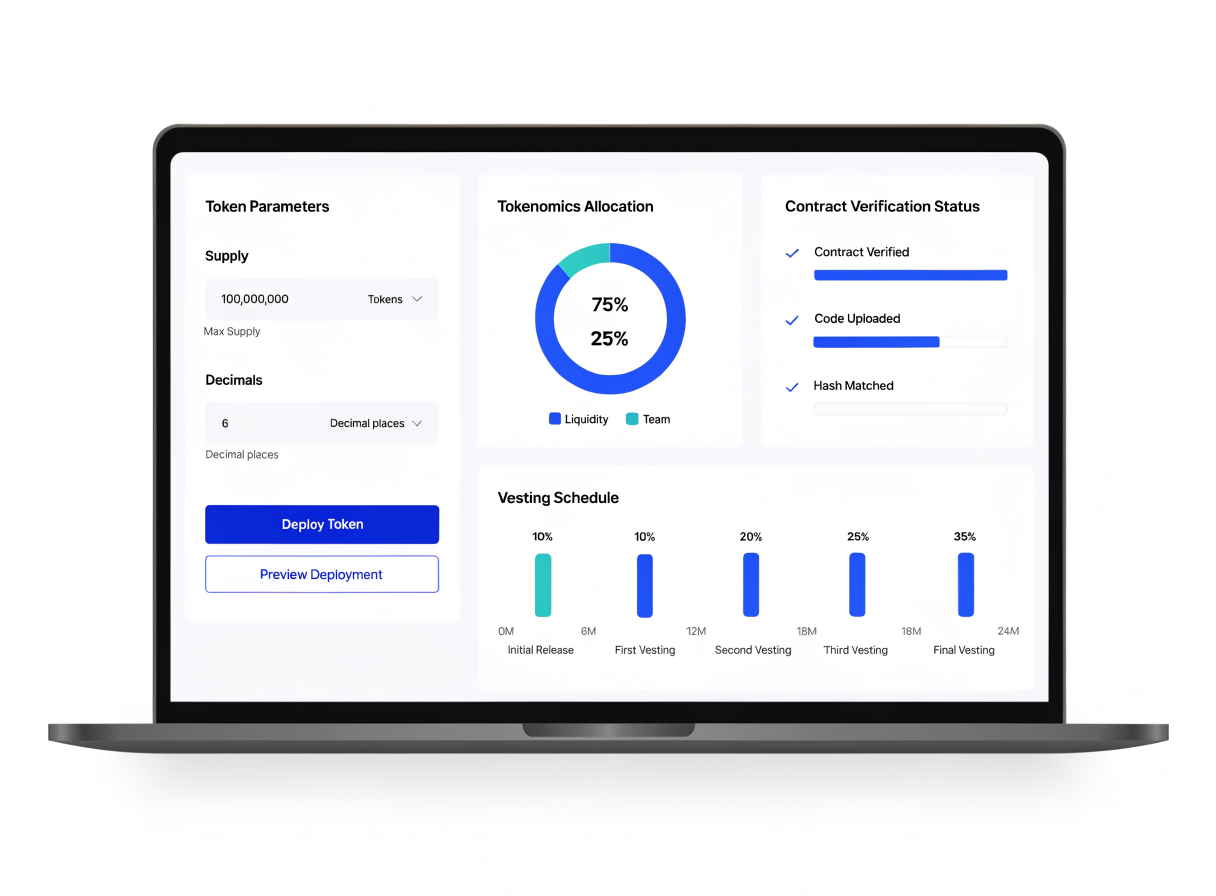
What Is Ethereum Smart Contract Development?
A smart contract is code deployed to a public chain that executes automatically and holds value. Development covers specifying what it must guarantee, implementing it in Solidity, testing those guarantees adversarially, measuring gas cost, and getting it independently reviewed before it is deployed.
What makes it different from ordinary backend work is finality. There is no hotfix on a Monday morning, no gradual rollout limiting damage, and no support team who can reverse a transaction. The code does what it does, immediately and publicly.
What You Receive
| Component | What It Covers |
|---|---|
| Contract implementation | Solidity source with documented interfaces and behaviour |
| Invariant specification | The properties that must always hold, written down explicitly |
| Test suite | Unit, integration, invariant and fuzz tests with coverage reports |
| Gas analysis | Measured cost per function at realistic input sizes |
| Deployment scripts | Reproducible deployment with verification on block explorers |
| Upgrade design | Where required, timelocked and scoped rather than open-ended |
| Audit coordination | Independent review with remediation and retest managed |
| Documentation | Technical docs and runbooks for whoever operates it next |
Share your specification and we will return the invariants and an audit plan before writing code.
Get a Free Live DemoTest Cases Prove Nothing. Invariants Prove Something.
Most contract test suites check examples: deposit 100, withdraw 100, assert the balance. That verifies the paths the author thought of, which is exactly the set of paths an attacker is not using.
Invariant testing inverts this. You state a property that must hold in every reachable state — solvency never violated, total shares always matching total assets — and then fuzz thousands of random operation sequences trying to break it. That finds the states nobody imagined.
Invariants written first before implementation, because they define what correct means.
Fuzzing across the state space random sequences rather than the paths the author considered.
Reentrancy modelled explicitly on every external call, not assumed safe.
Arithmetic checked at bounds rounding direction chosen deliberately, not left to chance.
Access control enumerated every privileged function and who can call it, listed.
Upgrade paths scoped timelocked and limited, because upgradeability is an attack surface.
We write the invariants before the implementation and hand them to the auditor alongside the code. If we cannot state what a contract guarantees, we do not yet understand it well enough to deploy it.
Surfaces This Scope Covers
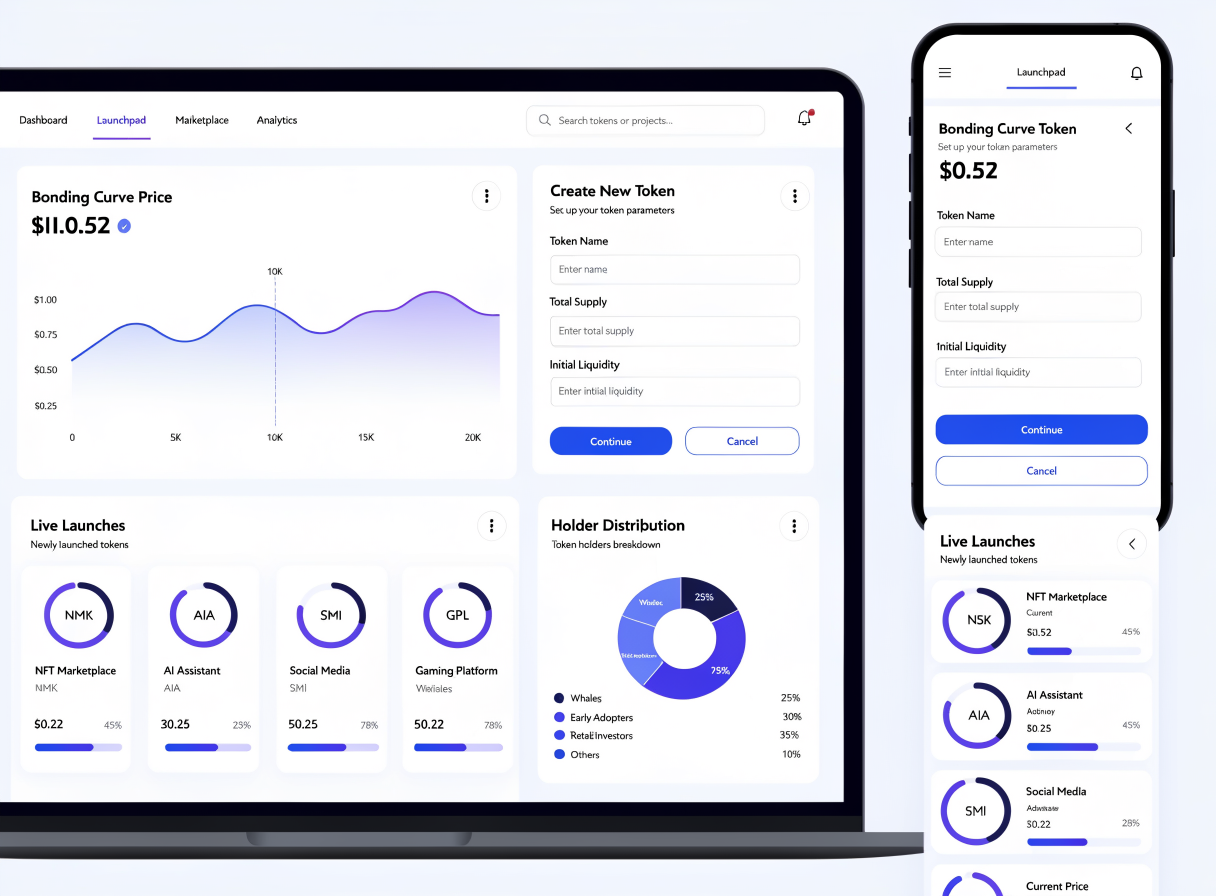
Reference concepts for an on-chain build — swap, liquidity and position surfaces. Not screenshots of a delivered client protocol; audited deployments are shown on a call.
What We Build
Token and Asset Contracts
- ERC20 with configurable supply and access control
- ERC721 and ERC721A for unique assets
- ERC1155 for semi-fungible items
- ERC1400 and ERC3643 for restricted transfer
- ERC4626 tokenised vaults
- Soulbound and non-transferable credentials
- Permit and gasless approval patterns
DeFi Primitives
- AMM pools with constant product or concentrated liquidity
- Lending markets with interest rate models
- Liquidation engines with partial liquidation
- Staking and reward accounting systems
- Vesting and escrow contracts
- Oracle integration with staleness handling
Governance and Treasury
- On-chain voting with delegation
- Timelock controllers with scoped permissions
- Multisig treasury integration
- Vote-escrow and time-weighted voting
- Proposal execution with simulation
- Emergency pause and guardian patterns
Quality and Safety
- Invariant and fuzz testing with Foundry
- Gas profiling at realistic input sizes
- Static analysis and linting in CI
- Independent audit coordination and remediation
- Deployment verification on block explorers
- Monitoring and alerting after deployment
Mapped to a release plan
We will send a contract architecture, invariant specification and audit plan with a delivery timeline.
Request a Feature PlanHow Contract Work Is Structured
The modules above map onto these layers. Each one ships with its own tests, documentation and runbook, so nothing arrives as a black box you inherit without an explanation.
Requests flow down, settlement and events flow back up. Every boundary carries logging, so a failure is traceable to a layer instead of guessed at.
Chains and Standards We Deploy To
Each deployment is a separate audit surface, not a redeploy. Gas economics, MEV exposure and bridge assumptions differ per chain, and a contract that is safe on one can be attackable on another.
How We Build Your Contracts
Contracts and interface follow separate tracks with separate release gates, because one is permanent and the other is not.
Specification and invariants
What the contract must do, and the properties that must never be violated.
Output → written specification with stated invariants
Implementation
Solidity written against the specification with tests developed alongside.
Output → contract source with unit and integration tests
Adversarial testing
Invariant fuzzing, fork testing against live state, and gas profiling.
Output → test reports with coverage and gas analysis
Independent audit
Third-party review, remediation, retest and optional second audit.
Output → audit reports with findings resolved
Deployment and handover
Scripted deployment, explorer verification, monitoring and documentation.
Output → deployed verified contracts with runbooks
Chains we deploy to
Development Timeline
| Scope | Timeline | Includes |
|---|---|---|
| Standard token contract | 2 to 3 weeks | Implementation, tests, gas analysis, audit |
| DeFi primitive | 6 to 10 weeks | Custom mechanism, invariant testing, audit cycle |
| Protocol contract suite | 3 to 5 months | Several interacting contracts, governance, multi-audit |
| Complex protocol | 5 to 9 months | Novel mechanism, formal verification, staged deployment |
What extends the timeline: independent audit and remediation, which is never compressed on contracts holding value; invariant test development, which takes longer than example tests and finds more; fork testing against live chain state; and staged deployment with caps rather than a full launch on day one.
Revenue Models
| Model | How It Works |
|---|---|
| Protocol fee capture | Fees routed through contracts you deploy and control |
| Transaction fee share | A cut of activity flowing through your contracts |
| Licensing to integrators | Charges to other protocols building on your contracts |
| Treasury deployment | Yield on protocol-owned assets and liquidity |
| Subscription access | Recurring charges for gated contract functionality |
| Governance value capture | Fees directed by token holders to stakers or treasury |
| Reduced operational cost | Automation replacing manual settlement and reconciliation |
Every fee is public and comparable on-chain, so pricing has a hard competitive ceiling. We build fee parameters as governable values rather than constants so they can be tuned without redeployment.
Related services
Who This Is For
Building or extending on-chain financial primitives.
Needing contracts that will hold value indefinitely.
Replacing contracts that failed audit or outgrew their design.
Putting settlement or provenance logic on chain.
Governance, treasury and proposal execution contracts.
Vault and strategy contracts with strict accounting.
Why Choose Coinsclone
Invariants before implementation
Because a contract you cannot state guarantees for is one you do not understand yet.
Fuzz testing, not example testing
Random operation sequences across the state space find what example tests miss.
Gas measured at real sizes
Profiled at the input sizes users will actually use, not at minimums.
Upgrades scoped and timelocked
Upgradeability is an attack surface, so it is limited rather than open-ended.
Audit coordinated and remediated
Findings resolved and retested rather than delivered as a report.
Full source code ownership
Contracts, tests, scripts and documentation transfer on delivery.
What Our Clients Say
Operators who launched with us, in their own words. Hover to pause.















A members-only NFT marketplace for Digital Freemasonry
 Digital Free MasonryNFT marketplace · delivered and live
Next phase in progress: the ODFT Token and the MasonicVerse platform.
Working with Coinsclone has been one of the best professional experiences I have had in the blockchain industry.
From the very beginning of our NFT Marketplace project until its successful completion, the entire team demonstrated exceptional technical expertise, professionalism, patience, and commitment. Every stage of development was handled with great attention to detail, and every challenge we encountered was approached with a solution-oriented mindset.
Read the full client note
Our project was far from a standard NFT Marketplace. It included custom blockchain architecture, Polygon integration, ERC-721 and ERC-1155 standards, royalty implementation, token-gated access through Masonic Passport, multiple payment methods, marketplace customization, advanced testing, and many unique business requirements. Throughout the entire process, the team consistently delivered high-quality work while maintaining clear communication, transparency, and a strong commitment to excellence.
I would especially like to express my sincere appreciation to Mr. Jeeva, Mr. Bala, Mr. Saravanan, Mr. Veeramani, Mr. Akshay, and the entire development team for their outstanding support, professionalism, responsiveness, and dedication throughout the project. Their technical expertise, patience, and willingness to understand even the most complex business requirements gave us complete confidence during every phase of development.
What impressed me the most was not only their excellent blockchain development skills, but also their ability to understand our vision and transform it into a secure, scalable, and highly professional NFT Marketplace.
For me, Coinsclone is not simply a software development company — they are a trusted long-term technology partner. After successfully completing our NFT Marketplace, we are now preparing to continue our collaboration on the next major phase of the Digital Freemasonry ecosystem, including the development of the ODFT Token and the future MasonicVerse platform.
I highly recommend Coinsclone to anyone looking for a reliable, experienced, and highly professional blockchain development company. They have earned my complete trust and respect, and I sincerely look forward to working with them again on future projects.
Start Your Contract Project
Tell us what the contracts need to do and we will respond with an architecture, invariant specification and audit plan.
- Invariants written before implementation
- Fuzz tested across the state space, not by example
- NDA signed before technical discussion
Request received
A solution architect will reply within one business day with a scoped proposal and demo link.
Ethereum Smart Contract Development: Frequently Asked Questions
What does Ethereum smart contract development involve?
Specifying what a contract must guarantee, implementing it in Solidity, testing those guarantees adversarially, measuring gas, and getting independent review before mainnet deployment.
Why is smart contract work different from normal backend development?
Because it is final. There is no hotfix, no gradual rollout and no way to reverse a transaction. The code executes publicly with real value from the moment it is deployed.
What is invariant testing?
Stating properties that must hold in every reachable state, such as solvency never being violated, then fuzzing thousands of random operation sequences trying to break them. It finds states nobody thought to test.
Why are example-based tests insufficient?
They verify the paths the author imagined, which is precisely the set an attacker is not using. Most exploited contracts had passing test suites.
Should contracts be upgradeable?
It is a trade-off. Upgradeability allows fixes and introduces centralisation plus a new attack surface. Where included, it belongs behind a timelock with scoped permissions; immutable is preferable for core primitives.
How is gas cost reduced?
Storage layout optimisation, avoiding redundant reads and writes, batching, and choosing data structures deliberately. Gas is profiled at realistic input sizes rather than estimated at minimums.
Do you handle audits?
We coordinate independent third-party audits, manage remediation and retest, and hand the invariant specification to the auditor alongside the code so review is more productive.
Is one audit enough?
For a simple contract it can be. For anything holding significant value, two independent audits plus invariant testing is the responsible standard, followed by staged deployment with caps.
Can you review or fix existing contracts?
Yes. We review deployed contracts, identify issues, and where the contract is immutable we design a migration path rather than pretending a patch is possible.
Which chains can you deploy to?
Any EVM chain, including Ethereum, Base, Arbitrum, Optimism, Polygon, BNB Chain and zkSync. Non-EVM chains such as Solana are separate implementations rather than ports.
How long does contract development take?
A standard token contract takes 2 to 3 weeks. A DeFi primitive takes 6 to 10 weeks. A protocol suite takes 3 to 5 months, and a complex novel protocol 5 to 9 months.
Will we own the contracts?
Yes. Source, tests, deployment scripts, documentation and monitoring configuration transfer on delivery, deployed under your own keys and governance.
Estimate Your Build
Pick a scope and the extras you need. On a protocol build the audit and economic-modelling lines are the ones that move the timeline, and neither compresses safely.
{{ estSummary }}
Ranges assume decisions arrive on time. Licensing, banking and third-party audits run on their own schedules and we plan around them rather than inside them.
Get This Scoped ProperlyReady to Build Your Contracts?
Share your specification and receive a contract architecture, invariant specification, audit plan and delivery timeline.