
What Is a DeFi Staking Platform?
A DeFi staking platform is a set of contracts that accept deposits, account for rewards accruing to each depositor over time, and return principal plus rewards on withdrawal. It sounds simple, and the accounting is where nearly every failure happens.
The question that decides whether a staking platform survives is where the yield comes from. Real staking rewards, protocol fee revenue and lending interest are sustainable sources. Newly minted tokens are not yield; they are dilution with a payout schedule.
What You Receive
| Component | What It Covers |
|---|---|
| Staking contracts | Deposit, accrual and withdrawal logic with invariant test coverage |
| Reward accounting | Per-share accounting that stays exact across deposits and exits |
| Yield sourcing | Documented source for every basis point of advertised return |
| Withdrawal design | Queue or buffer sized against realistic exit scenarios |
| Liquid staking | Optional receipt token with redemption and peg mechanics |
| Vote-escrow module | Time-weighted locking with boosted rewards where required |
| Dashboard | Positions, accrued rewards, queue status and historical yield |
| Source code | Contracts, tests, front end and deployment scripts on delivery |
Share your yield model and we will stress test it against exit scenarios before you build.
Get a Free Live DemoIf You Cannot Name the Yield Source, It Is Dilution
Every advertised APY has a source. Sometimes it is validator rewards, protocol fees or lending interest. Often it is newly minted tokens, which means depositors are paid in supply expansion funded by everyone holding the asset.
Emission-funded yield works until deposits grow, at which point the rate falls or the supply inflates faster. Platforms that never modelled that curve discover it when the APY drops and liquidity leaves in the same week.
Yield sourced explicitly every basis point traced to fees, interest or real staking rewards.
Emission curves modelled so the rate at ten times current TVL is known in advance.
Withdrawal queues sized against a realistic worst-case exit, not an average day.
Reward accounting proven per-share maths verified by invariant testing, not examples.
Slashing risk disclosed and mitigated where the underlying chain imposes it.
Liquid staking peg designed with redemption mechanics that hold under stress.
We will tell you when an advertised yield is unsustainable at scale. A platform that quietly halves its APY three months after launch loses the trust it spent that time building.
Surfaces This Scope Covers
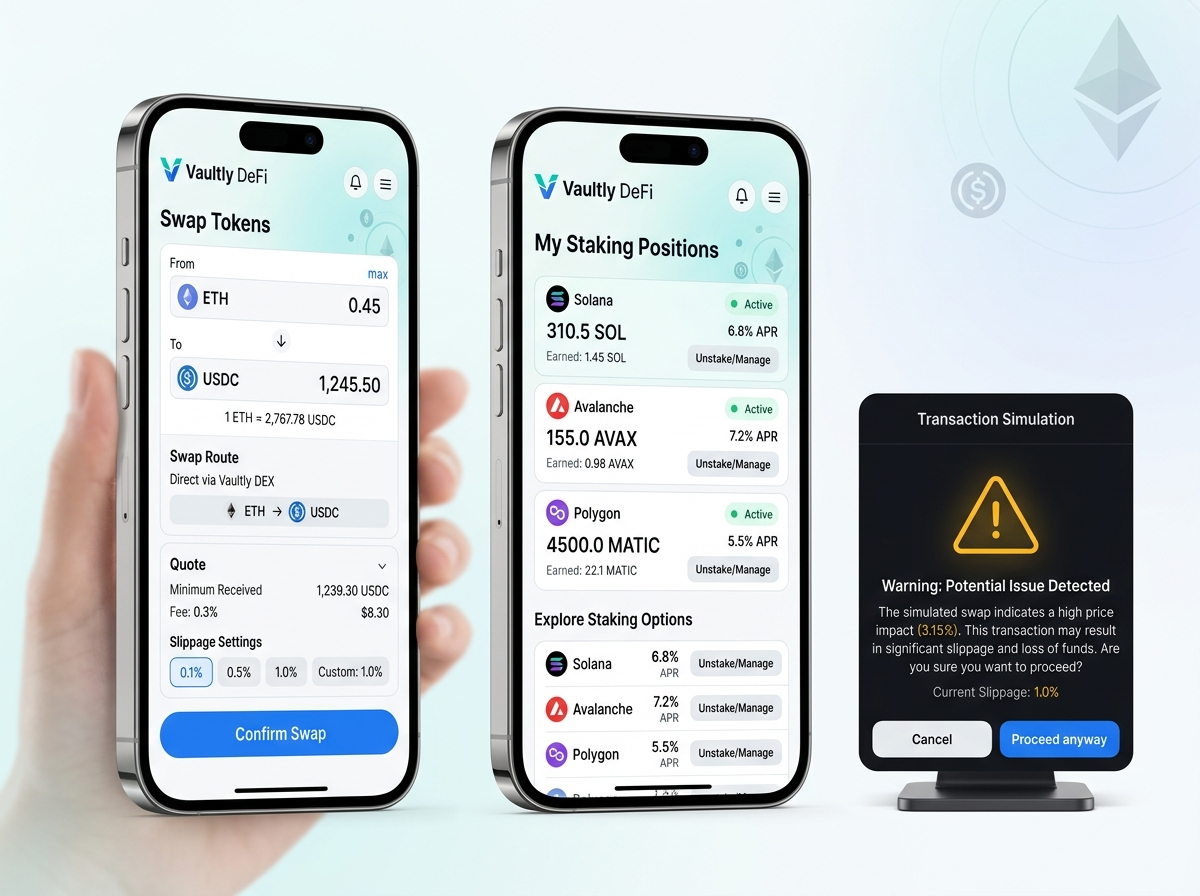
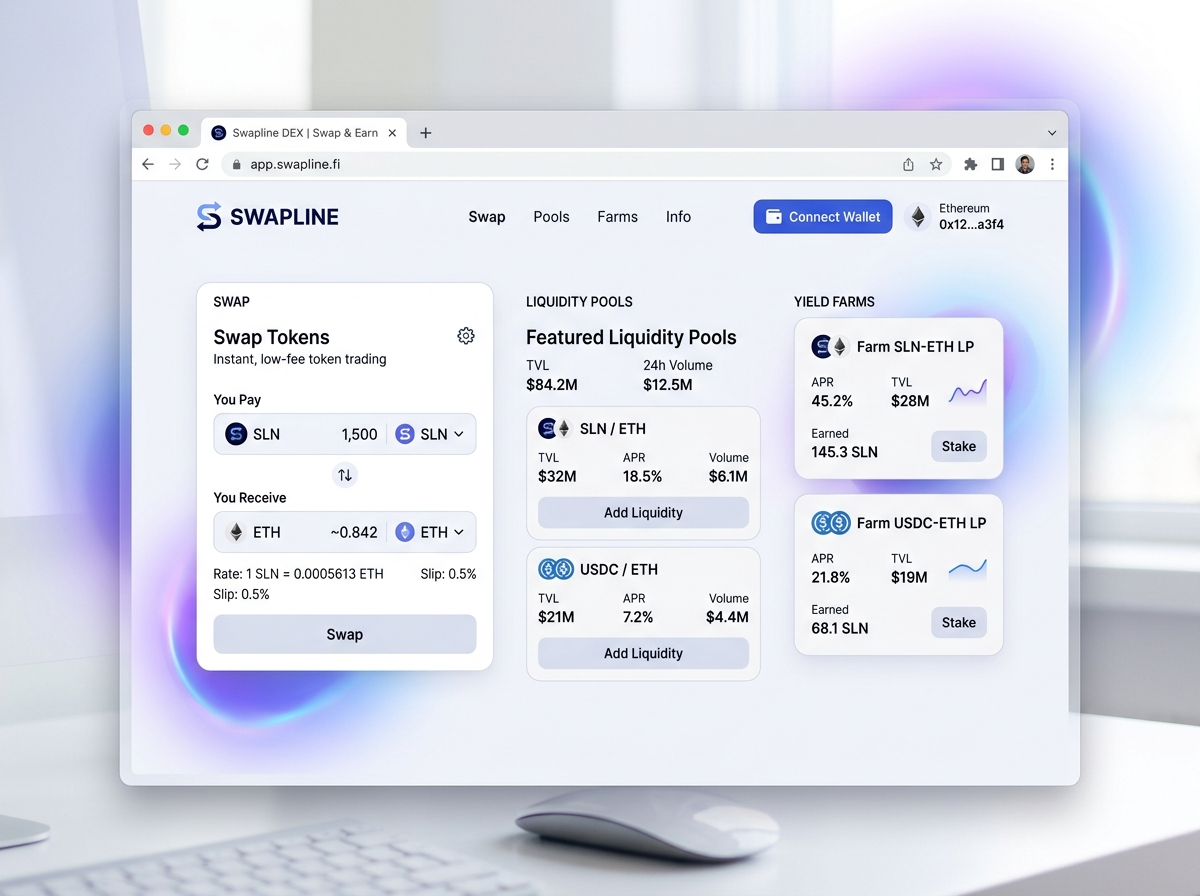
Reference concepts for an on-chain build — swap, liquidity and position surfaces. Not screenshots of a delivered client protocol; audited deployments are shown on a call.
Core Features
Staking Mechanics
- Single-asset and LP token staking pools
- Flexible and fixed-term lockup tiers
- Time-weighted and boosted reward multipliers
- Auto-compounding vaults with fee accounting
- Multiple reward tokens per pool
- Partial withdrawal and top-up support
Reward Accounting
- Per-share accrual exact across deposits and exits
- Continuous accrual rather than epoch snapshots
- Reward debt tracking with no dust loss
- Configurable emission schedules per pool
- Fee-on-transfer and rebasing token handling
- Historical yield reporting per position
Liquid Staking
- Receipt token minted against staked principal
- Redemption queue with buffer management
- Peg monitoring and arbitrage incentives
- Secondary market liquidity provisioning
- Exchange rate accrual rather than rebasing
- Integration hooks for lending collateral use
Security and Governance
- Invariant and fuzz testing on accounting paths
- Independent audit with remediation and retest
- Emergency pause and withdrawal-only mode
- Timelocked parameter governance
- Deposit caps during staged launch
- Monitoring on TVL, queue depth and reward solvency
Mapped to a release plan
We will send a yield model review, architecture and audit plan with a delivery timeline.
Request a Feature PlanHow a Staking Platform Is Put Together
The modules above map onto these layers. Each one ships with its own tests, documentation and runbook, so nothing arrives as a black box you inherit without an explanation.
Requests flow down, settlement and events flow back up. Every boundary carries logging, so a failure is traceable to a layer instead of guessed at.
Chains and Venues We Work With
Each deployment is a separate audit surface, not a redeploy. Gas economics, MEV exposure and bridge assumptions differ per chain, and a contract that is safe on one can be attackable on another.
How We Build Your Platform
Contracts and interface follow separate tracks with separate release gates, because one is permanent and the other is not.
Yield and economic design
Where returns come from, how they scale with TVL and what happens at ten times deposits.
Output → yield model with sensitivity analysis
Accounting architecture
Per-share maths, reward debt handling and the invariants that must always hold.
Output → specification with stated invariants
Contract development
Staking, accounting and queue logic with invariant and fuzz coverage.
Output → contract suite with test and coverage reports
Independent audit
Third-party review focused on accounting paths, remediation and retest.
Output → audit report with findings resolved
Staged launch
Deposit caps, monitoring, alerting and incident runbooks before caps lift.
Output → live platform with caps and response procedures
Chains we deploy to
Development Timeline
| Scope | Timeline | Includes |
|---|---|---|
| Standard staking platform | 6 to 9 weeks | Single-asset pools, accounting, audit, dashboard |
| Platform with vaults | 10 to 14 weeks | Auto-compounding, multi-reward pools, vote-escrow |
| Liquid staking platform | 4 to 7 months | Receipt token, redemption queue, peg mechanics |
| Multi-chain staking suite | 7 to 11 months | Several chains, cross-chain accounting, full governance |
What extends the timeline: independent audit of the accounting paths, which is where value is actually at risk; economic modelling of the yield curve, which is the highest-value work; liquid staking peg design, which needs stress testing rather than testing; and staged launch with caps rather than an open launch.
Revenue Models
| Model | How It Works |
|---|---|
| Performance fee | A percentage of rewards generated for depositors |
| Management fee | An annual rate on assets under management |
| Withdrawal fee | A charge on early exit from locked positions |
| Liquid staking spread | A cut of the yield accruing to the receipt token |
| Treasury staking | Protocol-owned assets earning alongside depositors |
| Integration fees | Charges to protocols using your receipt token as collateral |
| Governance value capture | Fees routed to lockers and the treasury |
Every fee is public and comparable on-chain, so pricing has a hard competitive ceiling. We build fee parameters as governable values rather than constants so they can be tuned without redeployment.
Related services
Who This Is For
Adding a staking surface with real fee-funded yield.
Giving holders a reason to lock rather than sell.
Productising delegation with a branded platform.
Offering on-chain staking alongside custodial products.
Deploying treasury assets into productive staking.
Seeding staking infrastructure for their validator set.
Why Choose Coinsclone
Yield sourced before launch
Every basis point traced to fees, interest or real rewards rather than described as APY.
Accounting verified by invariants
Per-share maths checked by fuzzing across the state space, not example tests.
Exit scenarios modelled
Withdrawal queues sized against a worst case rather than an average day.
Emission curves projected
The rate at ten times current TVL known before deposits arrive.
Audited on the accounting paths
Because that is where depositor value is actually at risk.
Full source code ownership
Contracts, tests, front end and deployment scripts transfer on delivery.
What Our Clients Say
Operators who launched with us, in their own words. Hover to pause.















A members-only NFT marketplace for Digital Freemasonry
 Digital Free MasonryNFT marketplace · delivered and live
Next phase in progress: the ODFT Token and the MasonicVerse platform.
Working with Coinsclone has been one of the best professional experiences I have had in the blockchain industry.
From the very beginning of our NFT Marketplace project until its successful completion, the entire team demonstrated exceptional technical expertise, professionalism, patience, and commitment. Every stage of development was handled with great attention to detail, and every challenge we encountered was approached with a solution-oriented mindset.
Read the full client note
Our project was far from a standard NFT Marketplace. It included custom blockchain architecture, Polygon integration, ERC-721 and ERC-1155 standards, royalty implementation, token-gated access through Masonic Passport, multiple payment methods, marketplace customization, advanced testing, and many unique business requirements. Throughout the entire process, the team consistently delivered high-quality work while maintaining clear communication, transparency, and a strong commitment to excellence.
I would especially like to express my sincere appreciation to Mr. Jeeva, Mr. Bala, Mr. Saravanan, Mr. Veeramani, Mr. Akshay, and the entire development team for their outstanding support, professionalism, responsiveness, and dedication throughout the project. Their technical expertise, patience, and willingness to understand even the most complex business requirements gave us complete confidence during every phase of development.
What impressed me the most was not only their excellent blockchain development skills, but also their ability to understand our vision and transform it into a secure, scalable, and highly professional NFT Marketplace.
For me, Coinsclone is not simply a software development company — they are a trusted long-term technology partner. After successfully completing our NFT Marketplace, we are now preparing to continue our collaboration on the next major phase of the Digital Freemasonry ecosystem, including the development of the ODFT Token and the future MasonicVerse platform.
I highly recommend Coinsclone to anyone looking for a reliable, experienced, and highly professional blockchain development company. They have earned my complete trust and respect, and I sincerely look forward to working with them again on future projects.
Start Your Staking Project
Tell us your yield model and target assets and we will respond with an architecture, risk assessment and delivery timeline.
- Yield source traced for every basis point
- Exit scenarios modelled before contracts are written
- NDA signed before technical discussion
Request received
A solution architect will reply within one business day with a scoped proposal and demo link.
DeFi Staking Platform Development: Frequently Asked Questions
What is a DeFi staking platform?
Contracts that accept deposits, account for rewards accruing to each depositor over time, and return principal plus rewards on withdrawal, with a dashboard showing positions and accrued yield.
Where should staking yield come from?
Validator rewards, protocol fee revenue or lending interest are sustainable. Newly minted tokens are not yield but dilution with a payout schedule, and the distinction determines whether the platform survives growth.
What happens when deposits grow?
With emission-funded yield the advertised rate falls as TVL rises, or supply inflates faster to maintain it. Modelling that curve before launch prevents an APY collapse three months in.
Why is reward accounting the risky part?
Because per-share maths must stay exact across every deposit, withdrawal and reward distribution. Rounding drift, reward debt errors and dust accumulation are the most common sources of loss in staking contracts.
How is accounting verified?
By defining invariants that must always hold, such as total accounted rewards never exceeding rewards received, then fuzzing across the state space to try to break them.
What is a withdrawal queue and why does it matter?
A mechanism for handling exits when principal is not instantly liquid. It has to be sized against a realistic worst-case exit rather than an average day, or the platform fails exactly when users most want out.
What is liquid staking?
Issuing a receipt token representing staked principal so holders retain liquidity while earning. It requires redemption mechanics and peg monitoring that hold under stress, not just under normal conditions.
Do you handle slashing risk?
Where the underlying chain imposes slashing, we disclose it explicitly in the interface and mitigate through operator diversification and monitoring. It cannot be engineered away, only managed and communicated.
Should the contracts be upgradeable?
It is a trade-off between fixability and centralisation. Where included, upgrades sit behind timelocked governance with published scope; immutable contracts are preferable for core accounting.
How does a staking platform make money?
Performance fees on rewards, management fees on assets, early withdrawal fees, liquid staking spread, treasury staking, integration fees and governance value capture.
How long does it take to build?
A standard platform takes 6 to 9 weeks. Adding vaults takes 10 to 14 weeks. A liquid staking platform takes 4 to 7 months, and a multi-chain suite 7 to 11 months.
Will we own the contracts?
Yes. Contracts, tests, deployment scripts, monitoring configuration and front end transfer on delivery, deployed under your own keys and governance.
Estimate Your Build
Pick a scope and the extras you need. On a protocol build the audit and economic-modelling lines are the ones that move the timeline, and neither compresses safely.
{{ estSummary }}
Ranges assume decisions arrive on time. Licensing, banking and third-party audits run on their own schedules and we plan around them rather than inside them.
Get This Scoped ProperlyReady to Build Your Staking Platform?
Share your yield model and target assets and receive an architecture, economic review, audit plan and delivery timeline.