
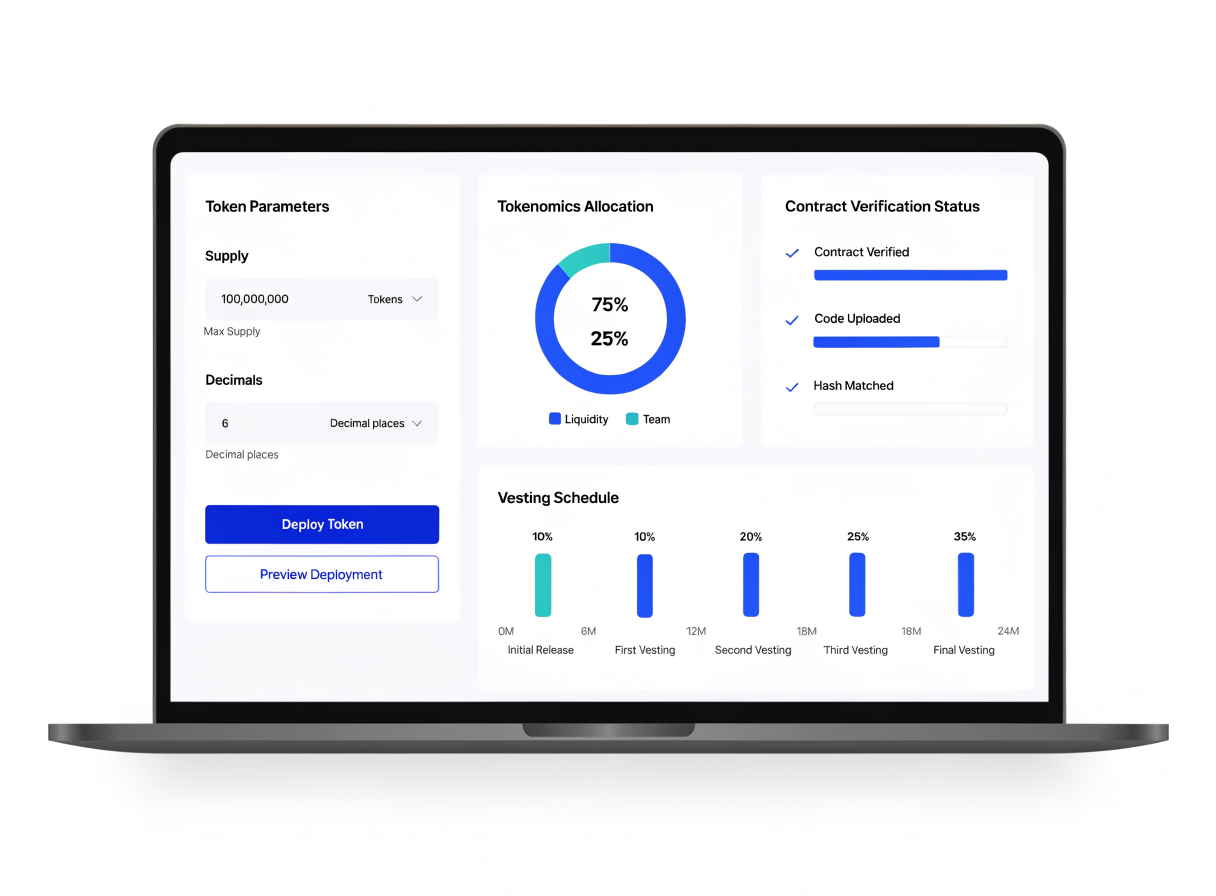
Coin or Token? The Answer Changes Everything
A token lives on an existing chain and inherits its security, wallets and tooling. A coin is native to its own blockchain, which means you also run consensus, validators, block explorers and every piece of infrastructure users expect.
Most projects asking for a coin actually need a token, and the difference is roughly two weeks against six months. We will tell you which one your idea requires before quoting anything.
What You Receive
| Component | What It Covers |
|---|---|
| Token or coin | Deployed and verified, with supply and mint controls |
| Tokenomics model | Supply, allocation and unlocks modelled against realistic liquidity |
| Distribution design | How supply reaches holders, and what happens when it unlocks |
| Wallet support | Compatibility across major wallets, or a branded wallet build |
| Vesting contracts | On-chain cliff and linear release, publicly verifiable |
| Treasury setup | Multisig control with timelocked withdrawal |
| Independent audit | Third-party review before any real value is held |
| Source code | Contracts, scripts and documentation on delivery |
Share your concept and we will tell you whether it needs a coin, a token, or neither.
Get a Free Live DemoToken Failures Are Distribution Failures
Deploying a token contract takes hours. What decides whether it is worth anything twelve months later is who holds it, why they hold it, and what happens on the day a large tranche unlocks.
Nearly every collapsed token had its cause visible in the original allocation table: a cliff releasing more supply than the market could absorb, or a demand mechanism that was only price expectation wearing a costume.
Unlocks tested against depth because a cliff bigger than the market is a scheduled price event.
Demand mechanism named something other than expectation of appreciation.
Allocation concentration checked since a few large holders can undo any schedule.
Sinks identified somewhere for supply to go other than back to the market.
Vesting enforced on chain a promised lockup is not a lockup.
Keys handed to your multisig with timelocks, so control is provable.
We model your distribution before writing the contract, and we will say when the numbers do not work. That conversation costs a week; discovering it after launch costs the project.
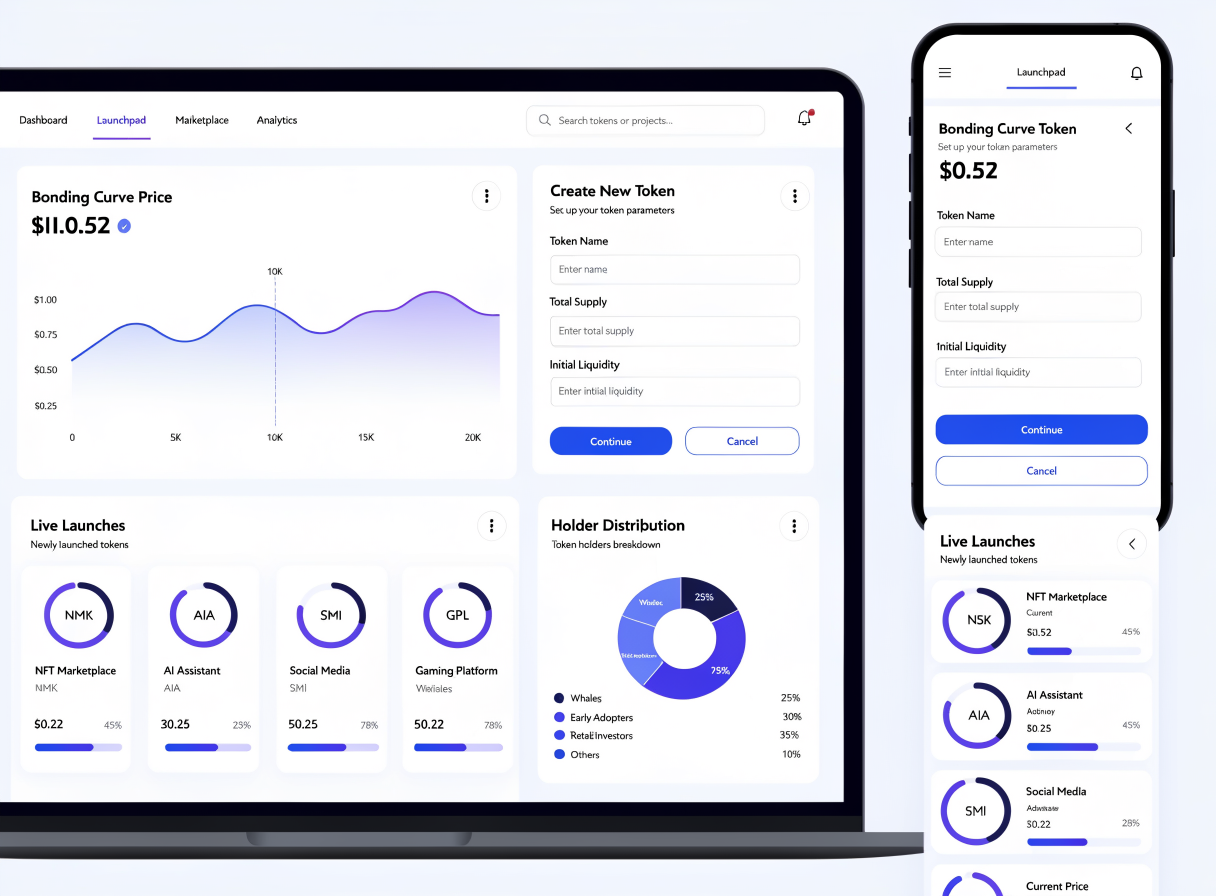
Surfaces This Scope Covers
Reference concepts for an on-chain build — swap, liquidity and position surfaces. Not screenshots of a delivered client protocol; audited deployments are shown on a call.
What We Build
Tokens on Existing Chains
- ERC20 and equivalents across EVM chains
- SPL tokens on Solana
- BEP20 on BNB Chain
- TRC20 on Tron
- BRC20 and Bitcoin-based standards
- Mint, burn and pause controls where appropriate
- Permit and gasless approval support
Coins and Networks
- Independent blockchain with configurable consensus
- Validator set design and onboarding
- Block explorer and network tooling
- Node distribution and RPC infrastructure
- Bridge to established chains
- Wallet and exchange integration support
Economics and Distribution
- Supply and allocation modelling with scenarios
- Emission and inflation curve projection
- Unlock schedule stress testing against liquidity
- Holder concentration analysis
- Sink and utility design
- Sale or airdrop mechanics where required
Safety and Launch
- Independent audit with remediation and retest
- Multisig treasury with timelocked withdrawal
- Contract verification on block explorers
- Liquidity planning for the first trading day
- Monitoring on holders, transfers and liquidity
- Exchange listing documentation support
Mapped to a release plan
We will send a coin-or-token recommendation, tokenomics review and delivery timeline.
Request a Feature PlanHow a Cryptocurrency Programme Is Put Together
The modules above map onto these layers. Each one ships with its own tests, documentation and runbook, so nothing arrives as a black box you inherit without an explanation.
Requests flow down, settlement and events flow back up. Every boundary carries logging, so a failure is traceable to a layer instead of guessed at.
Chains and Standards We Deploy To
Each deployment is a separate audit surface, not a redeploy. Gas economics, MEV exposure and bridge assumptions differ per chain, and a contract that is safe on one can be attackable on another.
How We Build Your Cryptocurrency
Contracts and interface follow separate tracks with separate release gates, because one is permanent and the other is not.
Concept and structure scoping
Whether you need a token or a network, and what the asset is actually for.
Output → recommendation with architecture and cost comparison
Tokenomics modelling
Supply, allocation, emissions and unlocks with sensitivity analysis.
Output → tokenomics model you keep and can edit
Contract or network development
Token contract or chain configuration with full test coverage.
Output → deployed testnet asset with test reports
Independent audit
Third-party review of supply, transfer and vesting paths.
Output → audit report with findings resolved
Launch and handover
Mainnet deployment, liquidity planning, treasury transfer and monitoring.
Output → live asset with treasury under your multisig
Chains we deploy to
Development Timeline
| Scope | Timeline | Includes |
|---|---|---|
| Token on an existing chain | 2 to 4 weeks | Contract, tests, audit, verification |
| Token with sale and vesting | 6 to 10 weeks | Sale contracts, vesting, treasury, audit |
| Token with full ecosystem | 4 to 7 months | Wallet, staking, governance, listing support |
| Independent blockchain | 6 to 12 months | Consensus, validators, explorer, bridges, tooling |
What extends the timeline: independent audit, since contracts holding value cannot be patched; tokenomics modelling, which is the highest-value work and usually iterates; validator onboarding if you are launching a network; and exchange listing processes, which run entirely on the exchange schedule.
Revenue Models
| Model | How It Works |
|---|---|
| Capital raised | Where a sale or private round funds development |
| Protocol fees | Revenue from whatever the token actually powers |
| Treasury deployment | Yield on treasury assets and protocol-owned liquidity |
| Transaction fees | Network fees where you operate your own chain |
| Staking commission | A share of rewards routed through your infrastructure |
| Ecosystem licensing | Revenue from projects building on your chain or token |
| Value capture to holders | Fees routed to stakers, treasury or burns |
Every fee is public and comparable on-chain, so pricing has a hard competitive ceiling. We build fee parameters as governable values rather than constants so they can be tuned without redeployment.
Related services
Who This Is For
Issuing a token to fund or coordinate a new product.
Adding a token layer to a product that already has users.
Issuing governance or membership supply.
Launching a native asset with proper distribution design.
Issuing a private or permissioned digital asset.
Relaunching or extending onto a new chain.
Why Choose Coinsclone
Coin versus token answered honestly
Most projects asking for a network need a token, and we say so before quoting.
Distribution modelled first
Unlocks tested against realistic liquidity, because that is where tokens fail.
Demand mechanism required
We will press on what creates demand beyond price expectation.
Vesting enforced on chain
Publicly verifiable rather than described in a document.
Independently audited
Supply, transfer and vesting paths reviewed before real value arrives.
Keys transferred to you
Treasury under your own multisig with timelocked controls.
What Our Clients Say
Operators who launched with us, in their own words. Hover to pause.














A members-only NFT marketplace for Digital Freemasonry
 Digital Free MasonryNFT marketplace · delivered and live
Next phase in progress: the ODFT Token and the MasonicVerse platform.
Working with Coinsclone has been one of the best professional experiences I have had in the blockchain industry.
From the very beginning of our NFT Marketplace project until its successful completion, the entire team demonstrated exceptional technical expertise, professionalism, patience, and commitment. Every stage of development was handled with great attention to detail, and every challenge we encountered was approached with a solution-oriented mindset.
Read the full client note
Our project was far from a standard NFT Marketplace. It included custom blockchain architecture, Polygon integration, ERC-721 and ERC-1155 standards, royalty implementation, token-gated access through Masonic Passport, multiple payment methods, marketplace customization, advanced testing, and many unique business requirements. Throughout the entire process, the team consistently delivered high-quality work while maintaining clear communication, transparency, and a strong commitment to excellence.
I would especially like to express my sincere appreciation to Mr. Jeeva, Mr. Bala, Mr. Saravanan, Mr. Veeramani, Mr. Akshay, and the entire development team for their outstanding support, professionalism, responsiveness, and dedication throughout the project. Their technical expertise, patience, and willingness to understand even the most complex business requirements gave us complete confidence during every phase of development.
What impressed me the most was not only their excellent blockchain development skills, but also their ability to understand our vision and transform it into a secure, scalable, and highly professional NFT Marketplace.
For me, Coinsclone is not simply a software development company — they are a trusted long-term technology partner. After successfully completing our NFT Marketplace, we are now preparing to continue our collaboration on the next major phase of the Digital Freemasonry ecosystem, including the development of the ODFT Token and the future MasonicVerse platform.
I highly recommend Coinsclone to anyone looking for a reliable, experienced, and highly professional blockchain development company. They have earned my complete trust and respect, and I sincerely look forward to working with them again on future projects.
Start Your Cryptocurrency Project
Tell us your target chains and the pairs you need to win and we will respond with a routing architecture and delivery timeline.
- Coin versus token assessed before any quoting
- Distribution modelled against realistic liquidity
- NDA signed before technical discussion
Request received
A solution architect will reply within one business day with a scoped proposal and demo link.
Cryptocurrency Development: Frequently Asked Questions
What does a cryptocurrency development company do?
Builds the asset and the infrastructure around it: token contracts or an independent network, wallets, distribution mechanics, vesting, treasury controls and audit coordination.
Should we build a coin or a token?
A token in most cases. A coin means running your own chain, consensus, validators, explorer and tooling, which is roughly six months against two weeks and a permanent operational burden.
What does it cost to create a cryptocurrency?
A token on an existing chain is a small fraction of an independent network. The variable is not the contract but the distribution design, audit depth and surrounding infrastructure.
What actually decides whether a token succeeds?
Distribution. Who holds it, why they hold it, and what happens when large tranches unlock. Nearly every collapse was visible in the original allocation table.
What makes a token model sound?
A demand mechanism that is not price expectation, an emission rate that holds at scale, at least one real sink, and unlock tranches sized to actual market depth.
Why must vesting be on chain?
Because a promised lockup is not a lockup. On-chain vesting with cliffs and linear release is verifiable by anyone considering buying, including exchanges.
Which chain should we deploy on?
It follows where your users hold assets, how often they will transact, and where liquidity for your asset will live. Low-fee chains suit frequent interaction; Ethereum carries deeper liquidity.
Do token contracts need an audit?
Yes for anything holding value or controlling supply. Contracts are immutable once deployed, so a defect found afterwards cannot be patched, only migrated away from.
Who controls the token after launch?
You do. Deployer keys transfer to your own multisig with timelocked controls, and we retain no access after handover.
Can you help with exchange listings?
We prepare the technical and tokenomics documentation exchanges request and advise on sequencing. We do not broker listings or promise placements.
How long does it take?
A token on an existing chain takes 2 to 4 weeks. With sale and vesting, 6 to 10 weeks. A full ecosystem takes 4 to 7 months, and an independent blockchain 6 to 12 months.
Will we own everything?
Yes. Contracts, deployment scripts, documentation and any infrastructure configuration transfer on delivery, deployed under your own keys.
Estimate Your Build
Pick a scope and the extras you need. On a protocol build the audit and economic-modelling lines are the ones that move the timeline, and neither compresses safely.
{{ estSummary }}
Ranges assume decisions arrive on time. Licensing, banking and third-party audits run on their own schedules and we plan around them rather than inside them.
Get This Scoped ProperlyReady to Launch Your Cryptocurrency?
Share your concept and receive a coin-or-token recommendation, tokenomics review, audit plan and delivery timeline.