
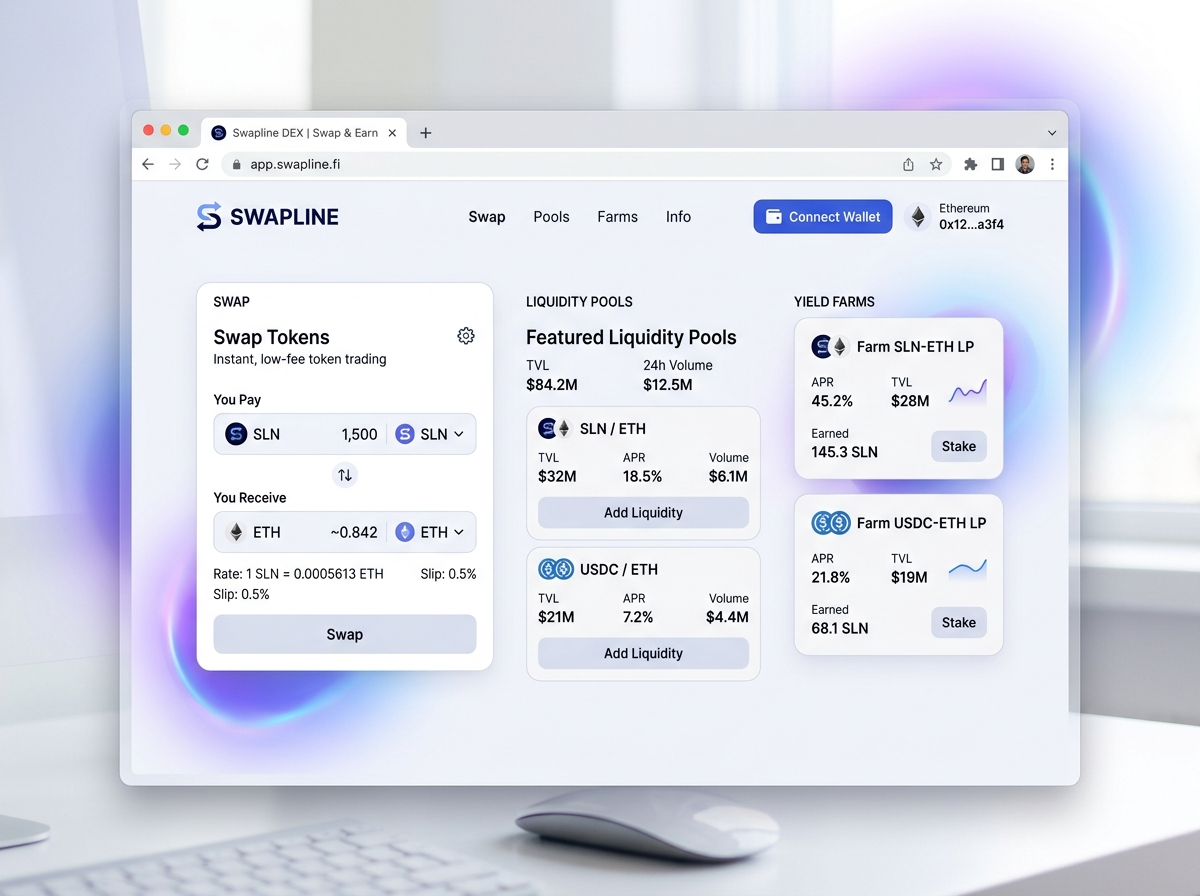
What Is a 1inch Clone Script?
A 1inch clone script is a ready-to-deploy DEX aggregator: an off-chain routing engine that reads liquidity across every pool on a chain, splits a single trade across several venues to reduce price impact, and an on-chain router contract that executes the whole path atomically. Users keep custody throughout; you never hold their funds.
The product is a pricing engine, not an exchange. You are competing on one number — the amount of output token a user receives after gas — and that number is compared against every other aggregator in real time, by bots and by users. For single-pool AMMs, see our Uniswap clone script page.
What You Receive
| Component | What It Covers |
|---|---|
| Routing engine | Off-chain pathfinder reading pool state across all supported venues |
| Router contract | Audited on-chain executor for atomic multi-hop, multi-venue swaps |
| Venue adapters | Per-protocol integrations for AMMs, order books and stable pools |
| Quote API | Low-latency quoting endpoint with gas estimation and slippage bounds |
| Swap interface | Token selector, route visualisation, price impact and settings |
| MEV protection | Private mempool submission and sandwich-resistant execution paths |
| Analytics | Volume, route quality and win rate against competing aggregators |
| Source code | Engine, contracts, adapters and front end transfer on delivery |
See live routing against real pools on your target chain before you commit.
Get a Free Live DemoYou Are Competing on One Number, Measured Continuously
An aggregator has no moat in features. A user pastes an amount and compares your output against three competitors in two seconds. If you lose by ten basis points consistently, you get no volume — not less volume, none, because integrators route to whoever wins.
Winning that comparison is a latency and coverage problem, not a UI problem. Missing one venue with deep liquidity, quoting from stale pool state, or ignoring gas in the path decision all cost you the trade. Every one of those is an engineering decision made before launch.
Venue coverage first because a route you cannot see is a price you cannot beat.
Pool state kept fresh event-driven updates rather than polling, since stale reserves quote wrong.
Gas priced into routing a three-hop path costing more in gas than it saves is a worse quote.
Split execution one trade across several pools to cut price impact on size.
MEV-aware settlement private submission so your users are not sandwiched on the way in.
Quote latency budgeted sub-second, or integrators time you out and route elsewhere.
We benchmark your router against live aggregators on real pairs before launch and show you the win rate. If the coverage is not there, you will hear it from us rather than from your users.
Surfaces This Scope Covers
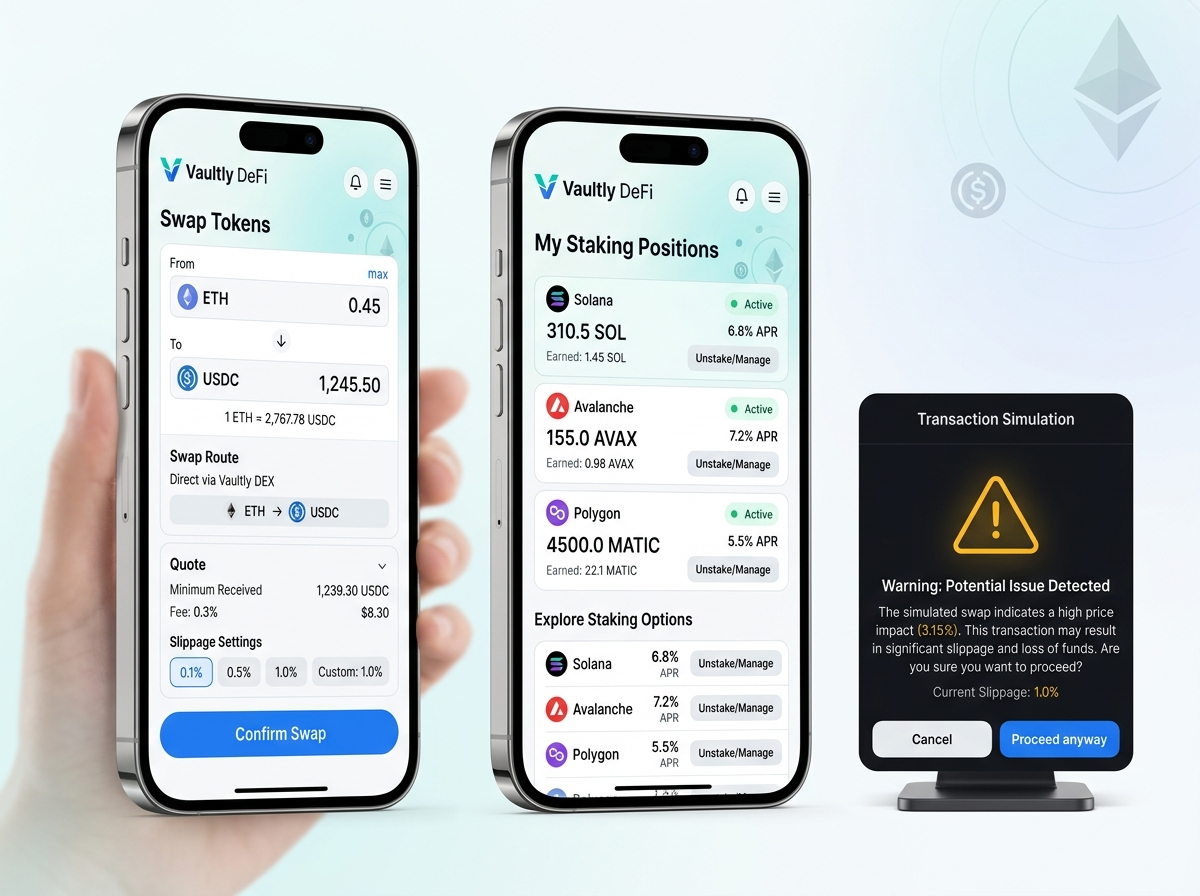
Reference concepts for an on-chain build — swap, liquidity and position surfaces. Not screenshots of a delivered client protocol; audited deployments are shown on a call.
Core Features
Routing and Pricing
- Multi-venue pathfinding across AMMs, order books and stable pools
- Split routing across several pools in one transaction
- Multi-hop paths with intermediate token selection
- Gas-aware route scoring rather than output alone
- Positive slippage capture and return
- Quote caching with event-driven invalidation
- Fallback routing when a venue reverts
Execution
- Audited router contract with atomic multi-venue settlement
- Permit-based and approval-free flows where the chain supports them
- Private mempool submission for MEV protection
- Partial fill and revert-safe execution
- Limit order and RFQ module options
- Cross-chain swap routing with bridge integration
Integration
- Low-latency quote and swap REST API
- WebSocket price streaming for integrators
- SDK for wallet and dApp embedding
- Referral and fee-share attribution per integrator
- Rate limiting and API key management
- Route explain endpoint for transparency
Interface and Operations
- Route visualisation showing every hop and venue
- Price impact, minimum received and gas in one view
- Wallet connect across major providers
- Admin controls for venue enable, fees and limits
- Monitoring on quote latency, win rate and revert rate
- Competitive benchmarking against other aggregators
Mapped to a release plan
We will send a routing architecture with venue coverage, latency targets and delivery timeline.
Request a Feature PlanHow 1inch Clone Script Is Put Together
The modules above map onto these layers. Each one ships with its own tests, documentation and runbook, so nothing arrives as a black box you inherit without an explanation.
Requests flow down, settlement and events flow back up. Every boundary carries logging, so a failure is traceable to a layer instead of guessed at.
Chains and Venues We Aggregate
Each deployment is a separate audit surface, not a redeploy. Gas economics, MEV exposure and bridge assumptions differ per chain, and a contract that is safe on one can be attackable on another.
How We Build Your Aggregator
Contracts and interface follow separate tracks with separate release gates, because one is permanent and the other is not.
Coverage and market scoping
Target chains, venues worth integrating and the pairs you must win.
Output → coverage plan with benchmark targets
Routing engine design
Pathfinding approach, split strategy, gas model and state freshness policy.
Output → engine architecture with latency budget
Contract and adapter development
Router contract, venue adapters and execution safety with full test coverage.
Output → contract suite with test and gas reports
Independent audit and benchmarking
Third-party review plus live win-rate benchmarking against competing aggregators.
Output → audit report and benchmark results
Launch and integration
Deployment, API rollout, integrator onboarding and monitoring.
Output → live aggregator with monitoring and runbooks
Chains we deploy to
Development Timeline
| Scope | Timeline | Includes |
|---|---|---|
| White label aggregator | 5 to 7 weeks | Rebranded interface, standard venues, one chain |
| Standard aggregator | 10 to 14 weeks | Custom routing, split execution, audit, quote API |
| Aggregator with MEV protection | 4 to 6 months | Private relay, RFQ module, advanced scoring |
| Multi-chain aggregator | 6 to 10 months | Several chains, cross-chain routing, integrator SDK |
What extends the timeline: audit and remediation on the router contract, which holds every trade in flight; each additional chain, since venue adapters do not port; MEV protection, which depends on relay relationships; and benchmarking, which is what proves the engine before real volume arrives.
Revenue Models
| Model | How It Works |
|---|---|
| Positive slippage capture | Retaining part of the surplus when execution beats the quote |
| Integrator fee share | A cut of volume routed through partner wallets and dApps |
| Spread on quoted output | A configurable basis-point take on each swap |
| RFQ market maker fees | Charges to market makers for order flow access |
| Premium API tiers | Higher rate limits and dedicated infrastructure for integrators |
| Referral programmes | Attribution-based revenue on volume you send outward |
| White label licensing | Licensing your routing stack to other operators |
Every fee is public and comparable on-chain, so pricing has a hard competitive ceiling. We build fee parameters as governable values rather than constants so they can be tuned without redeployment.
Related services
Who This Is For
Adding best-price swaps inside an existing wallet.
Extending a single-pool DEX into full-chain routing.
Building internal execution infrastructure with private flow.
Seeding an aggregator so their ecosystem has price discovery.
Embedding swaps without holding user funds.
Serving a market with local venue coverage others ignore.
Why Choose Coinsclone
Benchmarked before launch
Live win-rate testing against competing aggregators on real pairs, not synthetic tests.
Coverage engineered per chain
Venue adapters built and verified individually, because a missing pool is a lost trade.
Gas in the routing decision
Paths scored on net output after gas rather than gross output.
MEV-aware execution
Private submission paths so users are not sandwiched on entry.
Latency budgeted explicitly
Sub-second quoting, because integrators time out slow endpoints.
Full source code ownership
Engine, contracts, adapters and front end transfer on delivery.
What Our Clients Say
Operators who launched with us, in their own words. Hover to pause.















A members-only NFT marketplace for Digital Freemasonry
 Digital Free MasonryNFT marketplace · delivered and live
Next phase in progress: the ODFT Token and the MasonicVerse platform.
Working with Coinsclone has been one of the best professional experiences I have had in the blockchain industry.
From the very beginning of our NFT Marketplace project until its successful completion, the entire team demonstrated exceptional technical expertise, professionalism, patience, and commitment. Every stage of development was handled with great attention to detail, and every challenge we encountered was approached with a solution-oriented mindset.
Read the full client note
Our project was far from a standard NFT Marketplace. It included custom blockchain architecture, Polygon integration, ERC-721 and ERC-1155 standards, royalty implementation, token-gated access through Masonic Passport, multiple payment methods, marketplace customization, advanced testing, and many unique business requirements. Throughout the entire process, the team consistently delivered high-quality work while maintaining clear communication, transparency, and a strong commitment to excellence.
I would especially like to express my sincere appreciation to Mr. Jeeva, Mr. Bala, Mr. Saravanan, Mr. Veeramani, Mr. Akshay, and the entire development team for their outstanding support, professionalism, responsiveness, and dedication throughout the project. Their technical expertise, patience, and willingness to understand even the most complex business requirements gave us complete confidence during every phase of development.
What impressed me the most was not only their excellent blockchain development skills, but also their ability to understand our vision and transform it into a secure, scalable, and highly professional NFT Marketplace.
For me, Coinsclone is not simply a software development company — they are a trusted long-term technology partner. After successfully completing our NFT Marketplace, we are now preparing to continue our collaboration on the next major phase of the Digital Freemasonry ecosystem, including the development of the ODFT Token and the future MasonicVerse platform.
I highly recommend Coinsclone to anyone looking for a reliable, experienced, and highly professional blockchain development company. They have earned my complete trust and respect, and I sincerely look forward to working with them again on future projects.
Start Your Aggregator Project
Tell us your target chains and the pairs you need to win and we will respond with a routing architecture and delivery timeline.
- Live routing benchmarked against competing aggregators
- Venue coverage mapped for your target chains
- NDA signed before technical discussion
Request received
A solution architect will reply within one business day with a scoped proposal and demo link.
1inch Clone Script: Frequently Asked Questions
What is a 1inch clone script?
A ready-to-deploy DEX aggregator: an off-chain routing engine that reads liquidity across every pool on a chain, splits trades across venues to cut price impact, and an audited router contract that executes the full path atomically while users keep custody.
How is an aggregator different from a DEX?
A DEX holds liquidity in its own pools. An aggregator holds none — it finds the best path across everyone else’s pools and executes against them. The product is a pricing engine, not a venue.
What actually decides whether an aggregator succeeds?
One number: the output amount a user receives after gas. Users and integrators compare that against every competitor in seconds, so coverage, state freshness and gas-aware routing decide volume far more than interface quality.
Why does venue coverage matter so much?
A route you cannot see is a price you cannot beat. Missing one deep pool on a popular pair means losing that pair permanently, because integrators route to whoever wins consistently rather than occasionally.
What is split routing?
Executing one trade across several pools in a single transaction. Large orders move the price in any single pool, so splitting across venues reduces total price impact and produces more output than the best single route.
Do you include MEV protection?
Yes, through private mempool submission and sandwich-resistant execution paths. Without it, large swaps routed through public mempools are visible to searchers before they settle.
How is gas handled in route selection?
Paths are scored on net output after gas, not gross output. A three-hop route that produces more tokens but costs more in gas is the worse quote, and an engine ignoring this loses comparisons it appears to win.
How fast do quotes need to be?
Sub-second. Integrators set timeouts and route elsewhere when an endpoint is slow, so latency is budgeted as a hard requirement rather than optimised later.
Can other apps integrate our aggregator?
Yes. A quote and swap API, WebSocket streaming and an SDK let wallets and dApps embed your routing, with per-integrator fee share and attribution built in.
How does an aggregator make money?
Positive slippage capture, integrator fee share, a configurable spread on quoted output, RFQ market maker fees, premium API tiers and white label licensing. Fee take needs care, since every basis point is subtracted from the number users compare.
How long does it take to launch?
A white label aggregator takes 5 to 7 weeks. A standard build takes 10 to 14 weeks. Adding MEV protection takes 4 to 6 months, and a multi-chain aggregator 6 to 10 months.
Will we own the code?
Yes. Routing engine, router contracts, venue adapters, API and front end transfer to you on delivery, deployed under your own keys with no licensing dependency on Coinsclone.
Estimate Your Build
Pick a scope and the extras you need. On a protocol build the audit and economic-modelling lines are the ones that move the timeline, and neither compresses safely.
{{ estSummary }}
Ranges assume decisions arrive on time. Licensing, banking and third-party audits run on their own schedules and we plan around them rather than inside them.
Get This Scoped ProperlyReady to Launch Your Aggregator?
Share your target chains and priority pairs and receive a routing architecture, coverage plan, benchmark targets and delivery timeline.