
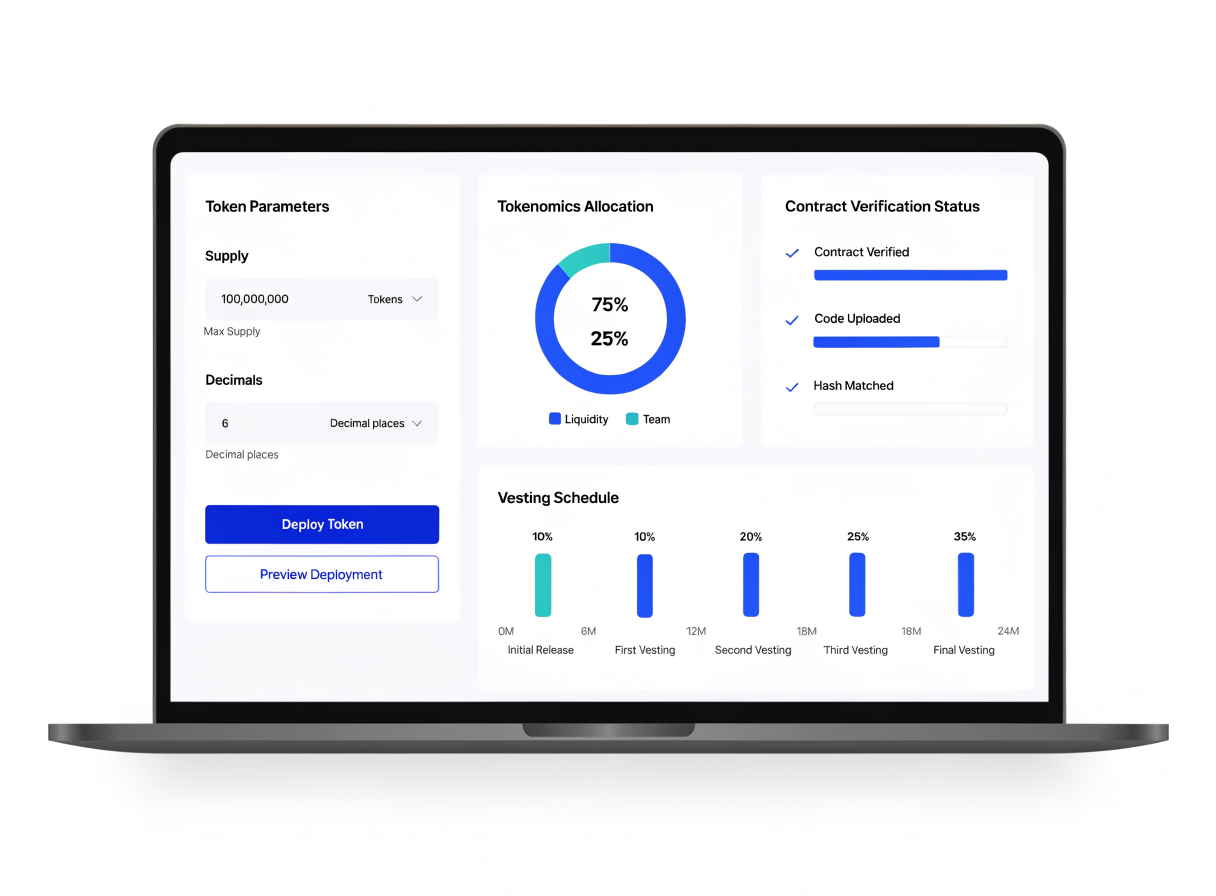
What Is a BEP20 Token?
BEP-20 is the fungible token standard on BNB Chain. It follows the same interface as ERC-20, so the tooling, wallets and DeFi patterns are familiar, and the practical difference is cost: transactions are cheap enough that mechanics which would be absurd on Ethereum mainnet become reasonable.
That changes what you can build. Frequent reward distribution, per-transaction redistribution, small-value transfers and gamified mechanics all work here. The risk is the mirror image: cheap deployment has made BNB Chain the default home for low-effort token launches, so credibility has to be earned deliberately.
What You Receive
| Component | What It Covers |
|---|---|
| BEP-20 contract | Compliant implementation with your supply, decimals and naming |
| Trust configuration | Ownership arrangement, privileged functions and their public documentation |
| Launch protection | Anti-sniping and per-wallet limits, time-boxed and disclosed |
| Scanner clearance | Contract tested against the automated honeypot detectors buyers actually run |
| Distribution layer | Merkle claims, vesting schedules and sale contracts |
| Liquidity package | Pool creation with a lock and publicly verifiable proof |
| Audit cycle | Independent review with published report and retest |
| Repository transfer | Contracts, tests and deployment scripts handed over |
Send us your token parameters and distribution plan and we will return contract scope, an audit path and a timeline.
Get a Free Live DemoCheap Transactions Enable Mechanics and Invite Suspicion
Low fees are a genuine product advantage. They also mean the chain hosts an enormous number of hastily deployed tokens, many with honeypot code, hidden mint functions or owner-only transfer switches. Buyers and exchanges know this and screen accordingly.
Which means a serious BEP-20 launch has to signal legitimacy explicitly: a published audit, renounced or multisig-controlled ownership, locked liquidity, verified source and no privileged function that can trap holders. Those are not formalities here; they are the entry requirement.
Verified source on day one unverified contracts are treated as hostile by default on this chain.
Ownership renounced or multisig with every privileged function documented publicly.
Locked liquidity with proof since pulled liquidity is the most common failure buyers screen for.
No hidden transfer controls no owner-only blocklists, sell taxes or trading switches unless disclosed.
Audit published, not claimed the report available rather than referenced in marketing.
Honeypot screening contracts tested against the same automated scanners buyers will run.
We build BEP-20 tokens to pass the automated scanners and manual checks that buyers and exchanges apply on this chain, because on BNB Chain the default assumption about a new token is that it is a trap.
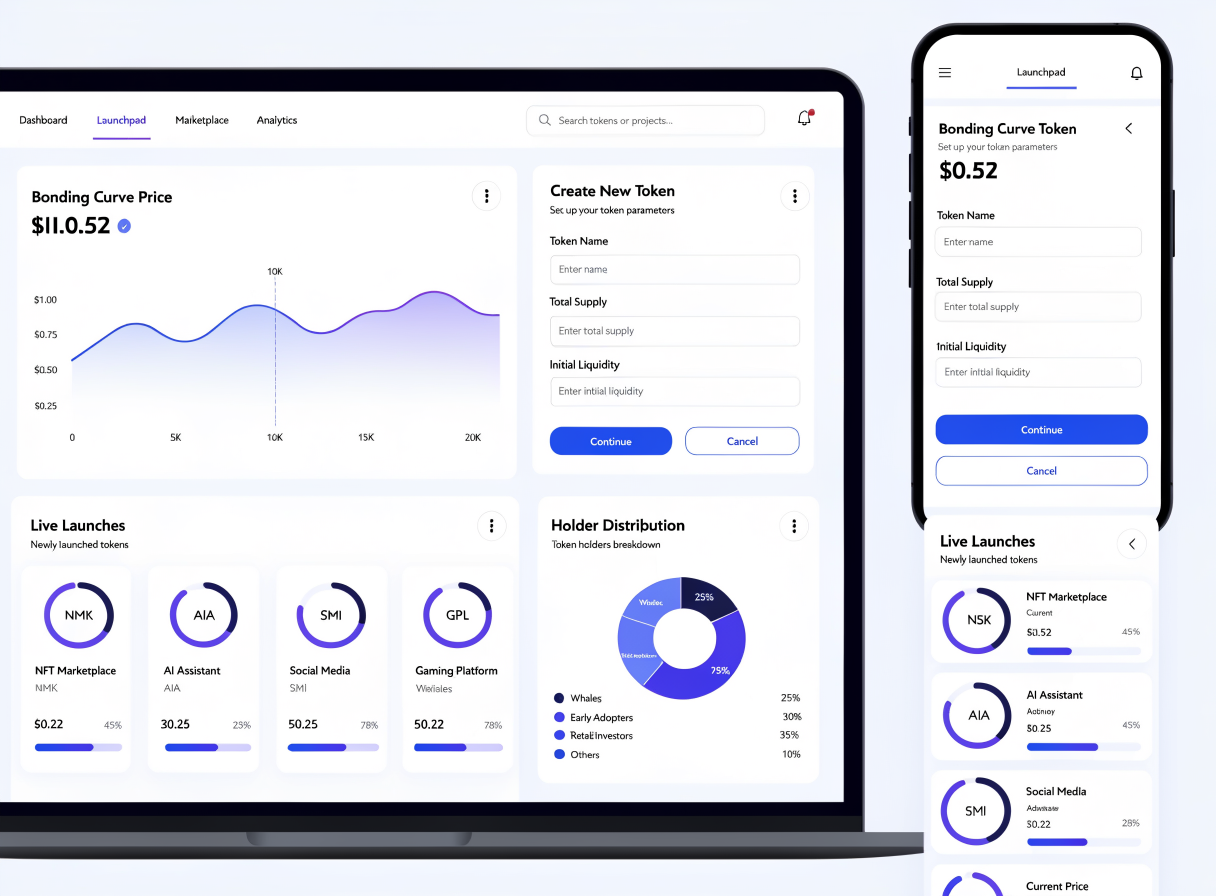
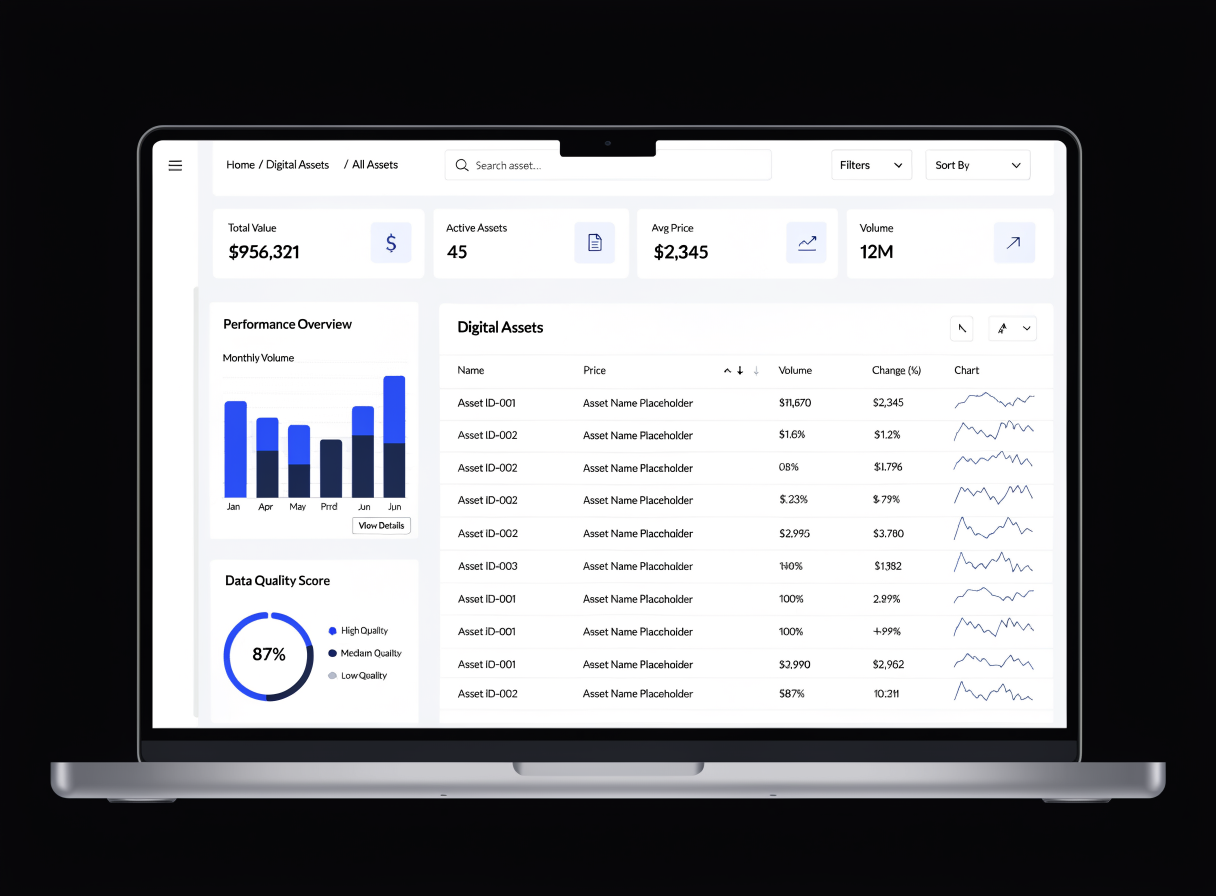
Surfaces This Scope Covers
Reference concepts for a token build — deployment, distribution and holder surfaces. Not screenshots of a delivered client launch.
What We Build
Core Token
- BEP-20 compliant implementation with configurable supply
- Fixed, capped or mintable supply under multisig control
- Burnable variants and deflationary mechanics
- Role-based access control with documented permissions
- Reflection and redistribution mechanics where appropriate
- Anti-bot and anti-sniping launch protection
- Gas-optimised implementation for high-frequency use
Low-Fee Mechanics
- Frequent reward distribution that stays economical
- Per-transaction fee routing to treasury, burns or holders
- Micro-transaction and tipping support
- Gamified reward and quest integrations
- On-chain leaderboards and activity tracking
- Batch operations for large holder sets
Distribution and Liquidity
- Merkle airdrop contracts with claim portal
- Vesting with cliff and linear schedules
- Presale and fair launch contracts
- DEX pool creation with locked liquidity and proof
- Treasury multisig with timelocks
- Allocation and unlock transparency dashboard
Trust and Launch
- Independent audit with remediation and published report
- Honeypot and scanner testing before launch
- BscScan verification and metadata submission
- Ownership renouncement or multisig handover
- Market data and exchange listing preparation
- Documentation and holder-facing transparency pages
Mapped to a release plan
We will send a prioritized build plan with your token parameters, distribution schedule and audit path.
Request a Feature PlanHow BEP20 Token Development Is Put Together
The modules above map onto these layers. Each one ships with its own tests, documentation and runbook, so nothing arrives as a black box you inherit without an explanation.
Requests flow down, settlement and events flow back up. Every boundary carries logging, so a failure is traceable to a layer instead of guessed at.
Chains and Assets We Work With
Each chain is a separate implementation with its own standard, tooling and supply accounting. Multi-chain issuance needs an explicit chain of record or your reported circulating supply drifts from reality.
How We Build Your Token
Tokenomics are modelled before contracts are written, because the contract only enforces decisions made earlier.
Trust and parameter design
Supply, taxes if any, ownership arrangement and which privileged functions will be disclosed.
Output → specification with a public permission map
Implementation and scanner testing
Contract built, then run through honeypot and rug detectors alongside the test suite.
Output → tested contract with scanner clearance report
Independent audit
External review with findings closed, retested and prepared for publication.
Output → audit report ready to publish at launch
Liquidity and launch protection
Pool creation, lock with proof, and time-boxed anti-sniping measures configured.
Output → locked liquidity with verifiable proof
Deployment and disclosure
BscScan verification, metadata submission, ownership handover and transparency pages.
Output → verified contract with published holder documentation
Networks and venues
Development Timeline
| Scope | Timeline | Includes |
|---|---|---|
| Standard BEP-20 | 1 to 2 weeks | Contract, tests, scanner clearance, verified deployment |
| With distribution and liquidity | 3 to 5 weeks | Claims, vesting, pool lock, published audit |
| With staking and utility | 6 to 10 weeks | Staking, reward distribution, governance, audit |
| Full launch programme | 3 to 5 months | Multi-contract system, dashboards, bridging, listing preparation |
What extends the timeline: the audit and its publication, which is part of how buyers judge you here; scanner and honeypot testing cycles; liquidity lock arrangements with a provider; and listing preparation, where BNB Chain projects face heavier scrutiny than the deployment itself suggests.
Revenue Models
| Model | How It Works |
|---|---|
| Transaction charges | Fees on transfers where the mechanic does not break your integrations |
| Reward distribution | High-frequency payouts that are only economical on a low-fee chain |
| Fee-funded burns | Supply retired from collected charges |
| Holder tiers | Access and benefits scaled by holdings |
| Governance weight | Influence over parameters and treasury |
| Micro-payment settlement | Small-value flows that would be impossible on mainnet |
| Treasury returns | Yield on reserves held by the project |
Low fees make redistribution mechanics viable here, and they also mean every competing token has the same option. Credibility, not cleverness, is what differentiates a BNB Chain launch.
Related services
Who This Is For
Where per-transaction cost decides whether the mechanic works.
Needing to prove legitimacy against a crowded, sceptical market.
Moving small values where mainnet fees are prohibitive.
Running many small on-chain actions per user.
Adding a BNB Chain deployment to reach a different audience.
Building where PancakeSwap liquidity is the primary venue.
Why Choose Coinsclone
Built to pass buyer screening
On BNB Chain the default assumption is that a new token is a trap, so we engineer for the checks buyers run first.
Honeypot patterns tested against
Contracts run through the same automated scanners your holders will use, before launch rather than after.
Audit published, not name-dropped
The full report goes out with the launch, because a claimed audit counts for nothing on this chain.
Liquidity locked with proof
Pool locks arranged and independently verifiable, since pulled liquidity is the failure buyers screen for hardest.
Cheap fees used properly
High-frequency reward and micro-payment mechanics designed to exploit the cost advantage rather than ignore it.
Nothing hidden in the code
No owner-only trading switches or silent blocklists, and every privileged function documented publicly.
What Our Clients Say
Operators who launched with us, in their own words. Hover to pause.
















A members-only NFT marketplace for Digital Freemasonry
 Digital Free MasonryNFT marketplace · delivered and live
Next phase in progress: the ODFT Token and the MasonicVerse platform.
Working with Coinsclone has been one of the best professional experiences I have had in the blockchain industry.
From the very beginning of our NFT Marketplace project until its successful completion, the entire team demonstrated exceptional technical expertise, professionalism, patience, and commitment. Every stage of development was handled with great attention to detail, and every challenge we encountered was approached with a solution-oriented mindset.
Read the full client note
Our project was far from a standard NFT Marketplace. It included custom blockchain architecture, Polygon integration, ERC-721 and ERC-1155 standards, royalty implementation, token-gated access through Masonic Passport, multiple payment methods, marketplace customization, advanced testing, and many unique business requirements. Throughout the entire process, the team consistently delivered high-quality work while maintaining clear communication, transparency, and a strong commitment to excellence.
I would especially like to express my sincere appreciation to Mr. Jeeva, Mr. Bala, Mr. Saravanan, Mr. Veeramani, Mr. Akshay, and the entire development team for their outstanding support, professionalism, responsiveness, and dedication throughout the project. Their technical expertise, patience, and willingness to understand even the most complex business requirements gave us complete confidence during every phase of development.
What impressed me the most was not only their excellent blockchain development skills, but also their ability to understand our vision and transform it into a secure, scalable, and highly professional NFT Marketplace.
For me, Coinsclone is not simply a software development company — they are a trusted long-term technology partner. After successfully completing our NFT Marketplace, we are now preparing to continue our collaboration on the next major phase of the Digital Freemasonry ecosystem, including the development of the ODFT Token and the future MasonicVerse platform.
I highly recommend Coinsclone to anyone looking for a reliable, experienced, and highly professional blockchain development company. They have earned my complete trust and respect, and I sincerely look forward to working with them again on future projects.
Brief Us on Your BNB Chain Token
Share your launch plan and we will return contract scope, a trust checklist and the liquidity lock arrangement buyers will look for.
- Contract cleared against honeypot and rug scanners
- Audit scheduled so the report publishes at launch
- NDA signed before technical discussion
Request received
A solution architect will reply within one business day with a scoped proposal and demo link.
Frequently Asked Questions
What is a BEP-20 token?
The fungible token standard on BNB Chain, following the same interface as ERC-20. Tooling and DeFi patterns are familiar, and transaction costs are low enough to support mechanics that would be uneconomical on Ethereum mainnet.
Why choose BNB Chain over Ethereum?
Cost. Frequent reward claims, per-transaction redistribution, micro-transfers and gamified mechanics all become viable when a transaction costs a fraction of a cent. The trade-off is a chain crowded with low-effort launches.
How do I make a BEP-20 token look legitimate?
Verified source, a published audit report rather than a claim, multisig or renounced ownership, locked liquidity with proof, and no hidden transfer controls. On this chain buyers screen for exactly these before anything else.
What is a honeypot token and how do you avoid it?
A contract that allows buying but blocks selling, usually through owner-only transfer controls or blocklists. We test contracts against the same automated scanners buyers use, and we do not build hidden trading restrictions.
Should ownership be renounced?
It depends. Renouncing signals that no privileged action can be taken and removes your ability to fix or upgrade anything. A timelocked multisig is usually the better balance, with every privileged function documented.
Can the token include a transfer tax?
Yes, and it has consequences: some routers, bridges and lending markets handle fee-on-transfer badly. We document what breaks and, where the trade-off is poor, design an alternative fee capture path.
How is liquidity handled at launch?
Pool creation on a major BNB Chain DEX, initial liquidity provisioning and a lock with publicly verifiable proof. Unlocked liquidity is the single biggest red flag buyers on this chain look for.
What is anti-sniping protection?
Measures that prevent bots from buying the entire initial supply in the first blocks, such as trading delays, per-wallet limits during launch and blocklisting of known sniper contracts, applied transparently and time-bounded.
Do BEP-20 tokens need an audit?
Yes, and more visibly than on other chains. On BNB Chain a published audit is part of how buyers distinguish a real project from the thousands of copy-paste launches around it.
How long does BEP-20 token development take?
One to two weeks for a standard token, three to five weeks with vesting and distribution, six to ten weeks with staking and governance and a full launch package.
Can the token be bridged to other chains?
Yes, with canonical or bridged issuance and explicit supply accounting so total and circulating supply remain accurate across chains.
Do I own the source code?
Yes. Contracts, tests, deployment scripts and documentation transfer on delivery, verified on BscScan under your own addresses.
Estimate Your Build
Pick a scope and the extras you need. Independent audit is the line that cannot be compressed, because a deployed contract cannot be quietly patched.
{{ estSummary }}
Ranges assume decisions arrive on time. Licensing, banking and third-party audits run on their own schedules and we plan around them rather than inside them.
Get This Scoped ProperlyReady to Launch on BNB Chain?
Share your token purpose and launch plan and receive contract scope, an audit path, liquidity plan and delivery timeline.