
What Is Asset Tokenization?
Asset tokenization is the process of representing ownership of a real-world asset as transferable tokens on a blockchain. The token is a record of an entitlement, and the entitlement itself is created by a legal structure: a special purpose vehicle, a fund, a note or a direct title arrangement that gives the holder a claim on the asset or its cash flows.
That sentence contains the whole discipline. The blockchain part is straightforward; the part that decides whether the project works is whether the legal wrapper, the custody arrangement and the token contract enforce the same rules. When they diverge, you have a token that trades freely and an entitlement that does not follow it.
What You Receive
| Component | What It Covers |
|---|---|
| Token contracts | Permissioned standards with on-chain transfer restriction enforcement |
| Investor onboarding | KYC, AML, accreditation and suitability workflows by jurisdiction |
| Whitelist registry | Eligible holder registry with jurisdiction and investor-type rules |
| Cap table | Live register of holders, positions and restrictions |
| Lifecycle automation | Distributions, dividends, redemptions, splits and corporate actions |
| Reporting | Investor statements, regulator exports and audit trails |
| Integration layer | Custodian, transfer agent, valuation and administrator connections |
| Source code | Contracts, platform and infrastructure transfer on delivery |
See a working tokenization platform with your asset class, investor rules and distribution flow.
Get a Free Live DemoThe Token Is the Easy Part; the Wrapper Decides Everything
Any competent team can deploy a token that represents a fraction of a building or a fund. The difficult questions are legal and operational: which entity holds the asset, what exactly does a holder own, who is the transfer agent, who can redeem, and what happens on death, dispute or default.
Tokenization projects fail at that seam. The contract permits a transfer that the fund documents prohibit. Tokens reach a holder who is not an eligible investor in their jurisdiction. A distribution is paid to a wallet whose beneficial owner has changed. Each of these is a compliance breach created by software that did not model the legal reality.
Transfer restrictions on-chain eligibility enforced at contract level, not by policy documents or hope.
Jurisdiction-aware whitelists holder eligibility evaluated per investor type and per country.
Lock-up and holding periods enforced automatically where regulation requires them.
Forced transfer and recovery controlled mechanisms for lost keys, death and court orders.
Single source of truth the on-chain register and the legal register reconciled continuously.
Corporate action automation distributions and redemptions executed against the register at record date.
We build the token contract to enforce the legal structure your counsel defines, and we design the reconciliation between on-chain register and official register from day one. Tokenization without that alignment is an unregistered securities problem with a technology budget.
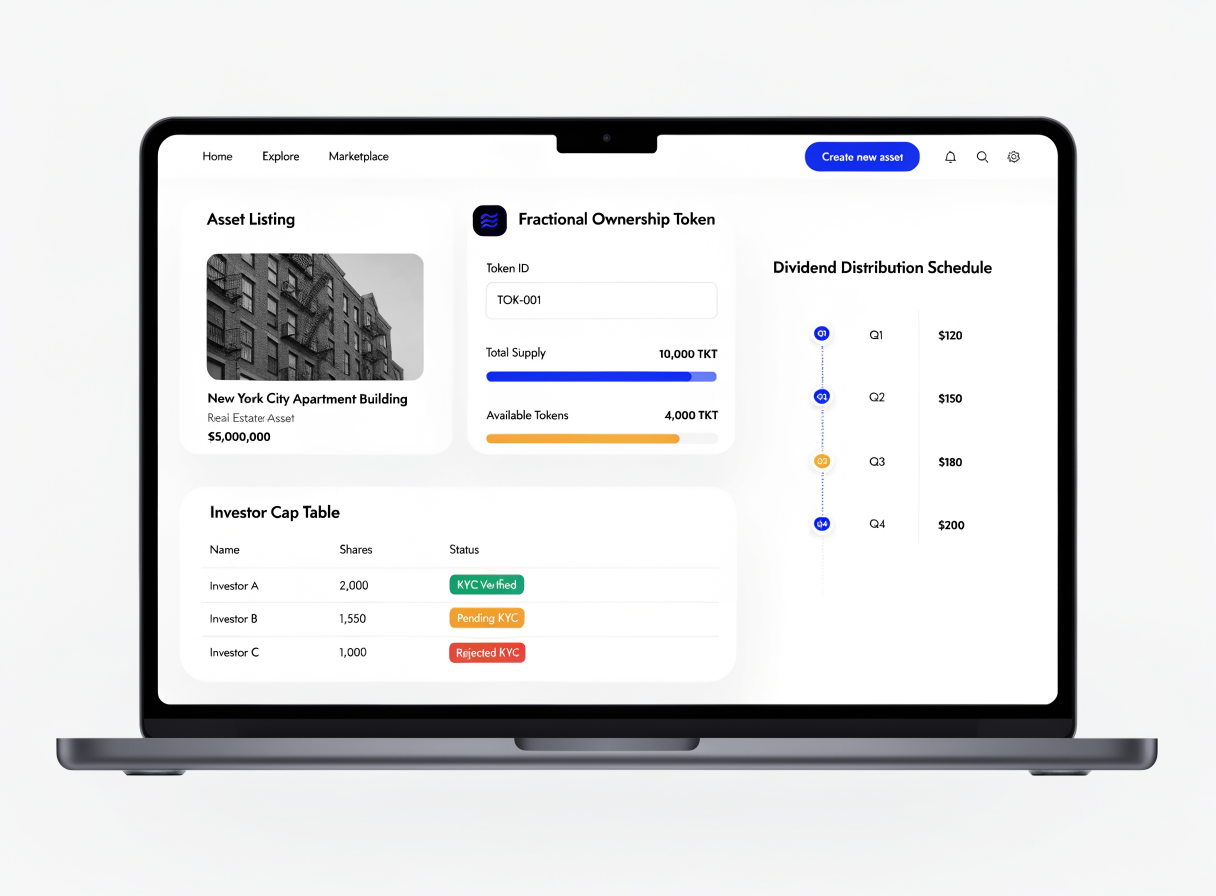
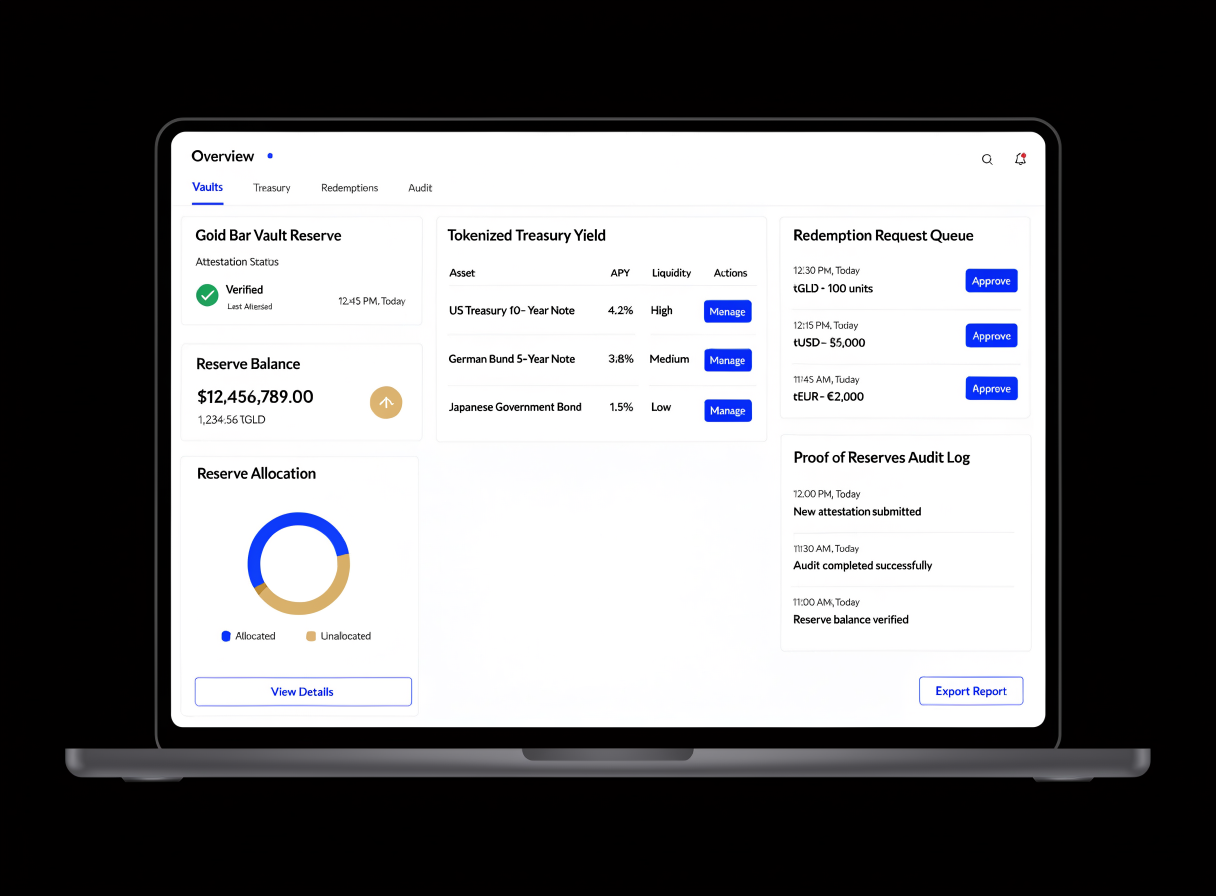
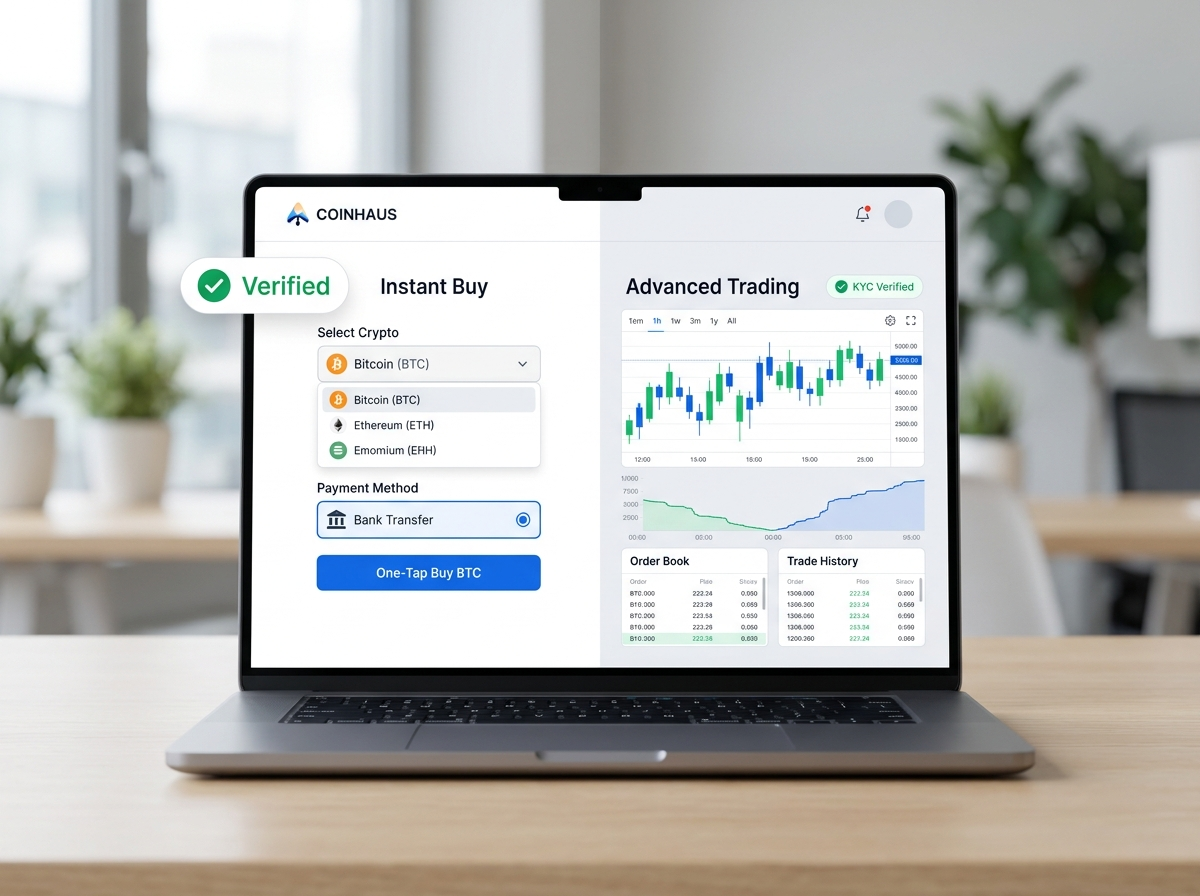
Surfaces This Scope Covers
Reference concepts for a tokenization build — asset register, investor and reporting surfaces. Not screenshots of a delivered client platform.
Core Features
Token and Compliance
- Permissioned token standards with transfer hooks
- On-chain eligibility and jurisdiction enforcement
- Lock-up, holding period and volume restriction rules
- Investor cap enforcement per class and per country
- Forced transfer, freeze and recovery mechanisms
- Multi-class tokens with different economic rights
- Audited contracts with upgrade governance
Investor Lifecycle
- Onboarding with KYC, AML and sanctions screening
- Accreditation and suitability verification by jurisdiction
- Subscription and funding workflow with fiat and stablecoin
- Document distribution, e-signature and consent tracking
- Investor portal with holdings, documents and statements
- Secondary transfer requests with approval workflow
Asset and Cap Table
- Asset registry with documentation and valuation history
- Live cap table with positions, classes and restrictions
- Distribution and dividend automation at record date
- Redemption and buyback processing
- Corporate actions including splits and conversions
- Reconciliation between on-chain and official register
Operations and Reporting
- Administrator, custodian and transfer agent integrations
- Investor reporting and tax document generation
- Regulator reporting exports and audit logging
- Role-based access with four-eyes approvals
- Fee and waterfall calculation per structure
- Analytics on holders, concentration and liquidity
Mapped to a release plan
We will send a structure-mapped build plan for your asset class, jurisdictions and investor types.
Request a Feature PlanHow Asset Tokenization Is Put Together
The modules above map onto these layers. Each one ships with its own tests, documentation and runbook, so nothing arrives as a black box you inherit without an explanation.
Requests flow down, settlement and events flow back up. Every boundary carries logging, so a failure is traceable to a layer instead of guessed at.
Chains and Assets We Work With
Network choice here follows custodians, administrators and permissioning rather than throughput. A regulated instrument needs transfer restrictions enforceable on whichever chain it settles on.
How We Build Your Platform
The legal structure is established with your counsel first, and the contracts are written to enforce it.
Structure and jurisdiction mapping
With your counsel: legal wrapper, investor eligibility, transfer rules and reporting duties.
Output → structure specification and rule matrix
Token and restriction design
Standard selection, transfer hooks, restriction logic and recovery mechanisms.
Output → contract specification with compliance mapping
Platform development
Onboarding, whitelist registry, cap table, distributions and investor portal.
Output → staging platform with test issuance
Independent audit
Third-party contract review plus control review of the restriction logic.
Output → audit report with critical and high findings remediated
Issuance and operations
First issuance, administrator integration, reconciliation and reporting runbooks.
Output → live platform with operational and compliance runbooks
Asset classes and standards
Development Timeline
| Scope | Timeline | Includes |
|---|---|---|
| Single-asset issuance platform | 8 to 12 weeks | One asset class, one jurisdiction, core lifecycle |
| Multi-asset platform | 4 to 6 months | Several classes, multi-jurisdiction rules, secondary transfers |
| Platform with secondary market | 6 to 9 months | Permissioned trading venue, matching, settlement |
| Institutional platform | 9 to 14 months | Administrator integrations, multi-entity, full reporting stack |
What extends the timeline: legal structuring, which runs on counsel and regulator timelines rather than yours; custodian and administrator onboarding; jurisdiction-specific eligibility rules, which multiply quickly; and audit of restriction logic, where errors are compliance breaches rather than bugs.
Revenue Models
| Model | How It Works |
|---|---|
| Issuance fees | A fee on each tokenized offering |
| Assets under administration | Recurring fee on tokenized value administered |
| Transaction and transfer fees | Charges on primary and secondary transfers |
| Platform licensing | SaaS fees to issuers using your infrastructure |
| Secondary market fees | Trading fees on a permissioned venue |
| Reporting and administration | Fees for statements, tax and regulator reporting |
| White label licensing | Licensing the platform to other operators |
Tokenization revenue is administration revenue: recurring, tied to assets under administration, and dependent on operational reliability rather than trading volume.
Related services
Who This Is For
Bringing funds and portfolios on-chain.
Fractionalising property equity or debt.
Distributing loan participations.
Issuing claims against physical reserves.
Offering tokenized products to clients.
Digitising ownership and distributions.
Why Choose Coinsclone
Contracts that enforce the structure
Transfer restrictions, eligibility and lock-ups implemented on-chain, so software and legal documents cannot diverge.
Jurisdiction-aware by design
Eligibility evaluated per investor type and country, because a single unrestricted transfer can be a regulatory breach.
Registers reconciled continuously
On-chain register and official register kept aligned, which is what makes distributions and audits defensible.
Recovery mechanisms built in
Lost keys, death and court orders handled through controlled processes rather than improvisation.
Lifecycle automated
Distributions, redemptions and corporate actions executed against the register at record date.
Full source code ownership
Contracts, platform and infrastructure transfer to you on delivery.
What Our Clients Say
Operators who launched with us, in their own words. Hover to pause.













A members-only NFT marketplace for Digital Freemasonry
 Digital Free MasonryNFT marketplace · delivered and live
Next phase in progress: the ODFT Token and the MasonicVerse platform.
Working with Coinsclone has been one of the best professional experiences I have had in the blockchain industry.
From the very beginning of our NFT Marketplace project until its successful completion, the entire team demonstrated exceptional technical expertise, professionalism, patience, and commitment. Every stage of development was handled with great attention to detail, and every challenge we encountered was approached with a solution-oriented mindset.
Read the full client note
Our project was far from a standard NFT Marketplace. It included custom blockchain architecture, Polygon integration, ERC-721 and ERC-1155 standards, royalty implementation, token-gated access through Masonic Passport, multiple payment methods, marketplace customization, advanced testing, and many unique business requirements. Throughout the entire process, the team consistently delivered high-quality work while maintaining clear communication, transparency, and a strong commitment to excellence.
I would especially like to express my sincere appreciation to Mr. Jeeva, Mr. Bala, Mr. Saravanan, Mr. Veeramani, Mr. Akshay, and the entire development team for their outstanding support, professionalism, responsiveness, and dedication throughout the project. Their technical expertise, patience, and willingness to understand even the most complex business requirements gave us complete confidence during every phase of development.
What impressed me the most was not only their excellent blockchain development skills, but also their ability to understand our vision and transform it into a secure, scalable, and highly professional NFT Marketplace.
For me, Coinsclone is not simply a software development company — they are a trusted long-term technology partner. After successfully completing our NFT Marketplace, we are now preparing to continue our collaboration on the next major phase of the Digital Freemasonry ecosystem, including the development of the ODFT Token and the future MasonicVerse platform.
I highly recommend Coinsclone to anyone looking for a reliable, experienced, and highly professional blockchain development company. They have earned my complete trust and respect, and I sincerely look forward to working with them again on future projects.
Start Your Tokenization Project
Tell us your asset class and jurisdictions and we will respond with a structure-mapped proposal and delivery timeline.
- Working platform demo with your asset class modelled
- Eligibility and transfer rules mapped to your structure
- NDA signed before technical discussion
Request received
A solution architect will reply within one business day with a scoped proposal and demo link.
Frequently Asked Questions
What is asset tokenization?
Representing ownership of a real-world asset as transferable blockchain tokens. The token records an entitlement that is created by a legal structure such as a special purpose vehicle, fund, note or title arrangement.
What is the hardest part of tokenizing an asset?
Aligning three things: the legal wrapper, the custody arrangement and the token contract. When the contract permits a transfer the fund documents prohibit, you have created a compliance breach in software.
Which token standard should be used?
Usually a permissioned standard such as ERC-3643 or ERC-1400 that supports transfer restrictions and identity checks, rather than a plain fungible token. The standard has to be able to enforce eligibility at transfer time.
How are transfer restrictions enforced?
In the contract itself, through hooks that check the recipient against an eligibility registry covering investor type, jurisdiction, lock-up status and holder caps. Policy documents cannot stop an on-chain transfer; code can.
What happens if an investor loses their keys?
A controlled forced-transfer and recovery mechanism, exercisable under defined conditions with documented approvals. Regulated instruments need this, since a permanently unrecoverable holding is not acceptable to a transfer agent or a court.
Do tokenized assets need a custodian?
Almost always. Something has to hold the underlying asset or the title to it, and investors need assurance it exists. We integrate with custodians, administrators and transfer agents rather than replacing them.
How are dividends and distributions handled?
Automatically against the register at a record date, paid in fiat or stablecoin, with statements generated per holder. Reconciliation between the on-chain register and the official register is what makes this defensible.
Can tokenized assets trade on a secondary market?
Only within the restrictions of the instrument, which usually means a permissioned venue where every participant is pre-verified. Free trading of a restricted security is the single most common failure in this space.
Which jurisdictions can we serve?
That is a question for your counsel, and the answer usually varies by investor type as well as country. We implement the eligibility matrix their advice defines, which is why the rule engine is configurable rather than hardcoded.
How does a tokenization platform make money?
Issuance fees, recurring fees on assets under administration, transfer and transaction fees, platform licensing to issuers, secondary market fees, and reporting and administration services.
How long does it take to launch?
A single-asset issuance platform takes 8 to 12 weeks. A multi-asset platform takes 4 to 6 months. Adding a permissioned secondary market takes 6 to 9 months, and an institutional platform takes 9 to 14 months.
Will I own the source code?
Yes. Contracts, platform and infrastructure transfer to you on delivery, with documentation for your own compliance and technology audits.
Estimate Your Build
Pick a scope and the extras you need. Legal structuring, custodian onboarding and administrator integration set this timeline, and none of them run on your schedule.
{{ estSummary }}
Ranges assume decisions arrive on time. Licensing, banking and third-party audits run on their own schedules and we plan around them rather than inside them.
Get This Scoped ProperlyReady to Tokenize Your Assets?
Share your asset class, structure and jurisdictions and receive a proposal mapped to your legal framework and delivery timeline.