
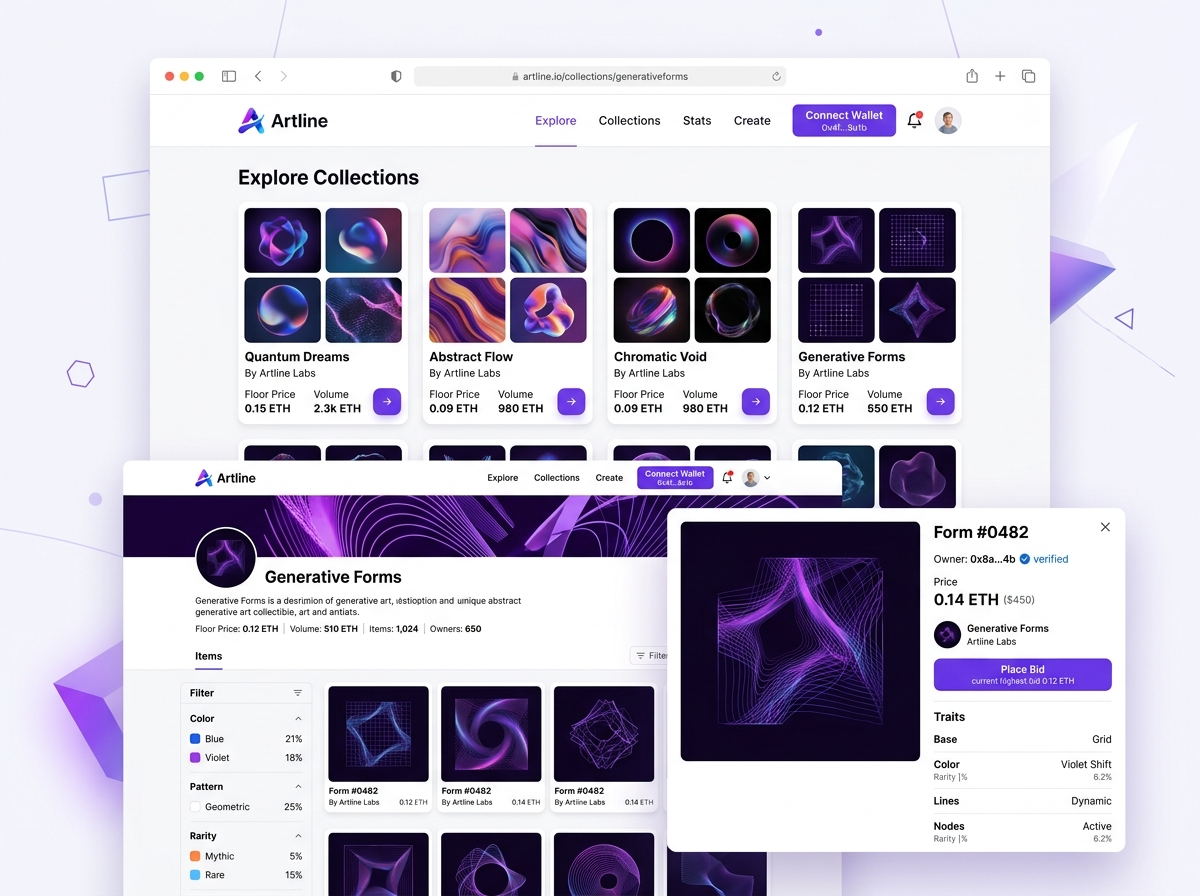
What Is an OpenSea Clone Script?
An OpenSea clone script is ready-to-deploy software that replicates the architecture of an open, permissionless NFT marketplace: anyone can mint a collection, list items for sale and trade across multiple blockchains, with the platform taking a fee on each secondary sale.
The defining characteristic is openness. Unlike curated platforms that approve creators before listing, an open marketplace accepts anyone. That drives volume and network effects, and it brings moderation burden, spam collections and scam listings as the cost of entry. This page covers building that model. For the full comparison across marketplace models, see our NFT marketplace clone script page.
What You Receive
| Component | What It Covers |
|---|---|
| Marketplace contracts | Listing, offer, settlement and fee distribution logic |
| Minting contracts | ERC-721 and ERC-1155 collection deployment with royalty config |
| Off-chain order system | Signed order storage, validation, cancellation, gasless listings |
| Indexer | Chain event ingestion, ownership tracking, collection stats |
| Web3 front end | Explore, collection pages, item pages, profiles, wallet connection |
| Metadata pipeline | IPFS or Arweave pinning with permanence strategy |
| Admin console | Collection verification, fee config, featured curation, moderation |
| Audit support | Third-party contract audit coordination and remediation |
| Source code | Full ownership on delivery |
See a working marketplace with your branding before you commit.
Get a Free Live DemoHow Gasless Listings Actually Work
This is the architectural detail that defines a modern open marketplace, and almost no clone script vendor explains it.
If every listing required an on-chain transaction, sellers would pay gas to list items that might never sell. Nobody would list. The solution is a signed off-chain order system.
A seller signs a structured message describing the sale terms: token, price, expiry, recipient, fee splits. This costs no gas because nothing touches the chain.
Your platform stores that signed order and displays it as a live listing.
When a buyer purchases, they submit the seller's signature to the marketplace contract along with payment. The contract validates the signature and executes the transfer atomically. The buyer pays the gas.
Cancellation happens either off-chain, by your platform invalidating the order, or on-chain via a nonce increment for guaranteed cancellation.
Why this matters for your build
The signed order system is where marketplace security actually lives. Signature replay, order malleability, expired order acceptance and cancellation race conditions are the real attack surface, not the token contracts. We implement structured typed data signing with domain separation and nonce management, and this is a specific focus of the security audit.
Indexer and order database are core
A marketplace whose listings lag behind chain state shows items as available after they have sold, which produces failed transactions and lost trust. We treat the indexer and order store as primary infrastructure, not supporting services.
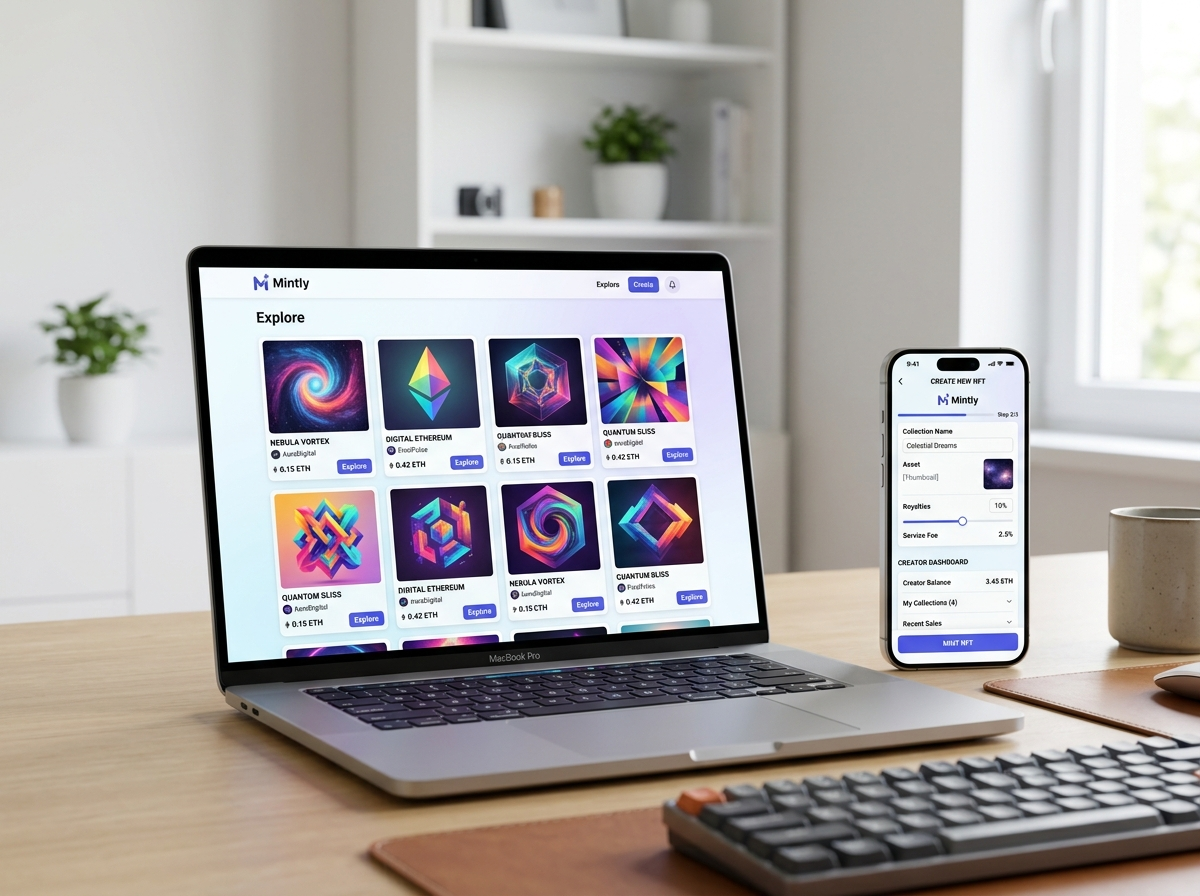
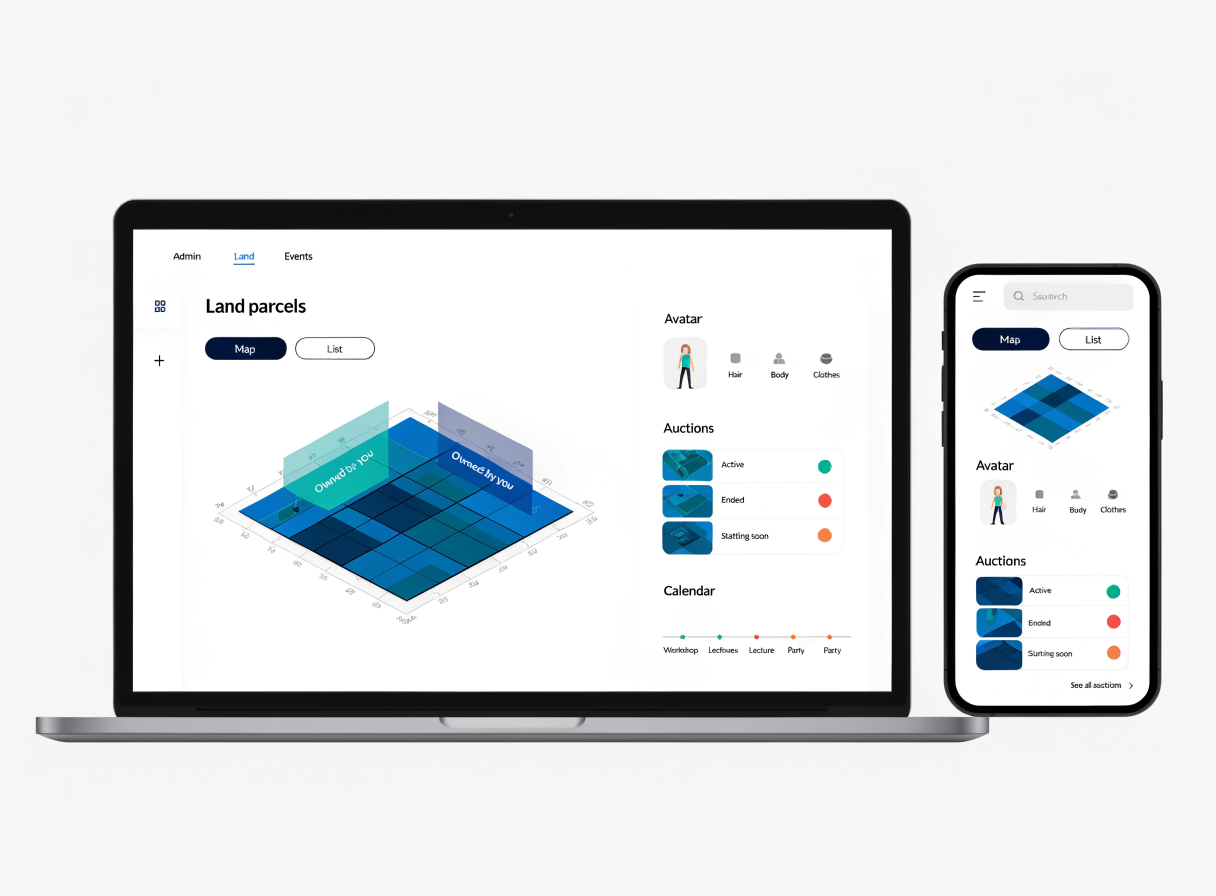
Surfaces This Scope Covers
Reference concepts for a marketplace build — collection, listing and creator surfaces. Not screenshots of a delivered client marketplace.
Core Features
Discovery and Trading
- Explore with filters by collection, trait, price, rarity, chain and recency
- Collection pages with floor price, volume, holder count and activity
- Item pages with trait breakdown, price history, provenance and offers
- Fixed price listings with expiry
- English auction with automatic extension on late bids
- Dutch auction with declining price curve
- Item-level, trait-level and collection-wide offers
- Bulk listing, bulk purchase and bundle sales
- Watchlist, favourites, price alerts and portfolio value tracking
Creator Tooling
- Single and bulk minting with metadata upload
- Lazy minting so listing costs no gas until first sale
- Collection deployment with configurable royalty percentage
- Allowlist and public mint phases with per-wallet limits
- Reveal mechanics for generative collections
- Creator profiles with verification badges
- Earnings dashboard covering primary sales and royalties
- Pairs with NFT token development for bespoke collection contracts
Platform and Admin
- Collection verification and badge assignment
- Featured and curated placement controls
- Platform fee configuration by collection and transaction type
- Reported item review and takedown workflow
- Spam and scam collection filtering
- Wash trading detection and exclusion from rankings
- Payout and royalty distribution reporting, plus CMS for campaigns
Wallet and Web3
- WalletConnect v2 plus browser wallet support
- Multi-chain switching with clear network signalling
- Token approval management with revocation
- Human-readable decoding of contract interactions before signing
- Transaction status tracking with explorer links
How OpenSea Clone Script Is Put Together
The modules above map onto these layers. Each one ships with its own tests, documentation and runbook, so nothing arrives as a black box you inherit without an explanation.
Requests flow down, settlement and events flow back up. Every boundary carries logging, so a failure is traceable to a layer instead of guessed at.
Chains and Assets We Work With
Marketplace contracts are per-chain deployments with their own royalty behaviour and metadata assumptions. Non-EVM chains use different token standards entirely and need separate marketplace logic.
The Open Marketplace Problem: Spam, Scams and Moderation
Permissionless minting is the model's strength and its operating cost. Anyone can deploy a collection means anyone can deploy a fake collection impersonating a real one, an airdropped spam NFT designed to lure users to a phishing site, or a contract that behaves unexpectedly on transfer.
Badges so users can distinguish authentic collections from impersonations, plus impersonation detection comparing new collections against verified ones by name, imagery and metadata similarity.
Automatic hiding of airdropped items from unknown contracts, user-level hide and block controls, and heuristics flagging bulk-minted zero-value collections.
Checking for non-standard transfer behaviour, unverified contracts and known scam patterns before an item can be listed.
Review queues, takedown, and creator appeal.
Across circular transfers, rapid buy-sell cycles at inconsistent prices and self-funding wallet clusters, so rankings and any reward mechanics stay meaningful.
Open marketplaces do not moderate themselves, and a platform full of scam listings loses legitimate collectors quickly.
Royalties: decide deliberately
The ERC-721 standard does not enforce creator royalties at protocol level; they are a marketplace convention. When marketplaces began making them optional to compete on fees, creator earnings collapsed. You must choose between enforcing royalties at the marketplace contract, making them optional, or supporting contract-level transfer restrictions that allowlist compliant marketplaces. The choice determines whether you attract creators or traders. Full detail on our NFT marketplace clone script page.
Metadata: decide deliberately
An NFT points to metadata. If the metadata disappears, the asset is functionally destroyed. Centralized URLs fail when servers go down. IPFS guarantees content by hash but requires active paid pinning indefinitely. Arweave pays once for permanence at higher upfront cost. We build with managed IPFS pinning plus optional Arweave and set the strategy during architecture rather than as an operational afterthought.
Competing With Aggregators
Open marketplaces now compete with aggregators that pull listings from multiple venues and route purchases to the cheapest source. A new marketplace with its own isolated listings is invisible to traders who shop through aggregators. Two viable responses:
Expose a clean public API and standard order format so aggregators can index your listings. This brings you buyers you did not acquire, at the cost of some direct traffic.
Pull external listings so your users see full market inventory even before your own supply builds. This makes your platform useful from launch, though margins on routed sales are thinner.
We build both. Realistically, a new open marketplace should do both: aggregate externally to be useful on day one, and expose an API so external aggregators surface your native listings.
Smart Contract Security
Every marketplace we deliver goes through independent third-party smart contract audit before mainnet deployment, with remediation and retest coordinated by us.
Marketplace-specific findings include signature replay in off-chain order systems, order malleability where parameters can be altered after signing, reentrancy in purchase and settlement paths, rounding errors in royalty and fee splits, access control gaps on privileged functions, and unchecked external calls to arbitrary token contracts. The off-chain order layer carries more real risk than the token contracts, which is why it needs specific audit attention.
Publish the audit report. Collectors and creators check for it before committing valuable assets.
Want a review of your architecture, including order signature handling?
Request a Security ReviewMulti-Chain Support
Chain choice is mostly a fee question. Ethereum carries the strongest collector base and secondary credibility but prices out low-value trading. Polygon, Base and other L2s enable affordable minting and trading. Solana suits high-volume low-price collections but needs a separate contract implementation since it is not EVM-compatible.
Launch on one chain and expand. Multi-chain from day one splits scarce early liquidity and complicates the collector experience for no benefit.
Development Timeline
| Scope | Timeline | Includes |
|---|---|---|
| White label marketplace | 4 to 6 weeks | Rebranded platform, standard features, single chain |
| Standard open marketplace | 8 to 12 weeks | Minting, listings, auctions, offers, royalties, admin |
| Customized marketplace | 12 to 16 weeks | Launchpad, token rewards, aggregation, advanced curation |
| Multi-chain marketplace | 14 to 20 weeks | Multiple chains including non-EVM implementations |
What extends the timeline: independent audit and remediation, non-EVM chains requiring separate contracts, aggregator integrations dependent on external APIs, launchpad and reveal mechanics, and native token reward systems.
Revenue Models
| Model | How It Works |
|---|---|
| Trading fee | Percentage of every secondary sale, the primary line |
| Primary sale commission | Share of mint revenue on hosted drops |
| Verification fees | Charges for verified badge and priority review |
| Featured placement | Paid prominence in explore and collection surfaces |
| Launchpad fees | Fees or allocation share from curated drops |
| Premium creator tools | Subscription for analytics, bulk tooling and support |
| Aggregator routing share | Revenue on sales routed through your interface to external venues |
| Native token economy | Fee sharing, staking and governance utility |
We build a configurable fee engine so rates can be adjusted by collection and transaction type without redeploying contracts.
Other marketplace clone scripts
Why Choose Coinsclone
NFT marketplace contract experience
Signed order handling, royalty split rounding, auction extension edge cases and indexer consistency under reorgs are problems we have already solved.
Order architecture built properly
Gasless listings depend on a signature system that is the real security surface of a marketplace. We build and audit it as such.
Royalty and metadata decided deliberately
Two choices that determine whether creators stay and whether your NFTs still work in five years.
Audit coordinated, not skipped
Independent third-party audit including remediation and retest before mainnet deployment.
Full source code ownership
Contracts, repositories, indexer and front end transfer to you on delivery, under your own brand rather than as a copy.
Confidentiality by default
Every engagement begins with an NDA. Your roadmap, drops and partnerships stay private.
What Our Clients Say
Operators who launched with us, in their own words. Hover to pause.












A members-only NFT marketplace for Digital Freemasonry
 Digital Free MasonryNFT marketplace · delivered and live
Next phase in progress: the ODFT Token and the MasonicVerse platform.
Working with Coinsclone has been one of the best professional experiences I have had in the blockchain industry.
From the very beginning of our NFT Marketplace project until its successful completion, the entire team demonstrated exceptional technical expertise, professionalism, patience, and commitment. Every stage of development was handled with great attention to detail, and every challenge we encountered was approached with a solution-oriented mindset.
Read the full client note
Our project was far from a standard NFT Marketplace. It included custom blockchain architecture, Polygon integration, ERC-721 and ERC-1155 standards, royalty implementation, token-gated access through Masonic Passport, multiple payment methods, marketplace customization, advanced testing, and many unique business requirements. Throughout the entire process, the team consistently delivered high-quality work while maintaining clear communication, transparency, and a strong commitment to excellence.
I would especially like to express my sincere appreciation to Mr. Jeeva, Mr. Bala, Mr. Saravanan, Mr. Veeramani, Mr. Akshay, and the entire development team for their outstanding support, professionalism, responsiveness, and dedication throughout the project. Their technical expertise, patience, and willingness to understand even the most complex business requirements gave us complete confidence during every phase of development.
What impressed me the most was not only their excellent blockchain development skills, but also their ability to understand our vision and transform it into a secure, scalable, and highly professional NFT Marketplace.
For me, Coinsclone is not simply a software development company — they are a trusted long-term technology partner. After successfully completing our NFT Marketplace, we are now preparing to continue our collaboration on the next major phase of the Digital Freemasonry ecosystem, including the development of the ODFT Token and the future MasonicVerse platform.
I highly recommend Coinsclone to anyone looking for a reliable, experienced, and highly professional blockchain development company. They have earned my complete trust and respect, and I sincerely look forward to working with them again on future projects.
Start Your NFT Marketplace Project
Tell us your marketplace type, chain and royalty approach and we will respond with a scoped proposal covering contracts, indexer, audit and delivery timeline.
- Working marketplace demo with your branding applied
- Royalty and metadata strategy recommendation
- Independent audit coordinated as part of delivery
Request received
An NFT architect will reply within one business day with a scoped proposal and demo link.
Frequently Asked Questions
What is an OpenSea clone script?
Ready-to-deploy software replicating the architecture of an open, permissionless multi-chain NFT marketplace, including minting contracts, a signed off-chain order system, auction mechanics, royalty distribution, an indexer and a Web3 front end.
How do gasless listings work?
A seller signs a structured off-chain message describing the sale terms, which costs no gas. The platform stores and displays it as a listing. When a buyer purchases, they submit the signature to the marketplace contract with payment, and the contract validates and executes the transfer atomically. The buyer pays gas.
Is the signed order system a security risk?
It is the primary security surface of a modern marketplace, more so than the token contracts. Signature replay, order malleability, expired order acceptance and cancellation race conditions are the real risks. We implement structured typed data signing with domain separation and nonce management, and it receives specific audit attention.
How do you handle spam and scam collections on an open marketplace?
Through collection verification badges, impersonation detection comparing new collections to verified ones, automatic hiding of airdropped items from unknown contracts, malicious contract screening before listing, a reported item review and takedown workflow, and wash trading detection excluded from rankings. Budget for a moderation function; open marketplaces do not moderate themselves.
Are creator royalties enforced?
Not automatically. ERC-721 does not enforce royalties at protocol level. You choose between marketplace-level enforcement, optional royalties, or contract-level transfer restrictions allowlisting compliant marketplaces. The choice determines whether you attract creators or traders.
Where is NFT metadata stored?
We use managed IPFS pinning with optional Arweave for guaranteed permanence. Centralized URLs fail when servers go down or domains lapse, and unpinned IPFS content disappears. We set the pinning strategy during architecture rather than as an afterthought.
Should my marketplace aggregate listings from other marketplaces?
Usually yes, and you should also expose an API so external aggregators can index you. A new marketplace with isolated listings is invisible to traders who shop through aggregators, and aggregating externally makes your platform useful before your own supply builds.
How long does it take to build an OpenSea-style marketplace?
A white label marketplace launches in 4 to 6 weeks. A standard clone takes 8 to 12 weeks. Customized platforms with launchpad and aggregation take 12 to 16 weeks. Multi-chain builds including non-EVM chains take 14 to 20 weeks.
Which blockchain should my marketplace use?
Mostly a fee question. Ethereum has the strongest collector base but prices out low-value trading. Polygon, Base and other L2s enable affordable minting. Solana suits high-volume low-price collections but requires separate contract implementation. Launch on one chain and expand.
Can users mint without paying gas upfront?
Yes, through lazy minting, where the NFT is created as a signed off-chain record and written to chain only on first purchase, with the buyer covering gas. This removes a significant barrier to supply-side growth.
How does an NFT marketplace make money?
Primarily a percentage trading fee on secondary sales, plus primary sale commission on hosted drops, verification and featuring fees, launchpad fees, premium creator subscriptions, aggregator routing share and native token economics.
Do the smart contracts need an audit?
Yes. Every marketplace we deliver goes through independent third-party audit before mainnet deployment, with specific attention to the off-chain order system. Publish the report; collectors check for it.
Will I own the source code?
Yes. Full ownership of contracts, indexer, repositories and front end transfers on delivery, with no ongoing licensing requirement.
Estimate Your Build
Pick a scope and the extras you need. Contract audit, metadata permanence and trust-and-safety tooling are the lines that decide whether a marketplace survives past launch week.
{{ estSummary }}
Ranges assume decisions arrive on time. Licensing, banking and third-party audits run on their own schedules and we plan around them rather than inside them.
Get This Scoped ProperlyReady to Launch Your NFT Marketplace?
Share your requirement and receive a scoped proposal covering contracts, order architecture, audit and delivery timeline. No obligation, full confidentiality.